


Training as an entry point
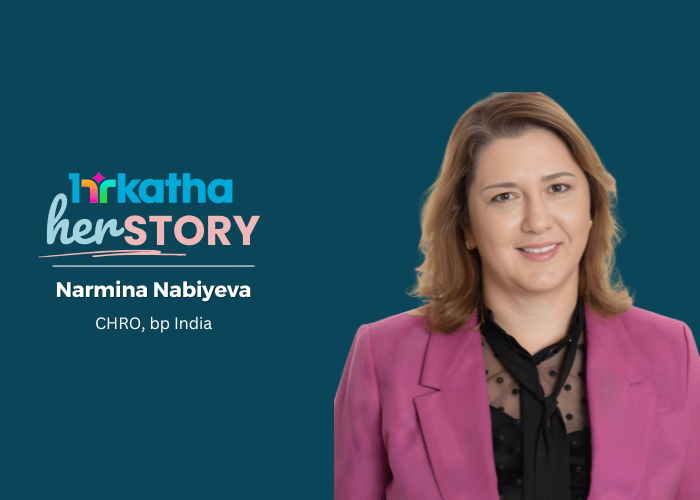
Narmina Nabiyeva may not have chosen HR with a grand plan at the start, but she certainly stayed on very deliberately. Why? Because it allowed her to combine her interest in learning with the bigger challenge of helping organisations work better.
She always wanted to work with adults on learning and development. She was interested in how people grow, how they build confidence, and how they become more effective.
Therefore, it isn’t surprising that she stepped into HR through a training role. Back then, most of the training was primarily done in-house, and was a very natural entry point.
From there, her world gradually widened, allowing her to move from leadership and professional development into broader talent work, and then into partnering with the business on the full range of people and organisation issues.
The realisation that all of it was actually connected kept her in HR. Talent, leadership, reward, culture, organisation design, and employee relations do not work properly in isolation. They have to connect to the business strategy, as well as to each other, in order to create a healthy culture.
Today, as CHRO at bp India, Nabiyeva leads with a philosophy forged across continents: sometimes we corner ourselves before anyone else does, and the strongest leadership comes from being yourself.
India is energising
Having worked in Azerbaijan, the Middle East, the UK and the US in the past, Nabiyeva declares that India has been unlike any other talent market she has worked with.
One of the first things she noticed is that “you have to hold two thoughts at the same time”. India has its own context, culture and complexity, which requires leaders to think very locally. At the same time, India is also a major global talent pool, making the capabilities built here relevant far beyond the country itself.
The second thing she talks about is the youth and energy of the talent market. In some mature markets, the focus is often on sustaining capability or managing established systems. In India, there is still strong emphasis on opportunity, social mobility, early talent, equal access, leadership development and helping people build meaningful careers. That energy strongly connects with her own values.
And then there is the diversity of India. Different regions, languages, family expectations, belief systems and ways of building trust all show up at work.
For an HR leader, that makes India fascinating. A global playbook cannot simply be transplanted neatly. Leaders have to listen, adapt and remain curious. That is what makes the work demanding, but deeply rewarding.
“India reveals far more complexity once you experience it from within.”
Contributing to the business conversation
One of the barriers Nabiyeva faced was learning to fully use her voice. Sometimes, there can be a subtle assumption that a woman in HR will naturally play the supportive or moderating role. Women are expected to bring empathy, read the room, and keep things balanced.
Of course, those things matter. However, HR leaders also need to challenge, test assumptions and speak directly about the business.
A moment that stayed with her was when a business leader she respected told her, “I do not see you as the HR leader at my table. I see you as a business leader who happens to specialise in HR.”
That advice encouraged her not to limit herself to HR topics, but to contribute to the broader business conversation. It also helped her realise that sometimes people restrict themselves before anyone else does.
Since then, she has consciously avoided shrinking the space she occupies, whether because of gender expectations or functional labels. She believes empathy and challenge can coexist, and that listening carefully does not prevent a leader from having a strong point of view.
“Empathy and challenge are not in conflict.”
Lessons from an international career
The biggest professional risk Nabiyeva took was choosing an international career and repeatedly stepping into unfamiliar environments.
She has worked across Azerbaijan, the Middle East, the UK and India, while also managing stakeholders in other markets, including the US. Every move looked exciting from the outside, but each transition required her to understand a new culture, business context, expectation set and way of building trust.
That experience taught her humility. Success in one geography does not automatically translate into another. Trust has to be earned repeatedly. Leaders have to listen before judging and immerse themselves in context before acting.
Every country challenged some assumption she carried. That not only made her a better HR leader, but also a more open person.
Deep tradition meets rapid modernity
What Nabiyeva enjoys most about her India stint is the combination of curiosity, warmth and ambition.
She finds Indian professionals deeply eager to learn, not only through formal training, but through questions, discussions and debate. There is a strong respect for education and self-improvement, something she personally finds energising.
She also values the importance attached to family, community and teamwork. Relationships matter deeply in India, and so does trust. People often bring a strong sense of responsibility not only to their own careers, but also to their families, teams and wider communities.
India itself fascinates her because of the blend of deep tradition and rapid modernity. It is a country with thousands of years of history and philosophy, whilst simultaneously pushing aggressively into AI, entrepreneurship and the future economy.
Ensuring dignity amidst tough decisions
The toughest decisions for Nabiyeva have usually been connected to change and transformation.
In large organisations, transformation is necessary. However, HR never experiences change merely as strategy or structure. HR leaders see the human impact directly.
Sometimes, transformation means saying goodbye to people who have contributed years of good work to the organisation. That is never easy.
What has always guided her is the belief that people should be treated with dignity, even when the outcome is difficult. If someone leaves the organisation, leaders have a responsibility to ensure they leave with confidence, support and a sense that their contribution mattered.
The uncertainty surrounding transformation can often be equally difficult. Employees may live with anxiety for months while decisions evolve. During such phases, leaders have to continue communicating, listening and supporting people even when all the answers are not yet available.
And after decisions are made, attention must also shift to those who remain. They too need help rebuilding confidence and adapting to a new reality.
For Nabiyeva, change tests clarity, empathy and stamina simultaneously.
Quick fire round
Your mantra for difficult days?
Never react on the first emotional impulse. Pause, steady yourself, then take a second look.
One thing you wish people understood about being a woman in HR leadership?
You do not have to fit a trope, masculine or feminine. The strongest leadership comes from being yourself.
Morning ritual that sets you up for success?
Yoga, one of the gifts I picked up in India that I know will stay with me.
What energises you most about your work?
People always bring a new challenge. Even after nearly 30 years, the work still keeps teaching me.
Best investment you’ve made in yourself?
Early on, it was learning, combining education, experience and curiosity. Now, it is also the quality of my relationships and the time I invest in health and wellbeing.
Evolving as a leader
The younger Nabiyeva describes herself as analytical, confident and expressive, someone
who enjoyed the spotlight and felt comfortable communicating strongly. That helped her early in her career, but it was not enough as she became more senior.
The older and more mature Nabiyeva began taking greater pride in putting her teams in the spotlight instead. She enjoys mentoring people, growing leaders and building teams capable of succeeding independently.
She now listens more than she once did and feels increasingly comfortable admitting when an answer is not immediately clear.
Working across geographies has also taught her flexibility. Different cultures respond differently to pace, hierarchy, directness and challenge.
However, she does not believe leaders need to become entirely different people in different countries. Values remain constant. What changes is the ability to listen carefully and bring people along in ways that suit the context.
What got us here won’t get us there!
The mindset that needs to retire, according to Nabiyeva, is the belief that “what got us here will get us there”.
The world of work is changing too quickly for that assumption to hold.
She believes AI is fundamentally different from earlier workplace trends because it will reshape jobs, skills, careers, productivity and the employee experience itself.
That means HR will need to rethink long-standing assumptions around work design, career progression, value creation and capability building.
At the same time, she believes the importance of people and culture will never disappear. Technology may reshape work, but organisations will still require trust, leadership, learning, inclusion and human energy.
Creating systems where people can thrive will continue to matter decades from now.