



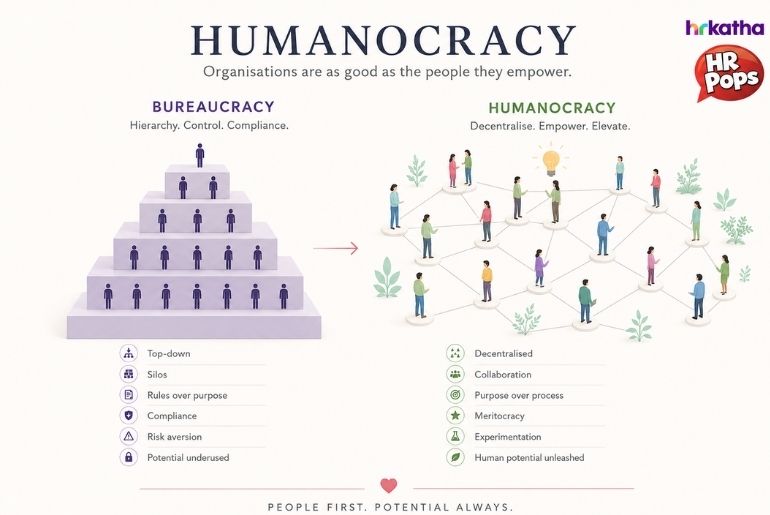
What ‘humanocracy’ mean?
Humanocracy is a management philosophy that argues organisations should be designed around people rather than bureaucracy.
Instead of relying on hierarchy, layers of approval and rigid rules, it advocates giving employees greater autonomy, ownership and freedom to make decisions. The idea is simple: organisations should trust people to think, not merely execute.
Its central argument is provocative. Most organisations are nowhere near as capable as the people who work inside them. The gap is created not by talent shortages but by bureaucracy.
Humanocracy, therefore, calls for more than flatter structures or employee empowerment programmes. It questions the very architecture of management, replacing control with trust, hierarchy with contribution, and compliance with initiative.
Where did the idea come from?
The term was introduced by Gary Hamel and Michele Zanini in their 2020 book, Humanocracy.
They argued that bureaucracy was designed for the industrial age, when stability, repetition and standardisation mattered more than creativity. Frederick Taylor’s scientific management helped organisations become efficient by concentrating authority at the top and breaking work into predictable tasks.
That model proved remarkably successful for more than a century.
The problem is that today’s organisations compete through innovation, adaptability and speed, qualities bureaucracy was never designed to encourage.
The authors point to organisations such as Morning Star, Haier and Google’s well-known “20 per cent time” initiative to show that distributing authority can produce stronger innovation and higher engagement than traditional hierarchies.
Why is it relevant for HR?
Few ideas challenge HR more directly than humanocracy.
If employees genuinely own decisions, HR has to rethink performance management, leadership development, career progression and even organisational design. Annual appraisals, rigid reporting lines and approval-heavy workflows begin to look like relics of another era.
The philosophy also aligns with what many organisations already claim to value: empowerment, psychological safety, agility and purpose. Yet these ideas often stop at language. Employees are encouraged to take ownership until a decision requires three approvals.
That contradiction is becoming harder to sustain. Younger employees increasingly value autonomy and meaningful work over titles and hierarchy. Organisations that continue to confuse supervision with leadership may struggle to retain their most entrepreneurial talent.
The uncomfortable reality
Almost every organisation says it wants empowered employees.
Very few are prepared to surrender the control required to make empowerment real. That is the paradox at the heart of humanocracy.
Bureaucracy survives not because nobody has discovered a better alternative, but because it serves powerful interests. Managers complain about bureaucracy in meetings, then return to their desks and create new approval processes to minimise risk.
The result is predictable. Companies launch empowerment initiatives but continue measuring attendance rather than outcomes. They celebrate innovation but punish failed experiments. They ask employees to think like owners whilst reminding them that major decisions still belong elsewhere.
In many organisations, bureaucracy is no longer protecting efficiency. It is protecting hierarchy.
The takeaway
Humanocracy asks an uncomfortable question.
If organisations genuinely believe people are their greatest asset, why are so many management systems built on the assumption that people cannot be trusted?
For HR, that question matters because every policy, approval process and reporting line either expands human potential or quietly limits it.
The challenge is no longer understanding the concept.
It is deciding whether the organisation is willing to remove the bureaucracy it keeps adding.