


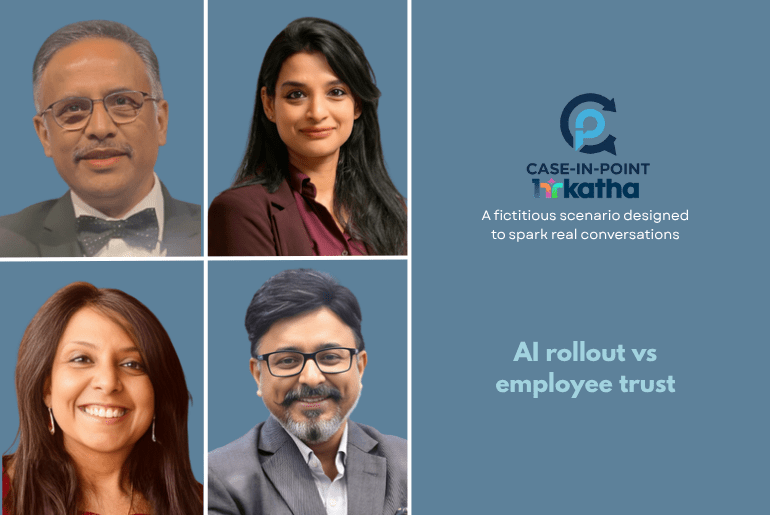
HRKatha’s Case-in-Point presents real-world HR dilemmas and invites leaders to weigh competing business and ethical choices.
Company: DataFlow Analytics (fictitious), a mid-sized business intelligence firm with 1,000 employees, providing data solutions, dashboards and insight services to clients across retail, logistics and financial services.
Background
For eight months, DataFlow’s technology team has been quietly building a tool that could fundamentally change how the company operates.
Developed internally and tested on live client data, it automates nearly 70 per cent of the work currently done by junior analysts: data cleaning, dashboard generation and basic insight reporting. In trials, it halved turnaround time while producing outputs senior leaders considered equal to, or better than, manual work.
The business case is difficult to ignore. Full implementation could save Rs 2 crore annually.
Last week, Rohan Mehta, the Chief Technology Officer, presented the results to the leadership team. The tool is ready. A phased rollout could begin this quarter.
Which means 40 junior analysts, most with less than three years’ experience, are sitting at their desks today with no idea that the work they were hired to do may not exist a year from now.
HR has now been asked to design the transition.
Before that plan can be written, one question has to be answered.
Do you tell them now, or manage the transition quietly?
The dilemma
Should HR inform the analyst team now, being transparent about what the technology means for their roles and offering structured reskilling, even if it triggers anxiety, premature exits and operational disruption before the rollout is complete?
Or should HR implement the tool gradually, communicating only when decisions are finalised, on the basis that early disclosure creates panic without giving employees anything meaningful to act upon?
And if neither feels right, is there a third path: telling employees that the nature of their work is changing, without immediately framing it as redundancy, while building a genuine transition programme alongside the rollout?
What’s really at stake
This is a question about what organisations owe their people once they know something that could fundamentally change their careers.
DataFlow’s leadership knows. The technology team knows. HR now knows. Forty analysts do not.
Every week without a conversation is another week in which those employees make career and financial decisions based on a future leadership already knows is changing. Some may be turning down opportunities. Others may be making long-term plans around roles that are already being phased out.
The argument for silence is not cynical. Early disclosure without a clear transition plan can create more harm than it prevents. Panic spreads faster than reskilling programmes can be built. Attrition may accelerate before the organisation is ready to manage it. Those are genuine operational risks.
The argument for transparency is different. Trust, once broken, is difficult to rebuild. If employees discover that leadership knew for months and chose not to tell them, the damage extends far beyond the 40 analysts directly affected. It sends a message to everyone about what the organisation believes employees deserve to know about their own futures.
There is also a practical reality. Reskilling takes time. If DataFlow hopes to redeploy even a portion of its analyst workforce, that journey can begin only when the conversation does.
The deeper question is harder to avoid: if an organisation already knows a decision will affect 40 people’s livelihoods, when does managing the transition become withholding the truth?
We asked four HR leaders how they would approach this dilemma.
What HR leaders said
Subrat Chakravarty, CHRO, DS Group
“If I were to answer this directly, the answer is yes: be transparent. But nothing is binary when you are dealing with human lives in dynamic business situations, so here are a few things worth thinking through.
 Situations like this are not new. The context changes: technology obsolescence, mergers and acquisitions, outsourcing, business model shifts. At the core, AI replacing roles is no different from any of these. It involves lives, careers, employer brand, and the trust that organisations have spent years building. That trust is hard to earn and very easy to lose.
My advice in all such situations is straightforward. Start with the end in mind. Have people and the impact on them as a design principle from the very beginning, not an afterthought. Just as every other business risk is identified and mitigated, people risk must be addressed through a structured plan: retraining, redeployment, outplacement, or where none of those are possible, a graceful and dignified exit. What I would never recommend is a surprise.
Surprise is what hits people hardest.
Communication planning must be integral to the overall plan. Announce early, not just as a decision, but with clarity on all possibilities, timelines and the support on offer. This is not an HR task alone. It is an organisational responsibility where every function must collaborate.
Leadership is tested in moments like these. In the era of social media, how an organisation handles its people during a difficult transition is watched closely by those inside and outside the firm. Leaders must take charge and not hide behind HR or any other function.
Authenticity and genuine concern for people can make the difference between a difficult situation handled well and one that causes lasting damage.
Having been through hundreds of such situations across my career, role redundancies at various levels and large-scale restructuring across geographies, this is what I have learnt. And to my HR colleagues: this is your moment to stand up as custodians of professional ethics, corporate values and employee morale. Take charge.
One final thought. The best way to approach a situation like this is to pause and ask: how would I want this handled if I were the one affected? Life’s best answers come when you allow yourself to be genuinely vulnerable, rather than hiding behind an acquired image.”
Divya Kiran, Global Head – HR, Aurigo
“The real HR question is not whether AI will change work. It already is. The real question is whether organisations choose to lead that transition deliberately, grounded in organisational reality, or allow it to unfold by default.
 My inclination would be firmly toward leading the change, not silently managing the fallout. If an organisation knows that a meaningful portion of work will be automated, withholding that information may preserve short-term stability, but it weakens alignment and makes transformation harder to execute over time.
This is where HR must lead, not simply react after decisions are made. Effective change leadership requires walking teams through a clear transition roadmap: what this transformation means for growth and the future shape of work, which tasks are being automated versus which roles are evolving, and what genuine reskilling or redeployment opportunities exist.
A few things also need to be said plainly. AI fluency is fast becoming a baseline professional capability, not a specialist skill. The real cultural shift is not the arrival of AI; it is the expectation that people know how to work intelligently with it. Organisations must invest in building this capability at scale through access to tools, learning pathways and practical role-based enablement. Employees also carry responsibility here. In a rapidly changing workplace, learning agility is no longer optional; it is part of employability.
AI may not replace every job. But it will change the expectations of every job.”
Shamita Ghosh, Head – HR, BookMyShow
“Transparency, but with structure, clarity and a plan behind it.
 One of the biggest mistakes organisations make during transitions like these is either communicating too late, or communicating without enough thought about what comes next for employees. Both create uncertainty. And uncertainty is what leads to panic, speculation and premature attrition.
The right move for DataFlow is to tell the team exactly what is coming. Not just ‘AI is replacing jobs.’ The conversation has to be: this is where the business is headed, this is what may change, and this is how we will support you through that transition. That is the difference between a warning and a starting point.
If a role is expected to evolve or eventually become redundant, employees deserve meaningful visibility and sufficient time to prepare, through a genuine transition window, not a symbolic one. Where redeployment or realignment is possible, HR must actively work to integrate affected employees into the organisation’s future structure. Where it is not possible, be upfront about that too.
Structured learning matters, but real transformation comes from hands-on exposure and mentorship: assigning mentors, identifying adjacent skill pathways, enabling people to learn while solving actual business problems.
Not every transition will lead to redeployment for every individual. But if people are treated with clarity, respect and fairness through the process, it builds far more long-term trust than silence ever could.
Technology will continue to reshape roles. The real differentiator will not be whether change happens. It will be how humanely and responsibly organisations choose to navigate it.”
Kaushik Chakraborty, Chief People Officer, Savills
“AI-led transformation should not be approached as a silent efficiency exercise. The moment organisations know that roles are likely to evolve or reduce significantly, HR has the responsibility to lead the conversation proactively rather than reactively.
 Yes, there is always a fear that early transparency may trigger anxiety or attrition. But the larger risk is loss of trust. Employees generally understand that technology will continue to reshape jobs. What damages culture is not change itself, but the feeling that change was hidden from them until decisions were already made.
In a case like this, HR should adopt a phased and responsible communication approach. Employees should be informed that the nature of work is evolving, while also being given clarity on timelines, future skill expectations and the support available to them. The conversation should not begin with redundancy. It should begin with transition and preparedness.
Equally important is the organisation’s investment in reskilling. If AI is taking over repetitive or transactional work, companies must create pathways for employees to move towards more analytical, client-facing, strategic or decision-making roles. Workforce transformation cannot succeed if employees view AI only as a threat. AI does not replace employees; it replaces employees who do not leverage AI for efficiency.
From a business standpoint, transparency creates stronger long-term outcomes. Employees are more likely to stay engaged when they feel respected and included in the journey. Silent implementation may reduce disruption temporarily, but it often creates deeper cultural damage once employees discover the intent behind the change.
The organisations that will navigate AI disruption successfully are not necessarily the ones adopting technology the fastest, but the ones building trust while doing so.”
If you were the CHRO at DataFlow
The technology is ready.
The business case has been approved.
Forty analysts don’t know.
Do you:
• Tell employees now and launch a structured reskilling programme alongside the rollout?
• Implement the tool first and communicate role changes only when decisions are final?
• Begin preparing employees for changing roles without immediately framing the conversation around redundancy?
Or is the bigger question this:
Once leadership knows people’s jobs may disappear, how long can it justify saying nothing?
Share your perspective in the comments or on LinkedIn using #HRKathaCaseInPoint.