


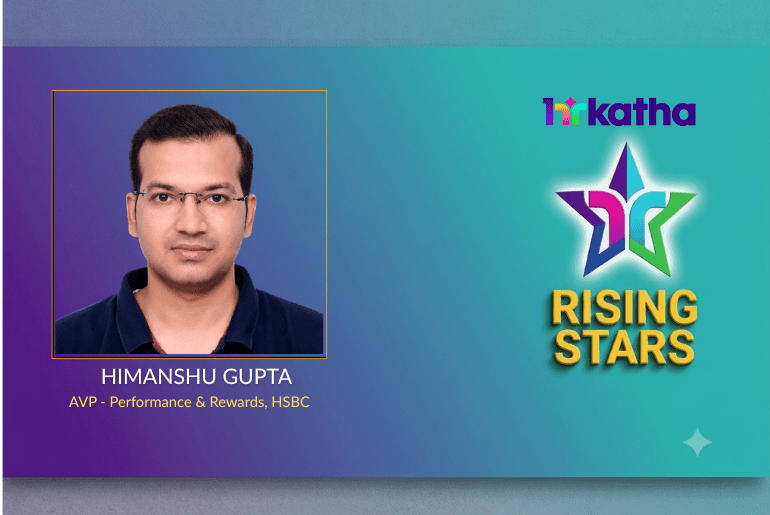
First Runner-Up | HRKatha Rising Star Leadership Awards 2025
Himanshu Gupta has spent much of his career on the design side of HR: building performance and rewards structures, integrating policies and creating frameworks where established ones were either absent or no longer fit for purpose.
That distinction has shaped how he thinks about the function. HR, in his view, creates value when its systems are closely connected to the way a business actually competes, grows and allocates resources, rather than when it simply administers processes efficiently.
His career has given him several vantage points on that problem. Consulting assignments at PwC and Mercer were followed by his current role at HSBC, where he works on performance and rewards questions with a global remit from India. That trajectory also underpins one of Gupta’s strongest convictions: proximity to headquarters is no longer a prerequisite for influencing global HR strategy.
Gupta is a runner-up of the HRKatha Rising Star Leadership Awards 2025.
Structure follows strategy
Gupta’s operating principle is straightforward: structure should follow strategy, and talent systems should reflect the culture an organisation is trying to build. That makes him wary of importing frameworks simply because they have worked elsewhere.
Whether the assignment involves integrating HR policy after a merger or introducing a structured performance system into a business that has not previously had one, Gupta believes the starting point should be the organisation itself: its economics, scale, workforce, regulatory environment and strategic priorities. Best practices can provide useful reference points. They cannot substitute for context.
That distinction is particularly important in rewards. A compensation or performance framework may be technically sophisticated and still fail if it does not reinforce the behaviour, capability or outcomes the business actually needs. For Gupta, design earns its value only when it connects back to strategy.
Leadership without a title
Gupta defines HR leadership around three qualities: humility, adaptability and purposeful execution. For professionals early in their careers, he believes leadership begins well before formal authority arrives. It comes from learning to influence without relying on hierarchy, listening carefully enough to understand the problem beneath the stated problem, and then following through consistently. Credibility, in this view, accumulates through execution.
That is also where Gupta draws the distinction between activity and impact. A function can launch programmes, produce frameworks and complete processes without necessarily changing an outcome. Leadership requires a stronger test: what became different because the work happened? The question runs through much of his approach to performance and rewards.
Engineering fairness into the system
Gupta applies a similar design philosophy to diversity and inclusion. Rather than treating inclusion as a parallel initiative, he believes it should be embedded in the systems that determine how people are paid, assessed, moved and developed.
In practice, that has included localised pay-equity reviews intended to identify gender and ethnicity gaps across markets, as well as internal mobility pathways aimed at widening access to opportunity for underrepresented groups, including women in technology and second-career professionals. The underlying principle is less about adding another DEI programme than examining whether existing mechanisms produce equitable outcomes, which shifts the question from intent to architecture. An organisation may genuinely want a more diverse leadership pipeline. Gupta’s argument is that the ambition matters little if the systems governing pay, progression and mobility continue reproducing the same patterns.
Proving it in numbers
Gupta is equally interested in whether HR interventions survive scrutiny beyond the function. During one post-merger integration, he worked on a unified HR policy framework spanning more than 25 areas. Cost modelling formed part of the case presented to leadership, while employee and manager satisfaction scores improved in the six months following implementation.
In another assignment for a logistics client, he helped redesign variable pay so that incentives were more directly connected to functional KPIs. The work secured executive support and led to an extension of the engagement. For Gupta, these examples reinforce a broader point: HR design becomes more credible when it can be discussed using measures the business already understands, not when every people decision is reduced to a financial equation, but when the organisational consequence of a recommendation can actually be explained.
What AI changes, and what it doesn’t
Gupta expects automation to take over more of the administrative work surrounding HR data and analytics. The opportunity, as he sees it, is not simply efficiency. It is what HR professionals do with the capacity that automation creates.
Predictive workforce analytics, scenario modelling and AI-assisted talent matching can make the function more analytically capable, but they also raise the bar for interpretation. If technology produces more insight, HR still has to decide which signals matter, what trade-offs they imply and how they should influence business decisions. That moves the profession further towards advisory work.
Gupta applies the same thinking to executive rewards, favouring compensation frameworks that connect long-term incentives more closely to future capability, business performance and sustainability rather than relying too heavily on tenure or conventional retention logic.
The technology may be new. The underlying design question is not: what behaviour should the organisation reward, and why?
The case for GCCs
The argument Gupta returns to most strongly is about where strategic HR work now happens. India’s Global Capability Centres were once associated primarily with shared services and execution. Many have since moved into analytics, advisory work, product ownership and global functional leadership, and Gupta sees rewards as part of that
transition.
“We are front-end strategic advisors leading multi-million dollar total rewards architectures across multiple regions and countries,” he says.
His own career reflects that shift. Working from India has not prevented him from contributing to global performance and rewards decisions involving multiple markets and business contexts. The more important implication is not that geography has become irrelevant, headquarters, reporting structures and organisational power still matter, but that the relationship between location and influence is becoming less automatic. Expertise that can solve a global problem, support its recommendation with evidence and work credibly across markets no longer has to sit physically beside the centre of corporate power. For India’s growing GCC ecosystem, that is a significant change.
Quick Takes
Leadership style, in one word: Purposeful.
An HR superpower for a day: Real-time market foresight.
Coffee chat or boardroom debate: Boardroom debate.
First move if an employee is upset about their salary slip: Listen first, review the records together, check the numbers for discrepancies, then explain clearly how the compensation framework translated into the individual’s payout.
Why he is a Rising Star
Gupta’s consistent instinct is to treat HR architecture as a lever for business outcomes rather than a function running alongside strategy, judging a rewards framework or policy integration by what actually changed, not by whether it was technically sound. What makes his profile distinctive is where that instinct is being applied from. His career reflects a broader shift in India’s Global Capability Centres, from execution hubs to sources of global functional expertise, suggesting that shaping international HR strategy increasingly depends on specialist depth and evidence rather than proximity to headquarters.
Rising Stars is HRKatha’s editorial series profiling the next generation of HR leaders shaping the future of the profession. The series features winners and finalists of the HRKatha Rising Star Leadership Awards alongside emerging professionals whose work, ideas and leadership potential deserve wider recognition.
