


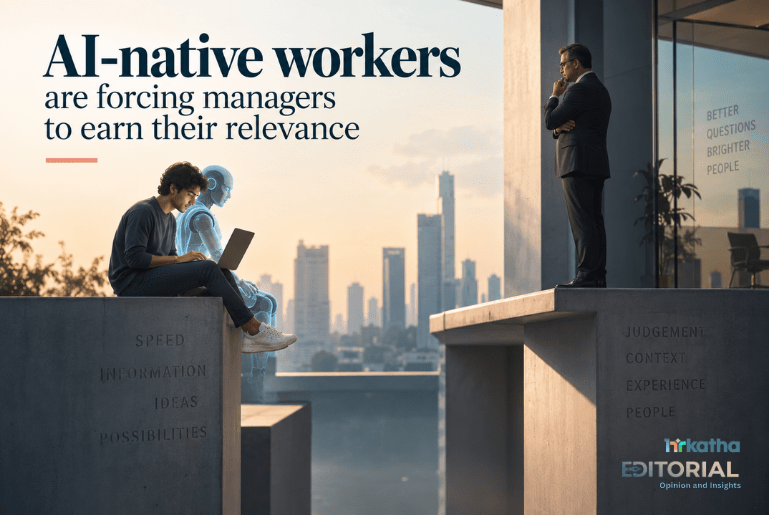
They did not arrive announcing themselves.
They joined as analysts, engineers, content writers, recruiters and consultants. On paper, they looked like every other new hire.
Then their managers noticed something.
The presentation was ready before it should have been. The research summary covered more ground than expected. The first draft arrived the same morning it was requested. The analysis that usually took two days was on the manager’s desk by noon.
Some managers were impressed. Others were suspicious. A few wondered whether corners were being cut.
Perhaps the more interesting possibility is that this person simply works differently.
Who is the AI-native worker
The AI-native worker is not simply someone who uses AI extensively. Many experienced professionals now do. They learnt to work without it and subsequently adopted it.
The AI-native worker entered professional life as generative AI became mainstream. AI was present while their working instincts were being formed. They are entering professional life at a time when researching, writing and solving problems with AI is rapidly becoming normal.
Unlike their managers, they are unlikely to spend a substantial part of their careers working without it.
That distinction matters.
An experienced AI adopter has an independent reference point. They know what producing a first draft used to involve and what research looked like without assistance. The AI-native worker begins somewhere else. Their sense of effort, speed and process was formed with AI already in the room.
In 2026, this cohort is only a few years into its career. It is far too early to declare what kind of leaders they will eventually become. But it is not too early to notice that they are developing differently.
They work differently
The most obvious difference is time.
A first draft, research synthesis or initial framework can appear much faster because the scaffolding appears faster. What the employee does with that scaffolding, how they interrogate it, refine it and apply judgement to it, is where capability increasingly becomes visible.
Managers accustomed to effort and time moving roughly together can misread this. Fast work can look superficial because good work historically took time. AI is weakening that association.
The managerial question therefore changes. It is no longer whether enough effort went into the work. It is whether enough judgement did.
But the more interesting consequence may have little to do with productivity.
When the first question goes to AI
The new employee who was stuck once did something entirely ordinary.
They asked someone.
A colleague, manager or somebody in another function who knew how things worked.
The answer mattered. But so did everything that came with it. Why the organisation did something a particular way. What had been tried before. Which rule mattered and which could occasionally be bent. The colleague also learnt something about the employee: what they understood, where they struggled and whether they asked good questions.
A relationship formed around the exchange.
The AI-native worker asks AI first.
It is faster, infinitely patient and carries no social risk. Often it provides a perfectly adequate answer.
But it cannot explain why this organisation abandoned that perfectly sensible idea three years ago. It does not reveal who really influences a decision despite having no obvious authority on the organisation chart. Nor does it create the small human exchanges through which trust and reputation accumulate.
The problem gets solved. Some of what once happened around solving the problem disappears.
In Indian organisations, where the formal structure and the way work actually gets done do not always correspond neatly, this matters particularly. Who carries real influence. What the unwritten rules are. Which battles are worth fighting and which are not. These things were never formally taught. They were absorbed through the interactions that AI is now bypassing. The AI-native worker who never navigates that gap through human conversation may never fully understand it, and may not realise what they are missing.
Efficiency, in other words, may remove interactions whose organisational value was never included in the calculation. Most organisations have not noticed. Partly because the productivity gain is visible and the relational loss is not.
The apprenticeship problem
There is a deeper consequence.
Junior work has always been partly about output and partly about apprenticeship.
An analyst building a financial model is producing analysis, but is also developing a feel for numbers. A recruiter writing job descriptions is producing a document, but is also learning how roles fit together and how an organisation thinks about talent.
Some mundane work creates judgement precisely because somebody has done it repeatedly.
AI can now remove or accelerate parts of that work. The productivity gain is obvious. The developmental consequence is less so.
If technology performs some of the tasks through which expertise was historically acquired, what replaces the learning that happened while doing them?
This matters because the currency of work changes with seniority. Junior employees are largely judged on whether they can produce good work. Further up the organisation, judgement, influence, context and the ability to navigate ambiguity matter considerably more.
The danger is not that AI-native workers will become incapable. It is that organisations may mistake accelerated output for accelerated development. They are not the same thing. By the time an organisation discovers that a highly productive analyst has not developed the judgement expected of a manager, the work through which previous generations acquired that judgement may already have disappeared.
The manager has a problem too
There is another side to this equation, and managers may find it less comfortable.
When an AI-native employee approaches a manager with a problem, the manager is no longer the first place they have looked. The employee has already asked AI, explored the obvious solutions and arrived with considerably more information than a junior employee once would have possessed.
For generations, experience gave managers an information advantage. They had seen more and therefore often knew more. Being able to solve a junior employee’s problem was one way managerial credibility was earned.
AI weakens that advantage.
A manager does not need to know more than AI. But they do need to add something AI cannot.
Why will the obvious solution fail here? Which assumption is wrong? What happened the last time the organisation tried this? Which stakeholder has been overlooked? When several answers appear equally reasonable, which one should be chosen and why?
That is where experience becomes judgement rather than merely accumulated information.
And it matters for something beyond productivity. A designation gives a manager authority. It does not guarantee credibility. If an employee repeatedly finds that the manager adds less to a problem than AI already has, the authority may remain while the respect underneath it begins to erode.
The old hierarchy of knowledge no longer maps as neatly onto the hierarchy of the organisation. That does not diminish experience. It raises the standard for what experience has to produce.
The manager who competes with AI on information will eventually lose. The manager who turns information into judgement remains enormously valuable.
Perhaps AI-native employees are not simply learning to ask managers fewer questions.
Managers are having to give them a reason to keep asking.
The generation that will eventually run these organisations
Today’s AI-native employees will not remain junior forever.
The analyst producing AI-assisted work today will eventually manage analysts. The engineer who learnt to code with AI beside them will make larger technical decisions. The recruiter who has rarely written a job description without assistance may eventually lead a talent function.
They will bring advantages their managers did not begin their careers with: speed,
adaptability and an instinctive ability to divide work between human and machine.
They may also arrive with different developmental histories.
The task for organisations is not to recreate the old path merely because it was familiar. It is to understand what that path built accidentally and decide what still needs to be built deliberately.
The AI-native worker will have to develop the judgement, relationships and organisational context that technology cannot readily provide. Their managers will have to demonstrate why their experience remains valuable when information itself is available to everyone.
The AI-native workforce is not the management problem.
The more interesting question is whether management is ready for the AI-native workforce.