


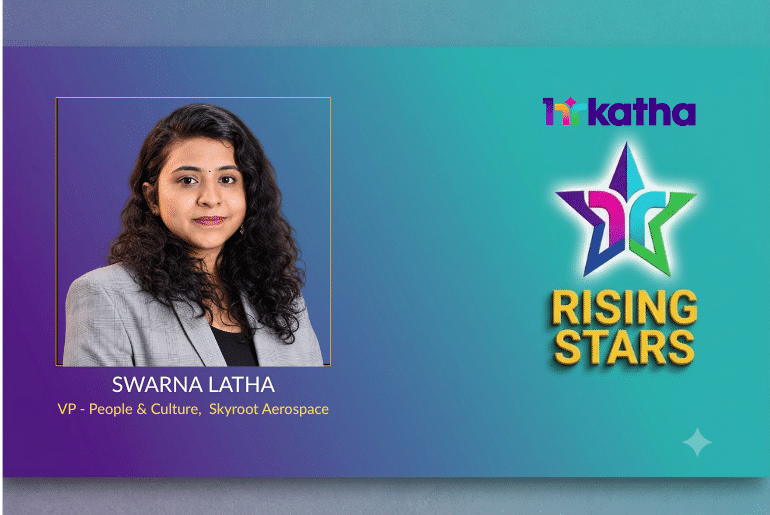
Swarna Latha Buravalli once imagined becoming a scientist. Early marriage and motherhood in her late teens changed that trajectory, and her career eventually took her into HR.
Years later, there is an unexpected symmetry to where she has arrived. At Skyroot Aerospace, she works alongside the engineers and scientists building India’s private space ambitions, shaping the organisation in which they do that work.
The environment has influenced how she thinks about HR itself. The engineers around her will iterate repeatedly on a component rather than accept something that does not meet the required standard. “This changes how you think about people systems,” she says.
Buravalli has tried to bring some of that discipline into role design, competency models and levelling architecture. Not because people systems can be engineered like rocket components, but because ambiguity in either can become expensive later. For her, rigour is not the opposite of speed. Done well, it is what allows an organisation to move quickly without repeatedly correcting what should have been thought through earlier.
Influence without authority
Buravalli’s definition of HR leadership is succinct: influence without authority. Many of the decisions HR needs to shape are not ultimately HR’s to make. Business leaders decide how managers lead, where resources are allocated and which priorities survive when circumstances change. Formal authority therefore gets an HR leader only so far. The rest depends on credibility.
That is why Buravalli advises younger HR professionals to go deep into the business itself: understand the revenue model, product roadmap, operating constraints and the problems occupying leaders’ attention. Only then, she argues, can people recommendations become part of the business conversation rather than something presented alongside it. The objective is not merely to learn the vocabulary of the room. It is to understand the problem well enough to contribute to solving it.
Where expertise now lives
Buravalli sees AI changing HR in a more fundamental way than simply making existing processes faster. A year ago, her team could spend considerable time producing first drafts of job descriptions, competency frameworks or policy documents. Generative AI can now compress much of that work into minutes. What becomes more valuable, therefore, is everything around the first draft: asking the right question, recognising what is missing, understanding context and exercising judgement over what the machine produces.
Some capabilities traditionally associated with a strong HR generalist, including process execution, documentation and consistent application of frameworks, can increasingly be assisted by technology. Buravalli believes that places a greater premium on critical thinking, contextual judgement and the ability to deal with ambiguity. “We’re actively rethinking what we hire for, what we develop, and how we describe value-add within the HR function itself,” she says.
Her team’s principle is AI literacy rather than AI adoption. The distinction is deliberate. Adoption asks whether people are using a tool. Literacy asks whether they understand what it can do, how to evaluate its output, when to trust it and when to challenge it.
Her team is experimenting with AI-assisted job design, structured interview frameworks and early-stage skills mapping. But Buravalli draws a clear boundary around judgement. AI can surface patterns and accelerate analysis. Decisions about people still require human accountability. That boundary matters most, she believes, precisely when technology makes it tempting to blur it.
Scaling without losing the standard
One of the achievements Buravalli is proudest of is helping Skyroot scale from around 300 employees to more than 1,000 while trying to preserve the speed, ownership and standards of the smaller organisation.
The numbers matter because of what sits behind them. With an average employee age of around 28, a predominantly young workforce is working on aerospace technology where the final margin for error can be exceptionally small. The people systems supporting that workforce therefore have to reflect a particular organisational reality rather than replicate practices borrowed from more mature or slower-moving industries. Onboarding, manager capability and ownership structures all had to evolve as the company grew.
The experience reinforced Buravalli’s belief in what she calls a first-time-right mindset: not the unrealistic expectation that nothing will ever fail, but the discipline of doing the thinking, preparation and checking necessary before something consequential is put into action. In that sense, thoroughness is not bureaucracy. It is part of how speed becomes sustainable.
When timing beats design
Rigour, however, does not guarantee adoption. Buravalli learnt that while introducing a structured assessment framework that she believed the organisation genuinely needed. The framework itself was well considered, but adoption was slower than expected.
The explanation became clearer when she considered what else was happening around it. The organisation was growing at extraordinary speed, teams were operating at full stretch and managerial attention was already heavily claimed by execution. A new assessment framework, however useful in principle, was competing for bandwidth the organisation did not have. The design was not necessarily the problem. The timing was.
For Buravalli, it became a lesson in sequencing. HR can correctly identify what an organisation needs and still misjudge when the organisation is capable of absorbing it. Every new people initiative carries an opportunity cost in managerial attention, and HR has to earn its place in the rhythm of the business rather than assume a good idea automatically deserves immediate adoption. Sometimes the more disciplined decision is to wait.
Quick Takes
A surprising skill that makes her better at HR: Asking questions like a journalist and being willing to sit with not knowing until the real answer surfaces.
Conflict style: Mediate first.
What drives engagement, recognition or rewards: Recognition. She believes rewards can reinforce outcomes, but recognition creates a more personal connection with contribution.
Feedback preference: Instant. Feedback loses much of its usefulness when separated too far from the moment that prompted it.
Team energy booster: Brainstorming. Coffee may fuel the individual; ideas fuel the team.
Why she is a Rising Star
Buravalli’s strength lies in borrowing the rigour of the organisation around her without pretending that people can be engineered like machines. Her experience scaling Skyroot from around 300 to more than 1,000 employees has taught her both sides of that lesson: systems need precision, but organisations also have rhythms that even a well-designed intervention must respect. Her distinction between AI adoption and AI literacy reflects the same judgement.
Rising Stars is HRKatha’s editorial series profiling the next generation of HR leaders shaping the future of the profession. The series features winners and finalists of the HRKatha Rising Star Leadership Awards alongside emerging professionals whose work, ideas and leadership potential deserve wider recognition.
