



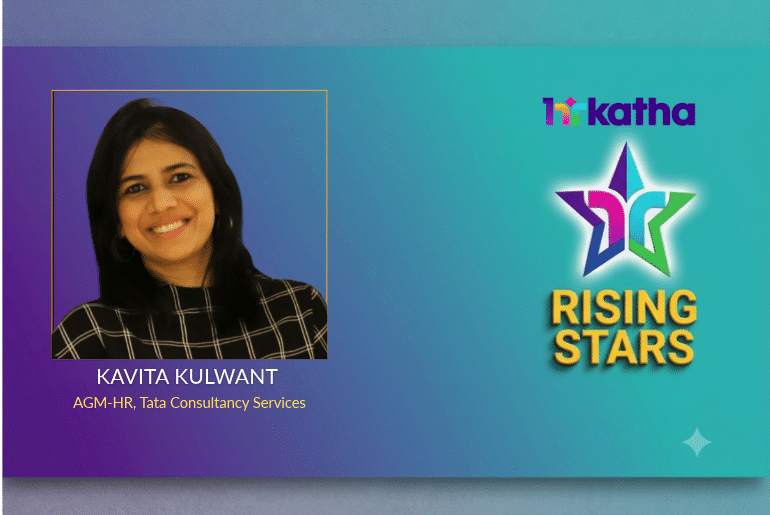
“Automate the routine. Elevate the human.”
It is a philosophy Kavita Kulwant has begun putting into practice rather than merely advocating.
Trained as a computer science engineer before pursuing an MBA in HR, Kulwant entered the profession with an understanding of how technology works and a growing interest in how people work.
Nearly two decades later, those two interests have converged.
At Tata Consultancy Services (TCS), where she works in total rewards, Kulwant has personally designed two AI agents intended to take over routine and clerical HR activities.
Her objective is not simply to make existing processes faster. It is to question why HR professionals should continue spending time on work that technology can perform when their judgement and attention are needed elsewhere.
Two agents, one purpose
Agentic AI interests Kulwant because it offers the possibility of changing how HR work is distributed between people and technology.
Administrative activities may be necessary, but they can consume time that HR professionals might otherwise devote to solving complex problems, supporting employees or contributing to business decisions.
Kulwant has designed two AI agents to handle some of that routine work.
“The real power of AI is not simply in doing things faster, but in creating the space for people to think differently, innovate, and make a greater impact,” she says.
That distinction influences how she intends to evaluate the agents.
While time saved, process efficiency and output quality are important measures, she also wants to examine whether automation creates greater capacity for strategic HR work.
It is an important test because efficiency gains do not automatically translate into more meaningful work. Time released from one activity can easily be absorbed by another unless organisations deliberately rethink how people use it.
For Kulwant, the value of automation ultimately depends on what HR professionals are able to do differently as a result.
What the dashboard cannot explain
Kulwant’s engineering background has given her an appreciation for structured problem-solving, evidence and measurable outcomes.
Her years in HR have also taught her that numbers rarely provide a complete explanation of employee behaviour.
She examines indicators such as engagement, retention, internal mobility, leadership development and productivity. But she believes these measures need to be considered alongside qualitative feedback and conversations with employees.
For example, a learning initiative may attract strong participation without necessarily improving capability or creating career opportunities.
Similarly, an engagement score may indicate that something has changed without explaining what employees experienced or why their views shifted.
“Data tells us what is changing, but conversations help us understand why. The real impact comes from bringing both together,” she says.
That thinking also shapes her view of AI.
Technology can help HR identify patterns and process information, but interpreting those patterns requires an understanding of context, relationships and the limitations of the available evidence.
For Kulwant, better data should strengthen human judgement rather than substitute for it.
Beyond the metrics
Kulwant’s work has also been recognised beyond India. In 2018, she was a finalist at Scotland’s HR Network National Awards.
Yet she is reluctant to treat awards as the ultimate measure of success. “Awards are wonderful milestones, but the real reward is the positive difference we make in people’s lives,” she says.
Balancing business demands with employee experience
One of the more difficult challenges of Kulwant’s career has been balancing changing business requirements with the human consequences of organisational transformation.
Businesses need to adapt, often under pressure to improve efficiency or respond to new priorities. Employees experience those changes through altered expectations, unfamiliar processes and uncertainty about their roles.
Kulwant believes HR must understand both perspectives rather than treating them as competing arguments to be settled through policy alone.
“People are more receptive to change when they understand its purpose and feel included in the journey,” she says.
Her approach emphasises communication, collaboration and listening, particularly when employees are trying to understand how a decision will affect them.
She has also learnt that leadership does not always require an immediate answer. Sometimes the more useful contribution is to ask a better question, recognise a concern that has been overlooked or examine whether a proposed solution addresses the underlying problem.
That becomes especially important when technology is introduced into people processes.
A technically-effective system may still create frustration or mistrust if employees do not understand how it works, what information it uses or who remains accountable for its decisions.
Trust requires boundaries
Kulwant regards trust as central to HR’s credibility, but she does not equate transparency with unrestricted disclosure.
Employees should be able to raise concerns knowing they will be handled sensitively and fairly. At the same time, HR must protect confidential individual and organisational information.
Her approach is to explain processes, decision-making principles and expectations as clearly as possible while being explicit about what cannot be shared.
“It is best to be honest when certain information cannot be shared, rather than creating unrealistic expectations,” she says.
The distinction becomes increasingly relevant as HR adopts AI and data-driven systems.
Access to more information does not remove the responsibility to protect it. Nor does an automated recommendation relieve HR of the obligation to examine whether the outcome is appropriate.
For Kulwant, trust depends on employees knowing that technology is being used responsibly and that human accountability remains intact.
Making room for people
Kulwant’s interest in reducing administrative work is also connected to her view of employee wellbeing.
She believes organisations need to recognise that people have responsibilities and aspirations beyond their professional roles.
Open conversations about workload, priorities and the need for support are therefore important, particularly in environments where employees may feel pressure to remain constantly productive.
Her experience has changed how she understands resilience.
Rather than expecting people to push through every difficulty, she sees resilience as including the ability to recognise when priorities or expectations need to be recalibrated.
The same principle applies to teams.
Sustained performance, she believes, is not achieved by expecting everyone to operate at maximum intensity every day. It depends on creating conditions in which people can contribute consistently without sacrificing their wellbeing.
Technology may help remove unnecessary work, but organisations still have to decide how to use the capacity it creates.
If automation merely raises expectations without addressing workload or improving the employee experience, its human benefits may never materialise.
Quick Takes
Conflict style: Mediation. Most conflicts can be resolved through empathy and meaningful dialogue.
Engagement driver: Recognition. Being genuinely valued often matters more than being rewarded.
Retention tool: Career growth. Compensation attracts talent, but meaningful growth helps retain it.
Team energy booster: Coffee break. Some of the best ideas and strongest connections emerge from informal conversations.
The HR function she wants to build
Kulwant envisages an HR function in which AI improves efficiency, employees contribute ideas and human judgement remains central to decisions.
That would involve simplifying processes, reducing unnecessary administrative complexity and giving HR professionals more time to work on issues affecting business performance and employee experience.
She also wants employee feedback to lead to visible action rather than becoming another set of survey results.
Her interest in technology is therefore inseparable from a question about organisational priorities: once routine work is automated, what should people be spending their time on?
Kulwant does not believe technology alone can answer that question.
“AI should take the administrative load off our shoulders, not the human responsibility out of our hands,” she says.
For an HR professional with a background in computer science, it is a distinction that defines how she wants technology to be used: not as a replacement for the function’s human responsibilities, but as a means of giving those responsibilities greater attention.
Why she is a Rising Star
Kulwant brings an unusual combination of technical capability and HR experience to the question of AI adoption. Rather than simply advocating automation, she has designed two AI agents to handle routine work and wants to assess their value through the capacity they create for more meaningful HR contributions. Her approach to data reflects the same balance: quantitative evidence identifies patterns, while conversations help explain them. What distinguishes Kulwant is her insistence that technological progress should increase the time and attention available for human judgement, not diminish accountability for it.
Rising Stars is HRKatha’s editorial series profiling the next generation of HR leaders shaping the future of the profession. The series features winners and finalists of the HRKatha Rising Star Leadership Awards alongside emerging professionals whose work, ideas and leadership potential deserve wider recognition.
