


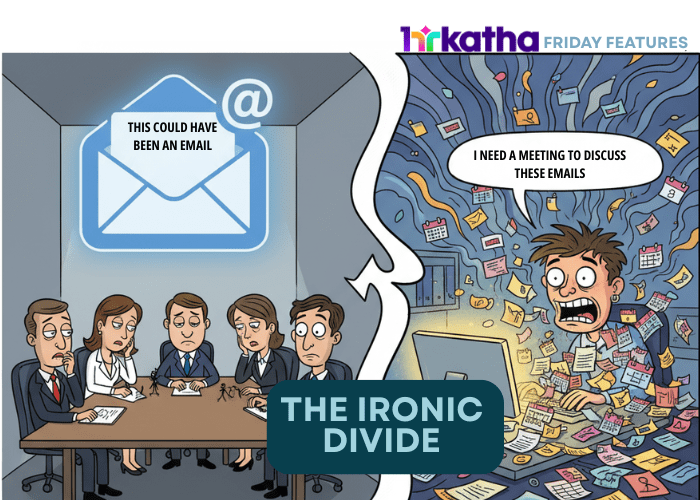
If aliens ever study corporate life, they’ll be baffled by one thing above all: our complete inability to choose the right communication format.
We schedule hour-long meetings to share information that could fit in three bullet points. Then we fire off vague emails about complex, emotionally charged issues that desperately need a conversation. It’s as if we’ve collectively agreed that the worst possible medium is always the correct one.

This isn’t about efficiency. It’s about a deeper workplace pathology: we’ve lost all sense of what actually requires human interaction and what doesn’t. The result? A daily carnival of miscommunication, wasted time, and the slow erosion of everyone’s will to live.
Part I: Meetings that should have been emails
1. The announcement meeting
Fifteen people summoned to a conference room. Someone reads, verbatim, from slides that were emailed the night before. No discussion. No questions. Thirty minutes later, you’re released, having learnt absolutely nothing you didn’t already know.
Why it’s a meeting: Because leadership needs to “cascade information” and “ensure alignment.”
Why it should have been an email: Because it literally already was an email. You just had to sit through a dramatic reading of it.
The real reason: Someone believes saying things out loud makes them more important. It doesn’t. It just makes them longer.
2. The “quick sync” that’s never quick
Calendar invite: “Quick Sync – 15 mins.” Forty-five minutes later, you’re still there, discussing tangential issues. No decisions are made. Another meeting is scheduled.
Why it’s a meeting: Because someone thought talking would be faster than writing. They were wrong.
Why it should have been an email: The core issue could be summarised in four sentences. The rest is just people enjoying the sound of their own voices.
The real reason: “Quick sync” is code for “I haven’t thought this through, so let’s brainstorm live and waste everyone’s time together.”
3. The status update meeting
Each person reports what they’re working on. Most people zone out. By the end, no one remembers what anyone said.
Why it’s a meeting: Managers believe hearing updates creates “visibility” and “accountability.”
Why it should have been an email: Status updates are informational, not collaborative. Bullet points achieve the same result in one-tenth the time.
The real reason: Managers don’t trust work is happening unless they can see people talking about it. This is a trust problem, not a communication problem.
4. The meeting to plan the meeting
You meet to discuss what will be discussed in the actual meeting. Agenda items are debated. Attendee lists are scrutinised. By the end, you’ve spent more time planning the meeting than the meeting itself will take.
Why it’s a meeting: Some organisations have replaced actual work with the meticulous choreography of future work.
Why it should have been an email: “Proposed agenda attached. Thoughts by EOD?” Done.
The real reason: Middle management has to justify its existence somehow, and planning meetings is easier than doing actual strategic thinking.
Part II: Emails that should have been meetings
1. The passive-aggressive essay
A 12-paragraph email dissecting a minor issue in excruciating detail. Every sentence is a landmine. The tone oscillates between faux politeness and thinly veiled accusation. You read it three times, still unsure what you’re supposed to do.
Why it’s an email: The sender is either too conflict-averse for a real conversation or enjoys crafting a written indictment.
Why it should have been a meeting: Complex interpersonal issues require tone, body language, and the ability to ask clarifying questions without waiting 24 hours for a reply.
The real reason: Email gives people courage they don’t have in person. It’s easier to be righteously angry in writing.
2. The vague “we need to talk” email
Subject line: “Can we talk?” Body: “Let’s discuss when you have a moment.” No context. No urgency indicator. Just dread.
You spend the next four hours spiralling. Am I being fired? Did I mess something up?
Why it’s an email: The sender hasn’t thought through what they want to say yet, but they want you to know something is coming.
Why it should have been a meeting: If you’re going to create anxiety, at least resolve it immediately. Leaving someone dangling isn’t strategic—it’s just cruel.
The real reason: The sender has confused creating anticipation with creating productivity. They’ve achieved neither.
3. The email chain with 47 replies
Someone asks a question. Seven people reply with different interpretations. Someone replies-all with “Thanks!” Another asks a tangential question. Someone forwards the entire thread to someone new, without context.
By reply 47, no one remembers the original question, and the actual answer is buried around reply 19.
Why it’s an email: Everyone assumed someone else would take the lead. No one did.
Why it should have been a meeting: After reply five, it was clear this needed real-time discussion. But scheduling a meeting requires effort. Replying to an email feels like progress even when it isn’t.
The real reason: We’ve committed to slow-motion chaos because synchronous discussion feels like too much work.
4. The “urgent decision needed” email sent at 6 p.m. on Friday
A multi-page email arrives late Friday, outlining a complex decision requiring input from six people and a final answer by Monday morning.
No one responds. Monday arrives. The sender is furious.
Why it’s an email: The sender wanted a paper trail showing they flagged the issue, even if the format guaranteed it wouldn’t be resolved.
Why it should have been a meeting: Urgent, complex decisions require synchronous discussion, real-time trade-offs, and someone empowered to make the call.
The real reason: The sender wanted to transfer the problem, not solve it. Email is perfect for that.
The real problem
We’ve stopped asking why we’re communicating and started defaulting to how we’ve always done it.
Meetings happen because meetings have always happened. Emails are sent because email exists. And in the process, we’ve created a system where communication is abundant but clarity is rare.
The solution isn’t complicated. It’s just uncomfortable.
Before you schedule a meeting, ask: Does this require discussion, or just distribution? If it’s the latter, write an email.
Before you send an email, ask: Does this require tone, emotion, or real-time problem-solving? If it does, schedule a meeting.
But that requires pausing. Thinking. Choosing the right tool instead of the convenient one.
And that, apparently, is too much to ask.
The verdict
So here we are—trapped in a world where meetings proliferate like weeds and emails multiply like rabbits, each in the wrong context, each making work harder instead of easier.
The meeting that should have been an email wastes your time.
The email that should have been a meeting wastes your sanity.
And somewhere, in a parallel universe, people actually communicate effectively.
We just don’t live there.
What’s your worst offender? The meeting that should’ve been an email, or the email that desperately needed to be a meeting? Share your war stories in the comments—because misery loves company, and so does bad communication.