



Express logistics operates at brutal velocity. Precision matters, speed is non-negotiable, and reliability shapes customer trust. Behind every package delivered on time is a vast frontline network that must remain resilient, adaptable and operationally excellent whilst continuously preparing for disruption. In this environment, HR isn’t support—it’s a critical business enabler.
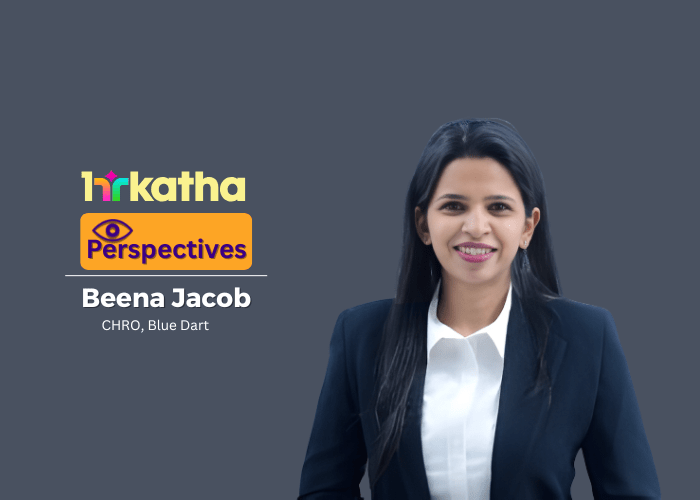
Beena Jacob, CHRO, Blue Dart, one of South Asia’s leading express logistics providers, operates within these realities daily. In conversation, she articulates why organisations don’t choose between readiness for today and capability for tomorrow but build both together, why psychological safety in India must be thoughtfully contextualised to cultural and organisational realities, and why credibility is built through competence, consistency and courage, not volume.
Delivering today, building tomorrow
Are you hiring for skills that exist today or capabilities to learn what doesn’t exist yet? What does future-ready talent mean at Blue Dart?
In a frontline-driven logistics organisation, we don’t choose between readiness for today and capability for tomorrow—we build both together. Learning here is continuous, driven by real-life challenges, autonomy at work and daily problem-solving that turns work itself into a classroom.
Many of our leaders started on the ground, proving that growth is not a promise but a lived pathway. For us, future-ready talent delivers today whilst consciously building the skills to lead tomorrow.
“In logistics, HR isn’t a support function—it’s an operational enabler”
One soul, many expressions
Can one culture truly serve five generations simultaneously, or are we heading towards fragmented, personalised employee experiences?
One rigid culture cannot serve five generations, but a strong shared value system absolutely can. What must evolve is not the culture, but how people experience it—through flexibility, technology and career design.
We believe in personalisation with a common backbone, not fragmentation without direction. Culture, after all, is one soul, many expressions.
“Credibility isn’t built through volume, but through competence, consistency and courage”
Challenge as collaboration
How do you build cultures where junior employees can challenge senior leaders without it being seen as disrespectful?
Psychological safety in India must be thoughtfully contextualised to our cultural and organisational realities. We focus on building cohesive teams where ideas are evaluated on merit and business outcomes, not hierarchy or titles.
When leaders separate intent from authority, challenge becomes collaboration rather than confrontation. This is absolutely a goal worth pursuing, because when people speak up, decisions improve and execution strengthens.
“Dashboards don’t make decisions—judgement does”
AI working with people, not on them
How are you helping employees see AI as a tool that amplifies their capabilities rather than a threat?
We position AI clearly as a colleague that augments human judgement, not a competitor that replaces it. We are experimenting with AI in hiring, attrition analytics and HR spend analysis to improve speed and consistency.
Our reskilling approach works at scale by embedding AI into everyday workflows rather than treating it as a separate intervention. Once people see AI working with them, not on them, fear gives way to curiosity.
“AI works best when positioned as a colleague, not a competitor”
Insight with intent becomes impact
Are we truly making better decisions with people analytics, or just faster ones with better dashboards? Where has data genuinely helped?
Data does not remove bias by itself; it only exposes it faster if governance is weak. Where data has genuinely helped us is in predictive forecasting, cost-benefit analytics, retention planning and succession readiness. It has strengthened HR’s role as a business enabler rather than a reactive function.
Insight without judgement is noise, but insight with intent becomes impact.
“When leaders separate intent from authority, challenge turns into collaboration”
Competence, consistency, courage
What experience shaped you most as a people leader, and what advice would you give your 25-year-old self?
My leadership has been shaped more by the risks I took and the multiple facets of business I explored—including business development, operations, M&A and HR—and leaders who challenged status quo and encouraged out-of-the-box thinking.
Being a leader in complex organisations taught me that credibility is built through competence, consistency and courage, not volume. To my younger self, I would say: Don’t be afraid to take risks—it always seems impossible till it’s done.
“Psychological safety in India isn’t imported; it has to be thoughtfully contextualised”
Judgement under pressure, empathy with discipline
For young HR professionals aspiring to work in logistics, what’s misunderstood about HR in this industry? What differentiates a great HR leader from a competent one?
What’s often misunderstood about HR in logistics and express delivery is the pace, scale and frontline intensity at which people decisions directly impact service, safety and customer trust. In India and South Asia, last-mile realities, regulatory guardrails and peak-cycle pressures intersect daily, leaving little room for theoretical HR.
In this context, HR is not a support function but a business enabler—ensuring workforce continuity, operational resilience and execution at speed. Great HR leaders are defined by judgement under pressure and empathy with discipline.
“Data doesn’t eliminate bias—it exposes it faster when governance is weak”
People strategy as measurable business value
If someone wants to be a CHRO in 15 years, what should they learn that isn’t in traditional HR curriculums?
Future CHROs must combine deep HR expertise with strong business, financial and digital acumen.
Understanding data, technology and AI is becoming essential, but it must be anchored in people judgement and ethical leadership.
Equally important are systems thinking, influencing skills and the ability to build trust, empathy and culture at scale. The real differentiator will be leaders who turn people strategy into measurable business value without losing the human soul of the organisation.