


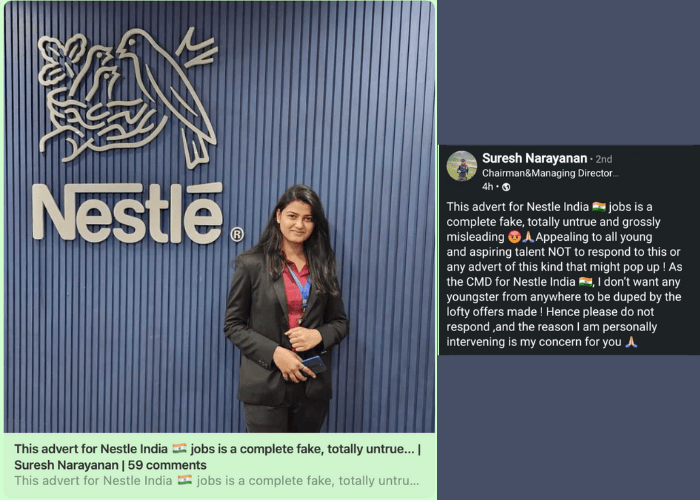
In an era when corporate identity can be mimicked with a few keystrokes, even the most recognisable brands find themselves struggling against digital impostors. Nestlé India recently discovered just how easily its name could be misappropriated when fraudulent job advertisements began circulating online, promising lucrative positions with salaries between Rs 5 lakh and Rs 10 lakh per annum. These phantom opportunities, distributed through unofficial channels, prompted the company’s CMD, Suresh Narayanan, to issue a personal warning on LinkedIn.
“Please beware of fake job postings,” wrote Narayanan, explaining that the firm adheres to a structured recruitment process through official channels only. His intervention highlighted a problem that extends well beyond a single multinational: the vulnerability of corporate reputations to digital deception.
The perpetrators of such scams operate with ruthless efficiency. They create convincing facsimiles of corporate communications, complete with logos and formatting that mimic official documents. Job descriptions are crafted to appeal to aspirational candidates, with salaries and benefits calibrated to seem plausible yet attractive. These fraudulent listings then proliferate across multiple platforms, from established job portals to messaging applications such as WhatsApp and Telegram, where oversight is minimal.
For the victims—typically ambitious job-seekers scanning countless listings daily—the costs can be both financial and emotional. “Fraudsters often demand a fee, claiming it to be a ‘screening charge’, only for applicants to later realise they’ve been duped,” explains Ramesh Shankar S, a senior HR leader and former CHRO, Siemens. “Victims frequently reach out to the company for clarification, adding pressure to corporate HR departments.” Even when direct financial losses are avoided, applicants often surrender valuable personal data, from identification numbers to bank details, which can be exploited for identity theft or sold to other criminal enterprises.
“Some companies post fake job openings under the name of bigger brands to collect CVs. Later, they use these CVs to poach talent for their own organisations.”
Manish Majumdar, head-HR, Centum Electronics

The damage extends to corporate reputations as well. When job-seekers associate a company with deceptive practices—even fraudulent ones perpetrated by external actors—the negative association lingers. Genuine recruitment efforts become tainted by suspicion, and the employer brand suffers. Social media amplifies these effects, with disappointed candidates often venting their frustrations publicly before establishing whether the company was actually responsible.
While global giants such as Nestlé possess the resources to monitor and counter such activities, smaller organisations find themselves particularly vulnerable. “A company such as Nestlé can swiftly issue a clarification, but mid-sized firms often struggle to monitor digital spaces effectively,” notes Manish Majumdar, head-HR, Centum Electronics. “This makes them even more vulnerable.”
Adding to the complexity is a parallel practice that Majumdar calls “piggybacking”—where smaller recruitment firms deliberately post fake positions under prestigious corporate brands. “Some companies post fake job openings under the name of bigger brands to collect CVs. Later, they use these CVs to poach talent for their own organisations,” he explains. This creates a bizarre ecosystem where job advertisements become unreliable currency, with applicants and employers alike struggling to distinguish genuine opportunities from sophisticated frauds.
“Fraudsters often demand a fee, claiming it to be a ‘screening charge’, only for applicants to later realise they’ve been duped.”
Ramesh Shankar S, a senior HR leader and former CHRO, Siemens

The most effective countermeasure appears to be swift, high-level intervention. When Narayanan personally addressed the job scam involving Nestlé India, he demonstrated the gravity with which the company viewed the situation. By choosing LinkedIn—a platform frequented by professionals and recruiters—he ensured his message reached relevant audiences. The clarity of his communication left no ambiguity about how Nestlé conducts its recruitment processes, providing job-seekers with a clear reference point against which to judge future claims.
For companies seeking to protect themselves against similar threats, a multi-layered defence is essential. Establishing dedicated teams to monitor digital mentions of the corporate brand allows for rapid response when fraudulent activities emerge. AI-powered tools can help scale this oversight, flagging suspicious content for human review. Regular public awareness campaigns can educate job-seekers about legitimate recruitment channels, reducing the pool of potential victims.
Legal recourse remains important, albeit challenging. While pursuing individual scammers is often impractical given their geographical dispersion and use of digital anonymity tools, selective prosecution of major offenders can serve as a deterrent. Collaboration with cybercrime units and job platforms can enhance the effectiveness of such actions.
Perhaps most crucial is maintaining clear, consistent communication about official recruitment channels. Companies that establish themselves as transparent and accessible in their hiring practices build a form of reputational immunity against fraudsters. When candidates know exactly how a legitimate recruitment process should unfold—from application channels to interview procedures—they become more adept at spotting deviations.
The Nestlé India case serves as a reminder that in the digital age, brand protection extends well beyond traditional copyright and trademark enforcement. It requires vigilant monitoring of how corporate identities are represented across an ever-expanding digital landscape. As recruitment increasingly migrates online—accelerated by pandemic-era shifts in working practices—the distinction between official corporate communications and sophisticated imitations becomes both more important and more difficult to maintain.
For job-seekers navigating this uncertain terrain, caution remains the watchword. Any request for payment during recruitment processes should trigger immediate scepticism. Official company websites and verified social media accounts provide reliable reference points against which to verify job postings. And as the digital employment marketplace continues to evolve, perhaps the oldest advice remains the most pertinent: if an opportunity seems too good to be true, it probably is.
