


The workplace is no longer defined by stability.
Organisations were long designed around predictability—structured career paths, fixed workplace models and relatively stable skill requirements. That architecture is now under strain.
Economic uncertainty, evolving workforce expectations and rapid shifts in how work is organised have made continuous recalibration the new operating reality.
Hybrid models have matured from experiments into standard practice. Flexibility has moved from perk to baseline expectation. Employee wellbeing has shifted from intention to measurable accountability.
For HR leaders, the challenge is no longer managing change episodically. It is sustaining performance while strengthening trust, building speed without losing empathy, and enabling growth without fragmentation.
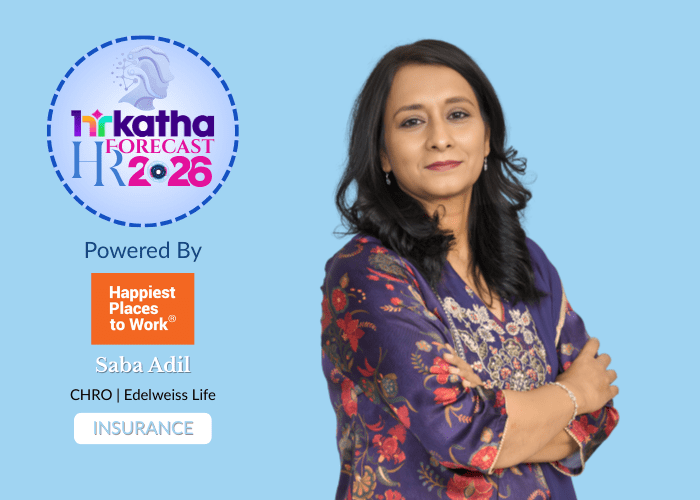
According to Saba Adil, Chief Human Resource Officer at Edelweiss Life, the organisations that succeed will be those that recognise the diversity of their workforce—across generations, career stages and aspirations—and design systems that work for all.
“Sustainable performance will increasingly come from organisations that create genuine win-win environments across generations,” she says.
Looking ahead to 2026, several signals are already emerging that indicate how this recalibration of work and organisations will unfold.
Signal 1: Multigenerational workforces will redefine inclusion
Workforces today span multiple generations, each bringing distinct expectations, working styles and career aspirations.
Experienced professionals contribute institutional memory and contextual judgment. Younger employees bring digital fluency, experimentation and fresh perspectives. The challenge lies in creating environments where these strengths complement rather than conflict.
“Inclusivity is no longer only a social imperative—it is a strategic one,” Adil notes.
Traditional HR policies designed for uniformity struggle to accommodate such varied needs, yet complete individualisation creates fragmentation and perceived inequity.
The emerging solution is principle-based flexibility—systems anchored in shared values such as fairness and performance whilst allowing meaningful choice around work arrangements, learning pathways and career progression.
Organisations that intentionally design policies, learning opportunities and career models to serve employees at different life stages will gain competitive advantage.
Rather than treating generational diversity as a challenge to manage, forward-looking organisations will treat it as a capability to leverage.
Signal 2: Reskilling will overtake hiring as primary talent strategy
The pace of technological change is accelerating skill obsolescence.
In response, organisations are shifting focus from degrees to capabilities—and from external hiring to internal reskilling.
“Continuous learning has become non-negotiable,” Adil says.
Across industries, companies are building large-scale reskilling initiatives to help employees adapt to emerging technologies, particularly artificial intelligence and data-driven work models.
Internal mobility is becoming central to this shift. Employees move across functions, acquire new competencies and remain relevant as business requirements evolve.
This approach offers multiple advantages. Developing talent internally is faster, more cost-effective and culturally cohesive than relying solely on external recruitment.
“Reskilling will increasingly overtake recruitment as the primary talent strategy,” Adil observes.
The competitive landscape reinforces this urgency. Agile startups are attracting employees seeking autonomy and purpose, pushing larger organisations to rethink retention, engagement and career pathways.
Organisations that succeed will treat capability-building as an ongoing strategic investment rather than episodic training.
Signal 3: Employee experience will become a measurable business metric
Organisational culture is no longer communicated through slogans or campaigns.
Employees evaluate culture through daily interactions—how decisions are made, how leaders communicate and whether opportunities feel fair and accessible.
Today’s workforce scrutinises transparency, consistency and trust with greater intensity than before.
“Culture is no longer a slogan—it is lived, observed and evaluated in every interaction,” Adil says.
As a result, organisations are designing employee journeys with the same discipline applied to customer experiences.
Hybrid and flexible work arrangements, once experimental, are becoming standard features of modern workplaces. From recruitment to everyday workflows, organisations are introducing clearer touchpoints, better communication channels and more intentional engagement strategies.
“Success is now measured not only by outcomes, but by the quality of experience employees have while achieving them,” Adil notes.
Over time, employee experience is likely to become a measurable business metric—directly linked to retention, productivity and long-term organisational performance.
Signal 4: AI will scale productivity—but human context will remain critical
Artificial intelligence is moving rapidly from experimentation to operational reality.
In sectors such as insurance, AI and advanced analytics are already compressing decision timelines, improving accuracy and enabling scale without linear increases in workforce size.
“Technology—particularly AI—is playing a defining role, not as experiment but as operating reality at scale,” Adil says.
Yet the next challenge lies beyond technology deployment.
Organisations must build what Adil calls “techno-mogul leaders”—leaders who understand both technology and the human dimension of decision-making, can translate technical insights into business impact, and possess capabilities in analytics, data interpretation and technology-driven strategy.
“The real shift ahead lies in building organisations that are fluent in data but grounded in strong ethical frameworks.”
This requires developing talent capable of interpreting data responsibly, applying insights in context and balancing automation with human judgment.
At the same time, organisations must ensure AI adoption strengthens—not weakens—trust with employees and customers.
Signal 5: Career models will evolve with longer working lives
Demographic shifts are reshaping how careers unfold.
Globally, employees are remaining active in the workforce longer, supported by better health and rising life expectancy.
This is giving rise to new career models such as soft retirement, where employees transition gradually from full-time roles to advisory, consulting or part-time engagements.
For organisations, this approach preserves institutional knowledge whilst offering employees flexibility and income continuity.
Such models may become increasingly common as organisations rethink traditional retirement structures and recognise the value of retaining experienced talent in flexible capacities.
Signal 6: Labour reforms will reshape workplace structures
In India, evolving labour regulations are influencing the future of work.
New labour codes aim to extend social security protections to gig, platform and unorganised sector workers whilst simplifying compliance for organisations.
While the final contours continue to evolve, the direction is clear: workplaces are becoming more structured, transparent and inclusive.
“The new labour codes represent a future-ready labour ecosystem—one that fosters stability, dignity and long-term security for employees whilst enabling organisations to formalise and scale effectively,” Adil notes.
The continuous recalibration imperative
Taken together, these signals point to a deeper shift in how organisations design work.
Multigenerational inclusion, reskilling priorities, employee experience, AI integration, evolving career models and labour reform are not isolated trends. They represent a broader transformation in how organisations operate and compete.
The forces shaping the future of work are increasingly intersecting across people, purpose and progress.
In this environment, HR’s role expands beyond policy design to strategic organisational stewardship. The priority is no longer merely enabling work—it is building workplaces that are adaptable, inclusive and capable of evolving continuously.
“The organisations that succeed will be those that balance technological progress with human empathy,” Adil observes.
Three Strategic Imperatives
Multigenerational Design: Build principle-based flexibility that serves employees across life stages whilst remaining anchored in shared organisational values.
Internal Capability Building: Prioritise reskilling over external hiring, treating capability development as an ongoing strategic investment.
Experience as Metric: Design employee journeys with the same discipline as customer experiences, making employee experience a measurable business metric tied to retention and productivity.
The adaptation advantage
The future of work will not be defined by a single disruption.
It will be defined by how effectively organisations recalibrate—continuously—to keep people, purpose and progress aligned.
Artificial intelligence, hybrid work models, reskilling imperatives and empowered employees are converging to reshape organisational structures and expectations.
Companies clinging to stability as their operating model will struggle. Those designing for continuous adaptation will gain decisive advantage.
Because the workplace is no longer defined by stability.
It is defined by the capacity to recalibrate—again and again—whilst maintaining trust, performance and purpose.
And that capacity will increasingly separate the resilient organisations from the rigid ones.Lead,
future of work, HRForecast 2026, Saba Adil, Edelweiss Life, multigenerational workforce, reskilling strategy, AI in workplace, employee experience, hybrid work, talent strategy, future workplace trends, HR leadership India, workforce transformation