



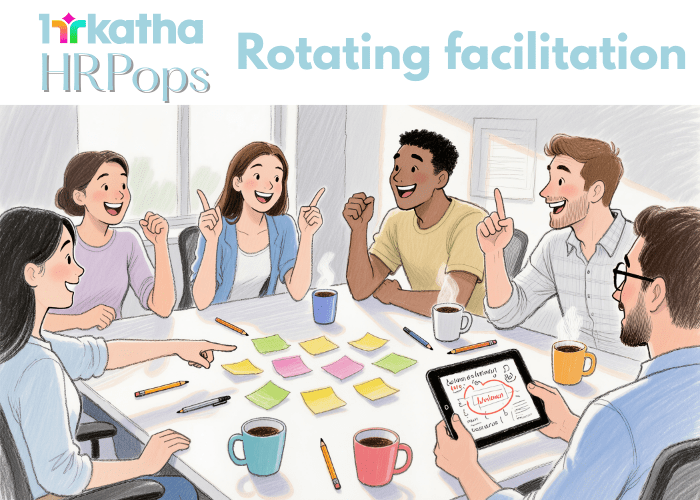
What is rotating facilitation?
Rotating facilitation is the practice of sharing meeting or workshop leadership amongst team members, rather than relying on a single permanent facilitator—typically a manager or team lead. Different individuals take turns guiding discussions, ensuring collective ownership of outcomes and encouraging diverse perspectives.
This approach distributes responsibility, promotes active participation, and keeps meetings fresh. Instead of the same voice setting the agenda and controlling the conversation, rotating facilitators bring varied styles, energy, and viewpoints—preventing monotony and meeting fatigue.

History
Facilitation as a professional practice emerged in the 1940s–1950s, post-World War II, alongside organisational development and group dynamics research. Institutions in the US and the UK began exploring how structured group processes could improve collaboration.
In the 1960s–1970s, experiments in participatory decision-making and democratic workplaces challenged the idea that facilitation should be monopolised by managers. Rotating roles reflected principles of equality and shared responsibility—popular in progressive organisational movements of the era.
By the late 1970s–1980s, rotating facilitators gained traction in training workshops and community organisations.
In the 1990s, the International Association of Facilitators (IAF, founded in 1994) standardised facilitation practices. Rotating facilitation was recognised as a technique to build inclusivity and leadership capacity.
In the 21st century, with the rise of agile teams, collaborative learning, and diversity initiatives, rotating facilitation became a mainstream HR and organisational development tool. It is now widely used in meetings, workshops, and project teams to distribute leadership and empower employees.
Why is it relevant for HR?
Rotating facilitation offers HR several strategic advantages. It reduces dependency on a single leader, empowering employees to step into leadership roles. It develops critical skills—conflict resolution, communication, decision-making—by giving team members practical opportunities to lead in a safe environment.
Fresh facilitators keep meetings engaging, driving away meeting fatigue. Different facilitators bring unique styles and perspectives, enriching discussions and preventing groupthink.
As part of leadership development programmes, rotating facilitation helps HR build leadership pipelines. It provides a low-risk space for employees to practise leadership skills and allows HR to spot potential leaders and hidden talent who might not otherwise be visible in traditional hierarchies.
Rotating facilitation also advances inclusion. By ensuring voices across levels, genders, and backgrounds are heard, it aligns with organisational missions to create workplaces where every employee feels valued. When junior staff or underrepresented employees facilitate, it challenges power dynamics and democratises influence.
The practice enhances transferable skills—managing group dynamics, encouraging collaboration, handling conflict—that strengthen overall organisational capability. These skills extend beyond meetings, improving day-to-day interactions and team effectiveness.
During change initiatives—whether introducing new policies, cultural shifts, or major transformations—rotating facilitation helps employees feel ownership of the change. When people lead conversations about change, they are more likely to buy in. This is invaluable for HR when driving organisational transformation.
The pitfalls: when rotation goes wrong
But rotating facilitation is not without risks. Inexperienced facilitators can derail meetings, allowing dominant voices to hijack discussions or failing to manage conflict effectively. When facilitation becomes a box-ticking exercise—rotating purely for the sake of rotation—it can lead to poorly run meetings, wasted time, and frustration.
There’s also the danger of reluctant facilitators. Not everyone wants to lead discussions. Forcing introverted or unprepared employees into facilitation roles can cause anxiety and resentment rather than empowerment.
If organisations fail to provide training or support, rotating facilitation can expose skill gaps publicly, embarrassing employees rather than developing them. And if senior leaders undermine rotating facilitators—interrupting, correcting, or taking over—it signals that the exercise is performative, not genuine.
For rotating facilitation to work, HR must ensure proper training, clear guidelines, and genuine leadership support. Otherwise, it risks becoming another well-intentioned initiative that breeds cynicism rather than capability.
When done right, rotating facilitation is a powerful tool to develop talent, foster inclusivity, and strengthen organisational culture. When done poorly, it’s just another meeting gone wrong.