

Close Menu
    Facebook X (Twitter) Instagram
    • Our Story
    • Partner with us
    • Reach Us
    • Career
    Subscribe Newsletter
    HR KathaHR Katha
    • Exclusive
      • Exclusive Features
      • Perspectives
      • Friday Features
      • herSTORY
      • Rising Stars
      • Case-In-Point
      • Point Of View
      • Research
      • HR Pops
      • Dialogue
      • Movement
      • Profile
      • Beyond Work
      • By Invitation
    • Brief News
      • Global HR News
      • Compensation & Benefits
      • Diversity
      • Events
      • Gen Y
      • Hiring & Firing
      • HR & Labour Laws
      • Learning & Development
      • Merger & Acquisition
      • Performance Management & Productivity
      • Talent Management
      • Tools & Technology
      • Work-Life Balance
    • Special
      • Editorial
      • HR Forecast 2026
      • Cover Story
      • HR Forecast 2024
      • HR Forecast 2023
      • HR Forecast 2022
      • HR Forecast 2021
      • HR Forecast 2020
      • HR Forecast 2019
      • New Age Learning
      • Coaching and Training
      • Learn-Engage-Transform
    • Studio
      • The CHRO Playbook
      • Quick HR Insights
      • The Corner Office
    • Reports
      • Whitepaper
        • HR Forecast 2024 e-mag
        • Future-proofing Manufacturing Through Digital Transformation
        • Employee Healthcare & Wellness Benefits: A Guide for Indian MSMEs
        • Build a Future Ready Organisation For The Road Ahead
        • Employee Experience Strategy
        • HRKatha 2019 Forecast
        • Decoding and Driving Employee Engagement
        • One Platform, Infinite Possibilities
      • Survey Reports
        • Happiness at Work
        • Upskilling for Jobs of the Future
        • The Labour Code 2020
    • Forums
      • HRKatha Inner Circle
      • HRKatha Futurecast
      • Leadership Summit 2025
      • Rising Star Leadership Awards
      • HRKatha Futurecast 2025
      • Automation.NXT
      • The Great HR Debate
    WhatsApp LinkedIn X (Twitter) Facebook Instagram
    HR KathaHR Katha
    Home»Exclusive Features»HR Pops»The Dunning-Kruger Effect: When confidence misleads competence
    HR Pops

    The Dunning-Kruger Effect: When confidence misleads competence

    How a cognitive bias identified in 1999 explains why the least skilled often feel the most confident—and what HR can do to build fairer, high-performing teams
    mmBy Liji Narayan | HRKathaDecember 9, 20253 Mins Read20487 Views
    Share LinkedIn Twitter Facebook WhatsApp
    Dunning-Kruger Effect
    Share
    LinkedIn Twitter Facebook WhatsApp

    What is the Dunning-Kruger Effect?

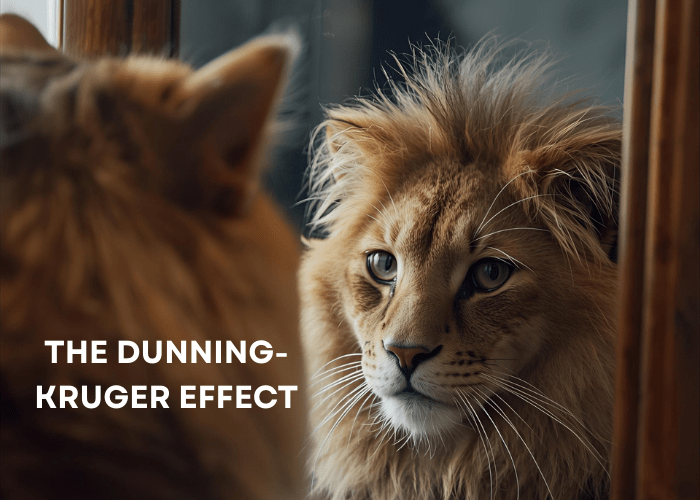
    The Dunning-Kruger Effect is a cognitive bias where individuals with limited competence overestimate their abilities, while experts often underestimate theirs. Simply put, people who know little about something often feel overconfident, while those who are truly skilled sometimes doubt themselves.

    For instance, someone who has just learned to cook a basic omelette may feel like a great chef because they are unaware of how much more there is to learn. A professional chef, despite being highly skilled, may feel less confident—assuming their expertise is so easy that anyone can do it.

    History

    The Dunning-Kruger Effect was introduced in 1999 by psychologists David Dunning and Justin Kruger. Their research revealed that people with low ability in a particular field often lack the metacognitive skills to recognise their own shortcomings, leading to overconfidence. Conversely, highly skilled individuals sometimes undervalue their expertise, assuming tasks they perform easily must be equally easy for others. This paradox of confidence versus competence has since become a cornerstone in understanding workplace behaviour and decision-making.

    At its heart, the effect creates a distorted self-assessment cycle: low performers overestimate their skills due to lack of awareness, while high performers underestimate theirs, assuming others share their knowledge.

    Why is it more relevant today?

    In today’s fast-evolving workplace—marked by remote work, AI disruption, and the rise of self-taught professionals—the Dunning-Kruger Effect has become more pronounced. The democratisation of information through online courses and social media has created a generation of workers who may acquire surface-level knowledge quickly but lack deep expertise. This amplifies overconfidence, particularly in emerging fields like AI, data science, and digital marketing, where the gap between knowing buzzwords and possessing real competence is vast.

    Meanwhile, the shift to remote and hybrid work has reduced informal feedback loops. Without daily interactions and peer observations, employees have fewer opportunities to calibrate their self-assessments. Overconfident workers may go unchecked longer, while talented but modest employees may remain invisible.

    The rise of personal branding and LinkedIn culture has also intensified the effect. Professionals curate confident online personas, sometimes masking actual skill gaps. For HR, distinguishing genuine expertise from polished self-promotion has become more challenging—and more critical.

    Why is it relevant for HR?

    This cognitive bias has critical implications for recruitment, leadership, talent management, and organisational culture.

    In hiring, candidates often mask skill gaps with extreme confidence. Structured assessments and competency-based interviews help HR identify genuine skills versus inflated self-perception. Leaders may fall prey to this bias, believing candidates are more capable than they actually are and assigning them excessive responsibility. Meanwhile, talented employees may hold back, underestimating their leadership potential.

    Overconfident employees resist constructive feedback, while underconfident high performers fail to seek advancement. HR systems must emphasise continuous learning, coaching, and mentoring to balance confidence and competence.

    If left unchecked, Dunning-Kruger dynamics hinder adaptability. Overconfident leaders ignore signals of change, while undervalued experts fail to voice critical insights. HR must foster psychological safety and ensure diverse voices are heard.

    This can be achieved by implementing 360-degree feedback for balanced perspectives, encouraging self-awareness training and reflective practices, using data-driven performance metrics to reduce reliance on self-assessment, and promoting mentorship programmes where experienced employees guide emerging talent. By addressing this bias, HR builds fairer, more inclusive, and high-performing organisations.

    cognitive bias competence David Dunning doubt themselves Dunning-Kruger highly skilled individuals HR Pops HRPops informal feedback loops Justin Kruger low performers low skills mask skill gaps overconfidence overestimate skills paradox pops Promotion psychological safety Self assessment self doubt think they know too much
    Share. LinkedIn Twitter Facebook WhatsApp
    mm
    Liji Narayan | HRKatha

    HRKatha prides itself in being a good journalistic product and Liji deserves all the credit for it. Thanks to her, our readers get clean copies to read every morning while our writers are kept on their toes.

    Leave A Reply Cancel Reply

    Related Posts

    Affinity bias: The comfort trap in HR

    October 6, 2026

    Dominant anxiety: The fear that follows every AI rollout

    September 29, 2026

    Managerial augmentation vs managerial substitution: When technology helps managers and when it replaces them

    September 22, 2026

    Career lattice: When sideways becomes the new forward

    September 15, 2026
    zoha
    Editorial

    The two-job job is becoming the new normal

    A colleague leaves. The position is not immediately filled. The work, however, does not wait…

    GCCs are not shrinking, the jobs that made them are

    The numbers that describe India’s GCC story in 2026 are impressive. More than 2,100 centres.…

    EDITOR'S PICKS

    Case-in-Point: The silent attrition signal

    October 8, 2026

    herSTORY: Sakshee Sud, People Director & Head of HR, Starbucks India

    October 8, 2026

    52.3% of urban Indian workers commute by two-wheeler

    October 7, 2026

    HR Perspectives by Puja Agarwal: “A manager who delivers numbers while losing people is not delivering sustainable performance”

    October 7, 2026
    Latest Post

    Porsche plans to cut 9,000 jobs by 2030 amid major restructuring

    Brief News October 8, 2026

    Porsche plans to eliminate around 9,000 jobs by 2030 as the German luxury carmaker restructures…

    HubSpot to cut 7% of workforce as it restructures around AI strategy

    Brief News October 8, 2026

    HubSpot plans to reduce its workforce by about 7 per cent, affecting nearly 660 employees,…

    Chinese restaurant owner gifts BMWs to top-performing employees

    Brief News October 8, 2026

    A restaurant owner in China has rewarded some of her top-performing employees with brand-new BMW…

    Shivani Hazari moves from leadership advisory to group head HR at Jindal Group

    Movement October 8, 2026

    Shivani Hazari has taken on the role of group head – human resources at Jindal…

    Asia's No.1 HR Platform

    Facebook X (Twitter) Instagram LinkedIn WhatsApp Bluesky
    • Our Story
    • Partner with us
    • Career
    • Reach Us
    • Exclusive Features
    • Cover Story
    • Editorial
    • Dive into the Future of Work: Download HRForecast 2024 Now!
    © 2026 HRKatha.com
    • Disclaimer
    • Refunds & Cancellation Policy
    • Terms of Service

    Type above and press Enter to search. Press Esc to cancel.