



Despite organisations’ plans to transform, HR leaders do not have organisation or job redesign on their list of priorities for 2017
With rising competition for talent and with business models being disrupted by technology and socio-demographic shifts, organisations are still taking an evolutionary approach to their talent strategies in the face of revolutionary changes. According to Mercer’s 2017 Global Talent Trends Study, the majority (93 per cent) of organisations worldwide report they are planning to redesign their structure in the next two years. Yet, only four per cent of business executives say their organisation is ‘change agile’.
The study that shares insights from over 7,000 perspectives and compares the views of senior business executives, HR leaders, and employees from organisations around the world, surprisingly reveals that business executives view talent scarcity more acutely than HR professionals, with 43 per cent expecting a significant increase in competition compared to 34 per cent, respectively.
Most notably, despite organisations’ plans to transform, HR leaders do not have organisation or job redesign on their list of priorities for 2017. In fact, the top priorities of HR leaders—specifically attracting top talent externally, developing leaders for succession, identifying high potentials, and building skills across the workforce—reflect the priority of evolving employee capabilities, but may not align with executives’ goals for more substantial workplace change.
Ilya Bonic, president of Mercer’s career business says, “In an age where digitisation, robotics, and AI are wreaking havoc with traditional business models, it is easy for executives to focus on superior technology as the solution to ensuring the competitiveness of their organisations and to overlook the human element.”
Additionally, the report states that although HR leaders express confidence in the talent management processes they have in place (70 per cent), employees are still looking elsewhere for new opportunities. Slightly more than one-third (34 per cent) of employees say they plan to leave their current role in the next 12 months, even though they are satisfied in their jobs.
Equally concerning is that those employees not planning to leave their current roles report they are less “energised” in terms of bringing their authentic selves to work, and therefore, less likely to thrive in a collaborative and innovative workplace. In line with that, “Growth rests on engaging and empowering today’s workforce in ways that we are just beginning to uncover. It takes employees armed with the right skills and opportunities to develop innovative solutions to advance the business and themselves,” Bonic opines.
“Organisations need to prioritise a culture of agility to stay ahead of rapidly changing market trends,” Kate Bravery, global leader for Mercer’s career business, adds. “Those employers that empower their workforce—by helping them plan for the unknown, mitigate risk, and thrive at work —will be more successful in building a responsive and successful organisation.”
In addition, the report also shares what is not on the HR agenda for 2017, demonstrating misalignment and perhaps missed opportunities to leverage what employees report as important:
Health over wealth: Despite 61 per cent of employees globally ranking their health as more important than their wealth or career, and 47 per cent indicating they expect their workplace to become more focussed on employee health in the next few years, health and wellbeing ranked second to last on HR leaders’ list of top talent management priorities this year.
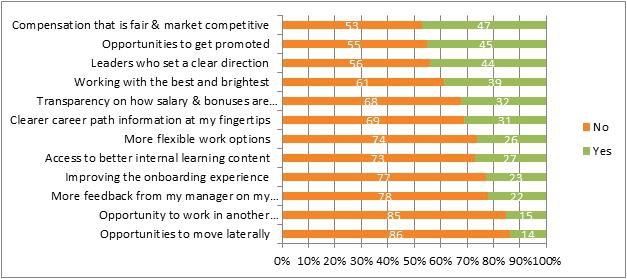
Wealth over career: While nearly all (97 per cent) employees reported that they want to be recognised and rewarded for contributions beyond the organisation’s financial results and activity metrics, just over half (51 per cent) think their company does this well. Furthermore, fair and competitive compensation ranked at the top when asked what would make a positive impact on their work situation. Yet, rewards were the least of priorities for HR leaders.
Gig is big: Flexible work arrangements are important to employees, with more than half reporting that both their direct manager and company leaders are supportive of it (61 per cent and 57 per cent, respectively). Nevertheless, 50 per cent of employees believe working remotely or part-time can adversely impact promotional opportunities. And while more than three-quarters (77 per cent) of full-time employees would consider working on a contingent or contract basis, neither business executives nor HR leaders have embraced these new forms of employment as much as expected or desired. Both the C-suite and HR leaders agree that they do not expect the “gig economy” to have a major impact on their business in the next two years.
A relevant experience: Beyond flexibility, personalisation is essential for creating an experience that resonates with employees. Less than half (49 per cent) of employees say that their company understands their unique interests and skills, while 53 per cent want their company to increase this understanding and help them invest in themselves.
Digital divide: Aspects of technology also show that HR is lagging expectations of both executive leadership and employees. Business executives (61 per cent) believe technology at work, including automation, robotics, machine learning, and wearables, is the workforce trend likely to have the most impact on their organisations in the next two years. Yet, less than half (49 per cent) of HR professionals agree. For employees, it is even more basic: just one in five organisations in Mercer’s study provide a digital experience for interacting with HR.
“Despite the desire to cling to more traditional methods, the landscape—for the workplace, the workforce, and the future of work—is changing too quickly and drastically to do so,” says Bravery. “To stay competitive, it is imperative that business executives and HR leaders collaborate and that organisations take new approaches to how employees access knowledge, adapt to technology, manage, communicate, and leverage their careers.”
Mercer’s 2017 Global Talent Trends Study, examines the top trends impacting today’s workforce and how organisations are responding and the study is based on the input of over 1,700 HR professionals, 5,400 employees, and 400 business executives from 37 countries and 20 industry sectors.