


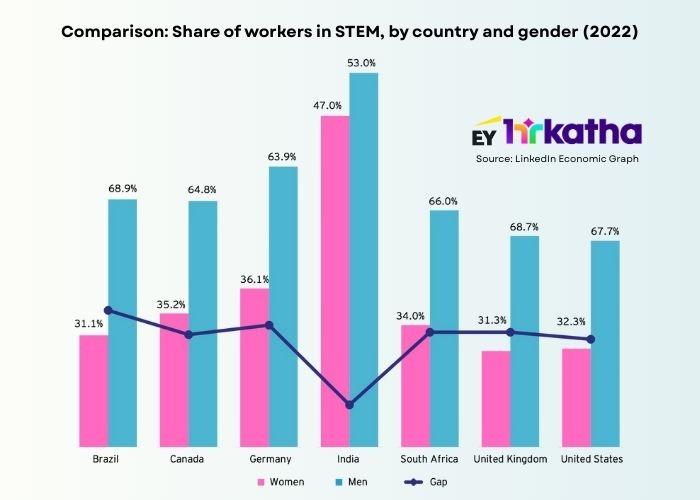
India produces more female science, technology, engineering and mathematics (STEM) graduates than Britain, Germany or France. Yet, few make it to the top. This contradiction reveals one of the country’s most expensive—and least acknowledged—economic failures.
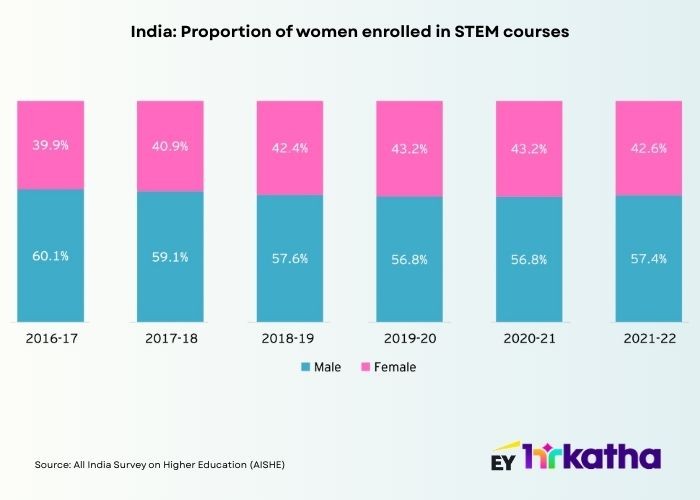
Women account for 42.6 per cent of India’s STEM graduates, well above the global average of 35 per cent and far ahead of most developed economies. Britain produces just 31 per cent, Germany 27.7 per cent and France 32 per cent. India churns out roughly 2.5 million STEM graduates every year, almost half of them women. On paper, it should possess the world’s deepest pipeline of female technical talent.
In practice, much of that promise evaporates after graduation.
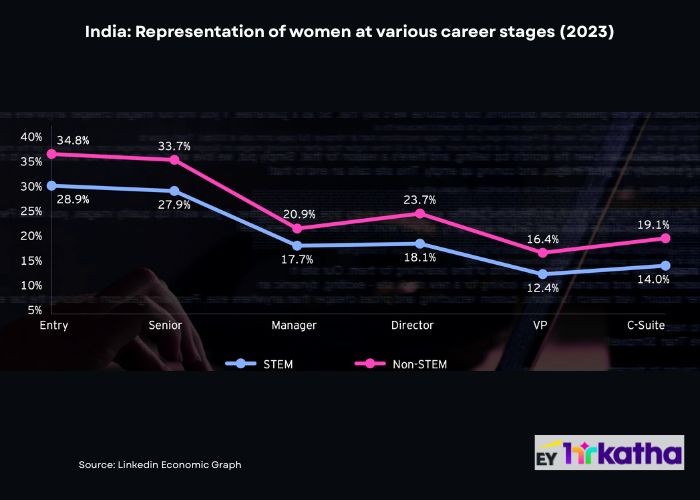
India begins well. The country has one of the smallest gender gaps in initial STEM employment globally. Women hold 28.9 per cent of entry-level STEM roles, only a modest distance behind men. But the attrition that follows is relentless. By the time careers reach the director level, women account for just 18.1 per cent of roles. At vice-president rank, the figure drops to 12.4 per cent. In the C-suite, it barely reaches 14 per cent.
This is not a story of individual choice alone. It is a story of systematic value destruction.
The arithmetic of waste
The World Economic Forum estimates that a global shortage of 85 million skilled workers by 2030 could erase $8.5 trillion from global GDP. Technology and engineering will bear the brunt. India, meanwhile, educates technical talent at scale but fails to deploy much of it over a full career.
The early years are misleadingly reassuring. India performs better than most developed economies at retaining women in STEM between graduation and first employment. Elsewhere, participation often halves before women even enter the workforce. India’s problem is not access but endurance.
Attrition occurs gradually—often a few percentage points each year—but compounds brutally over time. The result is a leadership pipeline that narrows precisely when experience should peak.
Non-STEM roles offer a revealing comparison. Women account for 34.8 per cent of India’s overall entry-level workforce and retain 19.1 per cent representation even at CEO level—higher than in STEM leadership. The implication is uncomfortable: something about STEM work cultures, rather than Indian corporate life broadly, accelerates exclusion.
The economics of exclusion
Three forces combine to thin the pipeline.
The first is educational filtering. Despite improvements in primary enrolment, secondary participation remains stuck at 65–70 per cent, far below levels in developed economies. This stage determines who studies STEM at all. Economic constraints, infrastructure gaps and social norms quietly remove candidates long before employers see them.
The second is household economics. Indian women spend 7.2 hours a day on unpaid domestic work, compared with 2.8 hours for men. This 4.4-hour daily gap creates a compounding opportunity cost across careers. A 2023 IBM study found nearly half of women would accept a 10 per cent pay cut for flexible schedules—an implicit tax on ambition that men rarely face.
Marriage and motherhood then act as a circuit breaker. Career breaks remain poorly supported, re-entry pathways weak, and caregiving expectations rigid. Biology becomes destiny not by necessity, but by institutional design.
Finally comes workplace architecture. Male-dominated leadership, bias in promotion, and thin mentoring networks create what economists would call negative network effects. Each departure raises the cost of staying for those who remain. Role models disappear just when they matter most.
Even in sectors where women dominate numerically, such as healthcare and education, STEM-specific leadership remains elusive. A female doctor faces better odds of advancement than a female biomedical engineer. The problem is not sectoral. It is structural.
Policy without power
India is not short of initiatives. Government schemes such as Vigyan Jyoti and the Pragati Scholarship have expanded access. Corporate programmes—from IBM and EY to Infosys Foundation and Dr Reddy’s—have invested heavily in outreach and mentoring. IBM’s STEM for Girls programme alone has reached 3,30,000 students across 12 states. Women’s labour-force participation has risen sharply since 2021, climbing from 32.8 per cent to 41.7 per cent by 2023-24.
Yet the gap between scale and impact remains stark. Despite hundreds of thousands of students touched by corporate programmes, leadership representation has barely budged—14 per cent in the C-suite, 12.4 per cent at vice-president level. Public spending on education remains stubbornly low at 4.1 per cent of GDP, well short of the 6 per cent target articulated repeatedly since 1968. For a country with a vast youth population, the shortfall is not marginal.
The deeper problem is that most interventions concentrate on entry rather than persistence. They help women start careers but do little to ensure they finish them with power.
A dam, not a leak
The popular metaphor of a ‘leaky pipeline’ understates the failure. This is not plumbing. It is architecture.
India has solved the first equation of development economics—educate at scale. It has not solved the second—convert education into productive leadership. The result is a dammed reservoir of human capital, pressure building behind cultural norms and institutional inertia.
Market forces alone will not resolve this quickly. Labour markets adjust slowly where social norms are entrenched. At current rates of change, gender parity in STEM leadership lies decades away.
India’s 42.6 per cent figure should not be celebrated. It should trouble policymakers and executives alike. It measures not success, but waste—of talent trained, ambition deferred and productivity unrealised.
Until education translates reliably into authority, India’s STEM story will remain one of promise postponed. In a world starved of technical skill, that is an indulgence the country can ill afford.