


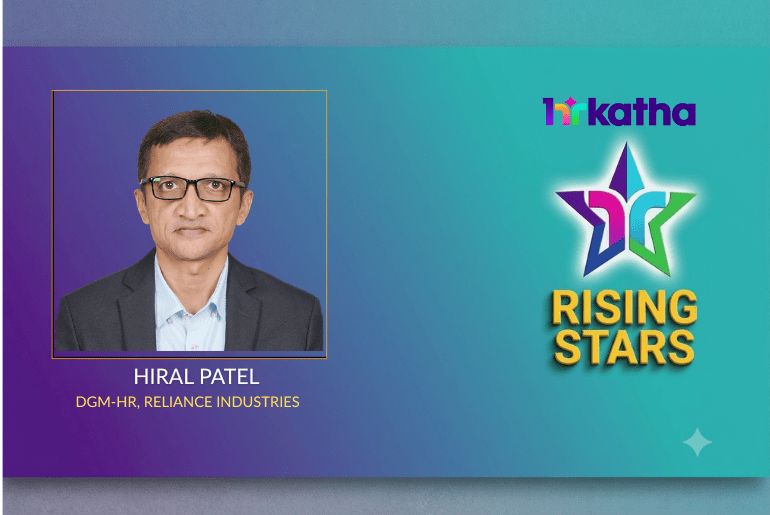
Finalist | HRKatha Rising Star Leadership Award 2025
Hiral Patel’s idea of relationship-building does not stop at the office door.
For him, understanding an employee can sometimes mean understanding something of the life surrounding the job: the family circumstances, pressures and aspirations that rarely appear in an HR system but inevitably travel to work with the person.
In some instances, that has included meeting employees’ families. Patel does not present this as an HR formula, but as part of his own relationship-led approach to the function. His larger point is that trust is difficult to build if HR knows employees only through transactions, performance conversations and workplace problems.
That philosophy has accompanied a career that moved from learning and development into core HR business partnering at Reliance Industries, taking Patel into manufacturing, a different stakeholder environment and a business he had to learn before he could credibly advise it.
Patel is a finalist for the HRKatha Rising Star Leadership Award 2025.
A new industry, familiar purpose
Patel’s transition was more than a change of HR specialism. Moving into manufacturing meant learning unfamiliar processes and systems while working with business leaders and employees whose expectations had been shaped by a very different operating environment.
His response was not to assume that what had worked before would work again.
He spent time understanding the business, listening to stakeholders and learning the context before deciding which parts of his previous experience remained useful. The lesson was less about acquiring another HR capability than recognising the limits of transferable answers. Experience travels; solutions do not always.
What remained constant was purpose. Whether working in learning and development or as an HR business partner, Patel saw the underlying task as enabling people to perform while helping the business address the human consequences of its decisions. That became his anchor while almost everything else around the role was changing.
Trust beyond the office
Patel does not see leadership as something conferred by title or tenure. He associates it more closely with listening, curiosity and relationships built deliberately over time, and with trying to understand problems before they become formal HR issues.
The family interactions are perhaps the most personal expression of this philosophy. Where appropriate, getting to know something about an employee’s circumstances beyond work has helped Patel understand the person behind the role. It is an approach that requires judgement and respect for personal boundaries, its value lying not in entering employees’ private lives but in avoiding the opposite mistake: assuming the employee who arrives at work can somehow be separated entirely from the person who exists outside it.
That understanding becomes particularly valuable when difficult conversations arrive. Trust built during ordinary moments can determine how candid people are willing to be when circumstances are less ordinary.
A business partner, not an HR partner
Patel has encountered business leaders who were sceptical about what HR could contribute. His response is not to defend the function. It is to understand the business better.
He describes his aspiration as being a business partner rather than merely an HR partner. In practice, that means using data and business insight to identify people problems that affect performance, then connecting talent, development and retention decisions to outcomes leaders already care about. A business leader may have little interest in the sophistication of an HR intervention. The more immediate question is whether it helps solve a problem: whether critical capability is available, good people are staying, a team can perform or the organisation is prepared for what comes next.
When interests diverge
The same principle becomes harder to apply when what employees want and what leadership wants are not easily reconciled. Patel begins with the organisation’s stated values and then looks for enough dialogue to understand what is driving each position. The objective is not to pretend that every disagreement can end with both sides getting what they want, but to make the eventual decision intelligible and defensible.
He applies a related philosophy to failure. Organisations that expect experimentation, he believes, have to distinguish between responsible failure and negligence. If every unsuccessful attempt carries a penalty, people quickly learn that avoiding risk is safer than trying something new.
Human and data-driven
Patel expects HR to become considerably more data-driven, but he does not see that as requiring the function to become less human. Analytics can help HR move beyond intuition, identify patterns earlier and test assumptions against evidence, and generative AI can extend that further by helping people functions interrogate information and support decisions more efficiently, provided data privacy and compliance are built into the architecture from the start rather than added after adoption.
More fundamentally, better data does not remove the need for judgement. An analytical system may reveal that a workforce pattern exists. It cannot fully explain the individual circumstances behind every data point or determine how a decision will affect trust.
Quick Takes
Conflict resolution style: Mediation.
Engagement driver, recognition or rewards: Both.
Feedback preference: Scheduled and structured.
Retention tool: Career growth.
If not HR: Singing and music.
Self-description: Proactive people manager, suave, genuine and empathetic.
Why he is a Rising Star
Patel’s approach holds an interesting tension: business proximity and data on one side, an unusually relationship-led view of employees on the other, one that asks HR to understand people beyond a role or a performance score. He doesn’t treat the two as competing. His move from learning and development into manufacturing HR required the same instinct twice over, resisting ready-made answers and understanding context before acting, whether that meant learning a new business or learning what sits behind an employee issue before responding to it.
Rising Stars is HRKatha’s editorial series profiling the next generation of HR leaders shaping the future of the profession. The series features winners and finalists of the HRKatha Rising Star Leadership Awards alongside emerging professionals whose work, ideas and leadership potential deserve wider recognition.
