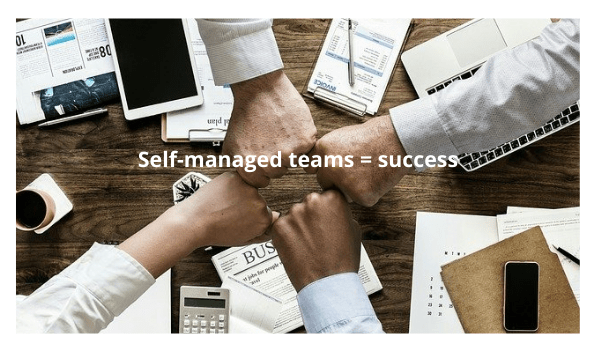
India continues to lurk in a stage where collective technical prowess in a team is a far-fetched idea. This can, however, be overcome. Self-managed teams can bring this change with adequate technology and application infrastructure. Less people, faster production is the idea.
Fun fact! Taco Bell, a major food chain now, on a global level, expanding everyday, was the noted pioneer of this. Back in the 1960s, when it faced an acute lack of people who could manage services as well as the work done by the lower-level trainees, it began training the on-ground employees to serve bigger expectations. Soon, the American fast-food chain was successful in creating a team that could actively manage the huge number of deliveries and take care of the supporting tasks, such as handling leaves and absences, looking after the workflow, allocating responsibilities, meeting deadlines and so on.
The BPOs will not be too successful with self-management because there are many people to connect and the maturity level is low.
Rajesh Balaji, CHRO, Matrimony.com
In this modern agile environment, we are in need of new ideas that will gear up the daily production operations and delivery services. Moreover, to conquer situations, such as the COVID-19 outbreak, we need a quick, hassle-free system, where even when the commute is eliminated and interpersonal contact is limited, the customer satisfaction and easy access are never put to halt. As Rajeev Singh, CHRO, ATG Tires, says, “This idea was a breakthrough in the 1990s. Now, it has been adapted into a time-bound, cross-functionally trained task force, often hired by separate organisations for a particular purpose.”
What exactly is a self-managed team?
A self-managed team is also known as a semi-autonomous team, natural team or self-organised team. The idea is to introduce a manager into a team of lower-level workers with less understanding of the business needs or the wider purpose, so to say, to provide the team members with the relevant tools and training, so that minimal interaction is needed in the future. Such teams require a thorough evolution of the leaders into resources, distributing roles and resources evenly, to bring the team closer to the wider purpose of the organisation.
As Amit Das, CHRO, Bennett Coleman & Company, correctly points out, “In such a setup, the leaders will shift their focus from supervising and managing, to leveraging the dynamic capability of the interconnected and collaborative employees, with the aligned and shared purpose of an engaged community.”
When he says, “People management should be less about extracting performance from the organised few, but more about curating contribution from limitless many,” we are reminded of a version of the idea of “Holacracy”, that Zappos came up with in 2012, where the entire team was supposed to present innovative ideas to design new products.
Empowerment and autonomy
Giving accountability, responsibility and decision-making powers to every member of the team, is what empowers the team. That is straight away democratisation. If one is looking to reinvigorate one’s work culture, where the levels of engagement and participation are significantly high, then this is the idea to be adopted. There are companies, such as Dynamic Events and Hubb, where the team members get to select their title when they are hired.
In self-managed setups, the leaders will shift their focus from supervising and managing, to leveraging the dynamic capability of the interconnected and collaborative employees, with the aligned and shared purpose of an engaged community.
Amit Das, CHRO, Bennett Coleman & Company
Rajeev Singh highlights the praise-worthy qualities, “These are more to bring about empowerment at the workplace, and to make the workplace more productive, engaged and connected. It is a management tool to encourage empowerment and collective decision making as a team. Joint ownership and joint accountability, is the idea. It becomes team responsibility.”
This is great for the new workforce because the younger generation wants to hunt down several opportunities at one time. They also have active access to social-networking tools, which equip them with prior crucial information regarding an organisation.
Das says,” In today’s knowledge-driven networked organisation ecosystem, where employees have ready access to enterprise social-networking tools, it is extremely important that we not only adopt an agile mindset, but more importantly, break free from legacy hierarchical structures and ways of working. The new-age workforce expects hyper personalised flexibility of work schedules, and prefers to work on multiple gig assignments in a flatter, project-based collaborative organisation structure, with freedom for experimentation within an entrepreneurial organisation culture.”
Who is in charge? Whom should we look up to for project completion?
“It is too early to have self-managed teams at this point of time. With so many changes taking place, this new change will be disastrous for the company. The change in skillsets is happening on a broader level. Self-managing remotely is the trend. In such an ecosystem, supervisors are already managing the workforce in ratios of 1:10, 1:15, 1: 20,” asserts Rajesh Balaji, CHRO, Matrimony.com.
Our society or education system adheres to an ecosystem that encourages individual success. In this kind of environment, the same traits reproduce themselves.
Rajeev Singh, CHRO, ATG Tires
In our society, where the educational setup is so individualistic in nature, where we cannot even think of dividing the rewards and benefits equally, this concept does not seem realistic anymore. Singh further adds to this limitation, saying, “Rewards philosophies are more individualistic. Right from LKG and UKG to postgraduation, it is all about individual results. Our society or education system adheres to an ecosystem that encourages individual success. In this kind of environment, the same traits reproduce themselves. It will have a limitation in recognising value and effective implementation across all parts of organisation, then.”
In fact, its feasibility largely depends on the nature of the work and the maturity level of the organisation. For instance, BPOs can never function under reduced supervision. They are not mature enough to assume roles organically and situationally. In a more mature organisation, on the other hand, such as in the technology development or software development sphere, everybody is a coder, an architect, a developer or a leader, right from the moment they enter the team. There is hardly any segregation, because each one is thoroughly informed about the technical tasks in hand. This indirectly means that these teams are highly task-specific or project-specific.
Balaji, resonates this idea when he says, “There are different natures of work. The BPOs will not be too successful with self-management because there are many people to connect and the maturity level is low. The ones who are managing to do so are ahead of the maturity curve. In technology development, for instance, agile methodology is used. The project manager is eliminated, and everybody is a worker there.”
Many people confuse this as a system that essentially eliminates the supervisor, but that is not the case. To introduce the teams to the technology and applications provided, the goals and the scope of the project, a manager becomes indispensable. Like Balaji states, “There is no adequate technology infrastructure or application infrastructure in place. Something will have to replace human beings. Metrics cannot talk. Somebody has to manage metrics to be taught, interpreted, made meaningful to manage teams.”
The constant need for assessment and re-alignment with the emerging business needs brings many hassles. “If there is an interdependency on something else, like for better production, then the team should be accountable and aligned with the wider purpose of the organisation,” suggests Singh.
While people expect such teams to come up with rockstar candidates multitasking 24×7, this surely will not be the case. Organisations following this pattern will also have mediocrity in store in equal levels. “If one is looking for a CEO to emerge from a self-managed team, it is too much to ask. They cannot be the bigshots or the future leaders. Ultimately, they have to go through the same rigour that every other team has gone through,” points out Singh.