



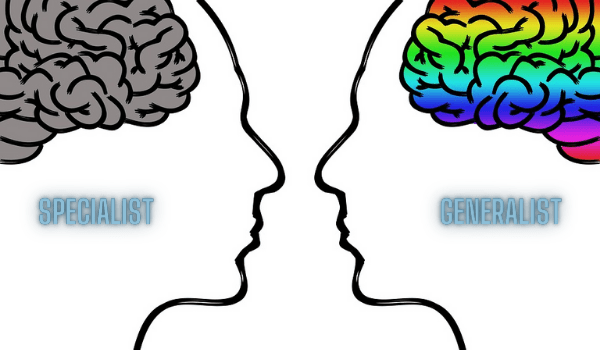
This question has led to endless debates. Not surprising, since both have their pros and cons. Specialists are experts in their fields, and well-versed with the tricks of the trade. Therefore, their experience can benefit startups immensely. In the case of generalists, however, they are jacks-of-all-trades — good at what they do while also in the know of other domains. Their biggest asset is that they can be stretched, moulded, nurtured and built to meet business goals. They are inquisitive and curious, which lends them the ability to think out of the box.
Startups are all about differentiation. Investors will look for startups that possess experience in the sector or are infused with entrepreneurial capabilities. The good part about having the right mix of generalists and specialists is that the former will push the envelope and ask ‘why not’, even when the experts are persistent in following a tried and tested path.

“If it’s an AI tech-based or SaaS-based company, it becomes essential to hire people with those specific capabilities. Certain staff functions, such as HR, generic marketing, and so on, can go for generalists at first and then bring in specialists at a later stage, depending upon the market and scale of the organisation. Today, there are cloud services for a few functions as well. Areas that are very critical to the business require specialists.”
Unmesh Pawar, advisor, KPMG India
From a startup’s perspective, who is a better hire?
It is difficult to say who would be a better choice, because each one brings along different qualities, skills and traits.
The debate begins!
Rishabh Gupta, SVP, and core team member, Khatabook, who in the past has also worked with few other startups such as Flipkart and Housing.com, is of the opinion that in the initial stage, for a startup, the most important thing is to understand the skill sets that the founding and core team brings to the table. In addition, there would be core capabilities that are absolutely essential for growth, and the team may not specialise in them. So, while functional expertise is very important, a winning candidate would have the expertise to handle more than one function. For instance, “A super-specialist in one area can be a generalist performer in other functions. Such people are of tremendous value in the early stages of a startup’s journey, when one has a very lean team to work with,” Gupta opines.
He also points out that in a start-up culture, most people are likely to pick up the skills of a generalist since the various departments in an organisation do not work in silos. Start-up culture provides freedom to individuals to figure out career paths, including if they would like to opt for super-specialised roles or acquire general skills and get into generalist roles. Also, as individuals grow in their careers, they are likely to pick up generalist capabilities to become good people managers.
“Irrespective of whether it is the initial stage or not, there is a product being made, marketed and sold. Once the life cycle of the product begins, there are many activities to be done. If I only have specialists, some of the activities will not get done because we haven’t scaled up. Such a situation will not emerge with generalists, because they can perform multiple tasks. The moment the product is developed, one will need various functions and that is when the need for specialists will arise.”
Sriram V, CHRO, BankBazaar.com
“At Khatabook, the engineering team members profoundly understand the product development function. Engineers have the flexibility to work with the product team and get involved in that function as thoroughly as they would like to. And that, we have noticed, has become a very motivating aspect of the work culture at Khatabook,” Gupta says.
It’s all about the team size
Interestingly, Sriram V, CHRO, BankBazaar.com, has a slightly different outlook on the topic. He believes that in the initial stages generalists are required to take up multiple responsibilities. For him, the growing size of an organisation’s team decides whether it needs more specialists or generalists. “Irrespective of whether it is the initial stage or not, there is a product being made, marketed and sold. Once the life cycle of the product begins, there are many activities to be done. If I only have specialists, some of the activities will not get done because we haven’t scaled up. Such a situation will not emerge with generalists, because they can perform multiple tasks. The moment the product is developed, one will need various functions and that is when the need for specialists will arise,” he points out.
“At Khatabook, the engineering team members profoundly understand the product development function. Engineers have the flexibility to work with the product team and get involved in that function as thoroughly as they would like to. And that, we have noticed, has become a very motivating aspect of the work culture at Khatabook.”
Rishabh Gupta, SVP, and core team member, Khatabook
Citing the example of the HR department, he explains that till the team size reaches 50, one doesn’t need an HR function really. It is the CEO who gets the first crew of people, who have full trust in him. However, the moment the team crosses the 50 mark, based on the company’s growth strategy, one needs to decide who else to get, and only recruiters can help at this juncture. When the size goes beyond 150 and inches towards 200, investment in a senior HR person or lead, who has seen it all, becomes essential.
As one starts moving forward, one needs to have people who can bring in depth. In the early stages, it is, therefore, advisable to make do with generalists. However, moving forward, when the need for certain specific capabilities emerges, one can hire specialists. Also, certain functions require specialisations. “If it’s an AI tech-based or SaaS-based company, it becomes essential to hire people with those specific capabilities. Certain staff functions, such as HR, generic marketing, and so on, can go for generalists at first and then bring in specialists at a later stage, depending upon the market and scale of the organisation. Today, there are cloud services for a few functions as well. Areas that are very critical to the business require specialists,” Unmesh Pawar, advisor, KPMG India opines.
“In my own experience, even large consulting firms, that have in the past approached top business schools and hired MBA graduates in dozens, are hiring specialists today — not only in the technical areas but also in diverse areas, such as arts, history and others. A traditional approach to finding solutions to business problems now needs a lot of creativity. I would any day prefer to go with specialists,”
Anand Talwar, former CHRO, ITC Infotech and HR consultant
Anand Talwar, former CHRO, ITC Infotech and HR consultant, however, reasons that specialists are in more demand, because there is so much competition in the world that, as an organisation, one needs to create those differentiators. Startups have to compete with large majors in the market. Therefore, they need to come up with unique differentiators and specialisations. “In my own experience, even large consulting firms, that have in the past approached top business schools and hired MBA graduates in dozens, are hiring specialists today — not only in the technical areas but also in diverse areas, such as arts, history and others. A traditional approach to finding solutions to business problems now needs a lot of creativity. I would any day prefer to go with specialists,” Talwar asserts.
The ideal mix
Now the question is, once the team is set, what should be the ratio of specialists to generalists? It is clearly established that there needs to be a balance in the workforce but what is an ideal percentage?
Gupta believes it isn’t easy to define specialists and generalists in percentage terms as this is difficult to quantify. “Often, people are hired in specialist roles, but we allow them to figure out what other responsibilities or skill sets they are up for and let them work with the respective functional teams. In a start-up culture, most people are likely to pick up the skills of a generalist since the departments or people do not work silos in an organisation,” he points out.
