



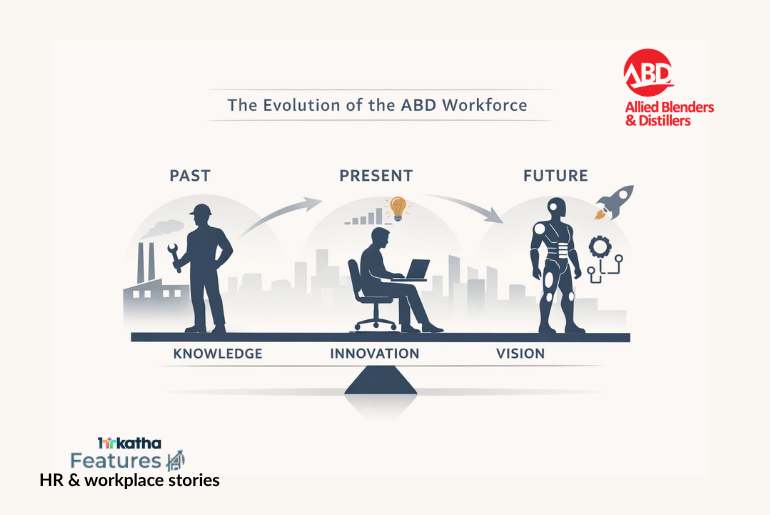
When Allied Blenders & Distillers (ABD) became a listed company in 2024, it marked more than a financial milestone. It also signalled the beginning of a new phase for the organisation—one that required different capabilities, faster decision-making and a workforce equipped to navigate an increasingly complex business environment.
At the same time, the alco-bev company deepened its premiumisation journey, expanding beyond mass-market offerings and strengthening its premium portfolio. Technology, analytics and governance were becoming increasingly important, while expectations from investors and stakeholders were also changing.
For many organisations undergoing such transformation, ‘workforce dynamics’ becomes a natural area of focus. New business priorities often require new skills, new ways of working and, in some cases, a different mix of talent.
Yet, according to Ralin Gomes, CHRO, Allied Blenders & Distillers, the company’s approach was never centred on hiring people based on age. “We’ve never looked at talent through the age lens,” he explains. “It’s always about having the right person in the right place doing the right job.”
However, as the business evolved, the profile of talent entering the organisation also began to change. The capabilities the company increasingly needed—particularly around technology adoption and analytics—often happened to be found among younger professionals.
“We’ve never looked at talent through the age lens. It’s always about having the right person in the right place doing the right job.”
Ralin Gomes, CHRO, Allied Blenders & Distillers

The challenge, therefore, was not about replacing one generation with another. It was about ensuring the organisation could build new capabilities while preserving the knowledge and relationships that had helped it grow over decades.
Where generational differences became visible
Unlike many industries where technology adoption creates visible divides across the workforce, Gomes believes the most noticeable differences at ABD emerged at leadership levels rather than on the shop floor or among frontline teams.
The nature of the alco-beverage industry plays a significant role in this.
Business success depends heavily on relationships built over years with distributors, trade partners and state authorities. Trust is a critical currency in the sector, and much of that trust is built through long-term engagement and experience.
As a result, decision-making often draws upon years of accumulated knowledge and market understanding.
At the same time, changing business realities are placing greater emphasis on analytics, technology-enabled insights and data-backed decision-making.
This is where different perspectives tend to surface.
According to Gomes, leadership discussions often involve balancing experience-driven judgment with data-driven approaches. While frontline roles remain largely execution-focused, strategic decisions increasingly require organisations to blend both viewpoints.
Rather than treating this as a conflict, ABD has sought to create a balance. The organisation today includes a mix of experienced industry professionals, younger employees and talent drawn from both alco-beverage and non-alco-beverage backgrounds.
This diversity, Gomes believes, strengthens decision-making by bringing multiple perspectives to the table.
The bigger challenge was not integration
While organisations across sectors often focus on integrating younger employees into established cultures, Gomes says integration itself has not emerged as a significant challenge for ABD.
The company’s existing culture has played an important role in this.
According to him, long-serving employees have generally been quick to absorb newcomers, regardless of age. The culture is collaborative and inclusive, making it easier for employees to settle into the organisation.
Instead, the more pressing challenge has been managing changing workforce expectations.
Retention of younger employees, Gomes notes, is a challenge being faced across industries rather than one unique to ABD. Younger professionals today are looking for continuous learning opportunities, faster growth, greater flexibility and a clearer sense of purpose in their work.
Meeting those expectations requires organisations to rethink many traditional practices.
For ABD, this meant revisiting several long-standing systems and policies.
Rethinking performance management and recognition
One area that required change was performance management.
Traditional annual appraisal cycles no longer aligned with what many younger employees expected from the workplace. Employees increasingly sought regular conversations, ongoing feedback and quicker visibility into their development.
As a result, the organisation began adapting its performance-management approach to enable more frequent feedback rather than relying solely on year-end discussions.
Recognition practices also underwent change.
Historically, recognition in many organisations has been concentrated around annual events and award ceremonies. However, Gomes points out that younger employees often prefer immediate acknowledgement of their contributions rather than waiting for a yearly cycle.
To address this, ABD expanded recognition beyond annual events and introduced more frequent formats, including monthly, quarterly and team-based recognition initiatives, particularly across its sales workforce.
The objective was to create faster and more visible appreciation mechanisms that aligned better with evolving employee expectations.
Flexibility became a business requirement
Workplace flexibility represented another area where the organisation had to adapt.
Interestingly, while many organisations have been moving away from remote work arrangements, ABD chose to reintroduce work-from-home provisions after recognising the importance younger employees placed on flexibility.
The company also introduced greater flexibility around working hours, allowing employees some leeway in managing their schedules.
These changes were not simply policy revisions. They reflected a broader recognition that workforce expectations have evolved and organisations need to respond accordingly if they wish to remain competitive in attracting and retaining talent.
According to Gomes, several such policy and process changes have been implemented over time as the company continues to adapt to workforce realities.
Challenging the perception of a legacy organisation
One interesting insight from Gomes is that younger employees often arrive with preconceived notions about what working in a nearly 40-year-old organisation may be like.
Many expect traditional structures, slower decision-making and limited opportunities for innovation.
However, their experience after joining often differs significantly from those assumptions.
Gomes points to several examples that challenge the perception of ABD as a conventional legacy company.
The company’s Iconiq brand was launched in the Metaverse in 2023, an initiative that reflected its willingness to experiment with emerging technologies and digital platforms. The organisation has also adopted AI-led marketing initiatives and established the ABD Maestro team, which Gomes describes as a young entrepreneurial group operating within a mature organisation.
As a result, newer employees often discover that the organisation’s internal mindset is far more progressive than they initially anticipated.
According to Gomes, it is often the younger employees who are surprised by the company’s forward-looking approach rather than the organisation being surprised by younger talent.
Protecting knowledge while bringing in new ideas
As new talent enters the organisation, another challenge naturally emerges: how to preserve institutional knowledge while simultaneously encouraging innovation.
For ABD, this issue is particularly important because much of the company’s expertise has been built over years of operating in a highly relationship-driven and regulated industry.
Understanding routes to market, regulatory frameworks and stakeholder relationships often takes considerable time to develop.
To address this, the organisation has focused heavily on succession planning.
Identifying future successors and enabling knowledge transfer between experienced leaders and emerging talent has become an important part of workforce planning.
Mentoring plays a key role in this process, helping younger employees learn from those who have spent years navigating the industry’s complexities.
At the same time, the company continues to bring in talent from adjacent sectors such as FMCG, FMCD and telecom.
These hires introduce fresh perspectives and ideas that may not naturally emerge from within the industry.
Together, these two approaches allow ABD to balance continuity with innovation.
Building leaders internally rather than buying externally
One of the most significant workforce priorities for ABD today is leadership capability building.
While many organisations have introduced initiatives such as reverse mentoring and cross-generational teams, Gomes believes long-term success depends on strengthening leadership pipelines.
The alco-beverage industry presents unique challenges that cannot always be addressed through external hiring.
Understanding the nuances of the business, route-to-market structures and industry regulations requires time and experience. As a result, continuously hiring leaders from outside may not always be effective.
The company has, therefore, placed greater emphasis on developing leaders internally.
This includes structured learning opportunities for managers as well as leadership-development initiatives designed to prepare employees for larger responsibilities.
ABD has also partnered with a globally-recognised e-learning platform to support manager development.
In addition, employees stepping into managerial roles for the first time undergo a dedicated first-time leadership programme. The programme focuses on people management and leadership fundamentals, helping managers understand how to lead increasingly diverse teams.
According to Gomes, one of the key learnings managers need today is that approaches that worked for previous generations may not necessarily work for younger employees.
Employees increasingly want context, explanations and clarity around decisions rather than simply being instructed on what needs to be done.
Preparing managers for this shift has become an important part of the organisation’s talent strategy.
Measuring whether the approach is working
Like many workforce initiatives, generational integration can be difficult to measure directly.
ABD, therefore, relies on a combination of indicators to assess progress.
Employee-engagement surveys provide one important measure. The organisation analyses engagement scores across different age groups and functions to understand how various segments of the workforce are experiencing the workplace.
Attrition data also serves as a critical indicator. By examining attrition through the lens of age and tenure, the company can identify patterns that may signal integration or retention challenges.
In addition, ABD tracks internal mobility as a leading indicator of workforce development and career progression.
Together, these metrics help the organisation evaluate whether its efforts to build a workforce that combines fresh capabilities with long-standing expertise are delivering the desired outcomes.
For ABD, the workforce transition underway is not about choosing between experience and new perspectives. It is about ensuring the organisation has the capabilities needed for its next phase of growth while retaining the knowledge and relationships that have been built over decades. As the company continues to evolve as a listed, premium-focused business, that balancing act remains central to its people strategy.