
Close Menu
    Facebook X (Twitter) Instagram
    • Our Story
    • Partner with us
    • Reach Us
    • Career
    Subscribe Newsletter
    HR KathaHR Katha
    • Exclusive
      • Exclusive Features
      • Perspectives
      • Friday Features
      • herSTORY
      • Rising Stars
      • Case-In-Point
      • Point Of View
      • Research
      • HR Pops
      • Dialogue
      • Movement
      • Profile
      • Beyond Work
      • By Invitation
    • Brief News
      • Global HR News
      • Compensation & Benefits
      • Diversity
      • Events
      • Gen Y
      • Hiring & Firing
      • HR & Labour Laws
      • Learning & Development
      • Merger & Acquisition
      • Performance Management & Productivity
      • Talent Management
      • Tools & Technology
      • Work-Life Balance
    • Special
      • Editorial
      • HR Forecast 2026
      • Cover Story
      • HR Forecast 2024
      • HR Forecast 2023
      • HR Forecast 2022
      • HR Forecast 2021
      • HR Forecast 2020
      • HR Forecast 2019
      • New Age Learning
      • Coaching and Training
      • Learn-Engage-Transform
    • Studio
      • The CHRO Playbook
      • Quick HR Insights
      • The Corner Office
    • Reports
      • Whitepaper
        • HR Forecast 2024 e-mag
        • Future-proofing Manufacturing Through Digital Transformation
        • Employee Healthcare & Wellness Benefits: A Guide for Indian MSMEs
        • Build a Future Ready Organisation For The Road Ahead
        • Employee Experience Strategy
        • HRKatha 2019 Forecast
        • Decoding and Driving Employee Engagement
        • One Platform, Infinite Possibilities
      • Survey Reports
        • Happiness at Work
        • Upskilling for Jobs of the Future
        • The Labour Code 2020
    • Forums
      • HRKatha Inner Circle
      • HRKatha Futurecast
      • Leadership Summit 2025
      • Rising Star Leadership Awards
      • HRKatha Futurecast 2025
      • Automation.NXT
      • The Great HR Debate
    WhatsApp LinkedIn X (Twitter) Facebook Instagram
    HR KathaHR Katha
    Home»Exclusive Features»Firing over feedback: Yes Madam’s ethical collapse
    Exclusive Features

    Firing over feedback: Yes Madam’s ethical collapse

    Breaching trust and weaponising feedback, Yes Madam’s actions highlight the perils of prioritising short-term efficiency over long-term ethics
    mmBy Radhika Sharma | HRKathaDecember 10, 2024Updated:December 10, 20244 Mins Read29037 Views
    Share LinkedIn Twitter Facebook WhatsApp
    Yes Madam
    Share
    LinkedIn Twitter Facebook WhatsApp

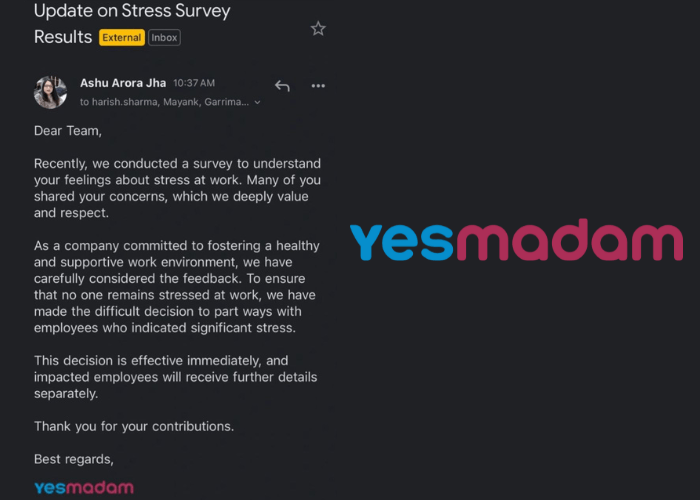
    The internet was abuzz on Monday with a story as shocking as it was bizarre. Yes Madam, a salon-at-home startup founded in 2016, allegedly fired over a hundred employees after they reported feeling stressed in a company-conducted survey designed to gauge workplace well-being. Rather than addressing the underlying causes of stress, the company reportedly weaponised the survey responses to single out employees deemed ‘problematic’.

    Yes Madam, which competes with Urban Company and others in the home-service sector, had previously secured funding from high-profile investors on Shark Tank India. However, this incident highlights the ethical pitfalls that even innovative startups can stumble into when governance and empathy are absent.

    Employee surveys are meant to identify organisational stressors and improve workplace conditions, not to punish honesty. Confidentiality is their cornerstone, fostering an environment where employees feel safe to share feedback. Breaching this trust not only undermines the survey’s purpose but sets a dangerous precedent.

    “Many startups lack the processes needed to uphold ethical norms. Firing employees based on a stress survey not only violates these norms but showcases a lack of understanding of how to build a sustainable enterprise.”

    Nihar Ghosh, senior HR leader

    Praveer Priyadarshi, a senior HR leader, condemns the company’s actions: “The first principle of any survey is ensuring confidentiality and using feedback for corrective actions, not retaliation.”

    Instead of fostering a culture of improvement, Yes Madam turned feedback into a weapon. Employees who were honest about their stress levels found themselves out of a job, a decision that damages morale and undermines trust within the organisation.

    Startups often operate in fast-paced, high-pressure environments, but that does not excuse unethical practices. Governance structures are essential for holding leadership accountable and ensuring decisions align with organisational values. Unfortunately, startups like Yes Madam frequently lack the maturity to uphold these standards.

    “Many startups lack the processes needed to uphold ethical norms,” says Nihar Ghosh, another senior HR leader. “Firing employees based on a stress survey not only violates these norms but showcases a lack of understanding of how to build a sustainable enterprise,” he adds.

    “The first principle of any survey is ensuring confidentiality and using feedback for corrective actions, not retaliation.”

    Praveer Priyadarshi,  senior HR leader

    Without robust governance, even well-meaning initiatives can spiral into reckless decisions. The Yes Madam case illustrates how an absence of oversight can transform a potentially positive exercise—gathering feedback—into an unethical act that harms employees and damages the organisation’s reputation.

    Firing employees for reporting stress is both shortsighted and counterproductive. Stress is often a symptom of systemic issues, such as poor management, excessive workloads, or inadequate resources. Instead of addressing these root causes, Yes Madam chose a path that perpetuates the problem.

    “Any organisation worth its salt should use feedback to identify and address workplace stressors rather than penalise employees for speaking out.”

    Ramesh Shankar S, a seasoned HR leader

    “Any organisation worth its salt should use feedback to identify and address workplace stressors rather than penalise employees for speaking out,” argues Ramesh Shankar S, a seasoned HR leader.

    By ignoring the systemic issues that contribute to stress, the company risks a ripple effect among the remaining workforce. Employees may feel insecure, leading to higher attrition, reduced morale, and a toxic workplace culture.

    Leadership maturity is crucial in navigating feedback and implementing solutions. Yes Madam’s approach reflects a retaliatory culture rather than one focused on improvement. Surveys are tools for growth, not instruments of punishment.

    “This decision is blasphemous and unbecoming of HR and management,” says Shankar. “It highlights an immature understanding of how to manage human capital effectively.”

    Such actions not only hurt employee morale internally but also tarnish the company’s external reputation. Potential recruits may view Yes Madam as a hostile employer, making it harder to attract top talent.

    The Yes Madam incident serves as a stark warning for startups and established companies alike. Ethical lapses, particularly those involving employees’ well-being, can have long-term consequences on trust, reputation, and business sustainability.

    “The very act of firing individuals who trusted the company with sensitive information contradicts the purpose of employee surveys,” Ghosh points out. Organisations must recognise that their success is tied to their people.

    Surveys should be tools for identifying problems and fostering improvement, not punitive measures. Priyadarshi stresses this point: “This decision demonstrates a fundamental misunderstanding of effective people-management practices. Ethical leadership involves more than compliance—it requires a commitment to employee welfare.”

    To prevent such missteps, companies must adopt governance frameworks that ensure transparency, accountability, and ethical decision-making. Addressing systemic issues, investing in leadership maturity, and fostering a culture of trust are essential steps toward building resilient and thriving workplaces.

    Ultimately, success lies in embracing empathy and ethics as core principles. Anything less is not only unsustainable but also a betrayal of the very people who drive an organisation forward.

    Employee Employee happiness Employee survey employee wellbeing employer Feedback firing over feedback Human Resources LEAD stress management well-being Workforce Workplace Yes Madam
    Share. LinkedIn Twitter Facebook WhatsApp
    mm
    Radhika Sharma | HRKatha

    Radhika is a commerce graduate with a curious mind and an adaptable spirit. A quick learner by nature, she thrives on exploring new ideas and embracing challenges. When she’s not chasing the latest news or trends, you’ll likely find her lost in a book or discovering a new favourite at her go-to Asian eatery. She also have a soft spot for Asian dramas—they’re her perfect escape after a busy day.

    Leave A Reply Cancel Reply

    Related Posts

    Pacific Inter-Link appoints Kiran Dhillon as CHRO

    October 21, 2026

    India’s tech professionals have already decided before you call them

    October 21, 2026

    HR Perspectives by Prabir Jha: “Psychological safety is talked about more from the pulpit than practised in the trenches”

    October 21, 2026

    PayU gets Megha Mahesh as director-talent and culture

    October 21, 2026
    zoha
    Editorial

    Can India become a skills-first economy while remaining a collar-conscious society?

    Consider two employees beginning their careers. One joins a technology company as a junior analyst.…

    HR’s credibility is tested after the complaint is filed

    The video of what appears to be a meeting between employees and Genpact’s employee relations…

    EDITOR'S PICKS

    India’s tech professionals have already decided before you call them

    October 21, 2026

    HR Perspectives by Prabir Jha: “Psychological safety is talked about more from the pulpit than practised in the trenches”

    October 21, 2026

    POV: Are annual performance reviews still relevant in the age of continuous feedback?

    October 19, 2026

    Can India become a skills-first economy while remaining a collar-conscious society?

    October 18, 2026
    Latest Post

    Pacific Inter-Link appoints Kiran Dhillon as CHRO

    Movement October 21, 2026

    Pacific Inter-Link (PIL), a Malaysia-based international business group with interests in edible oils, consumer goods,…

    India’s tech professionals have already decided before you call them

    Research October 21, 2026

    The careers page was designed to present an employer on its own terms. But candidates…

    HR Perspectives by Prabir Jha: “Psychological safety is talked about more from the pulpit than practised in the trenches”

    Perspectives October 21, 2026

    Organisations have become increasingly fluent in the language of culture, inclusion and psychological safety. Whether…

    PayU gets Megha Mahesh as director-talent and culture

    Movement October 21, 2026

    Megha Mahesh has joined PayU as director-talent and culture after spending over two years as…

    Asia's No.1 HR Platform

    Facebook X (Twitter) Instagram LinkedIn WhatsApp Bluesky
    • Our Story
    • Partner with us
    • Career
    • Reach Us
    • Exclusive Features
    • Cover Story
    • Editorial
    • Dive into the Future of Work: Download HRForecast 2024 Now!
    © 2026 HRKatha.com
    • Disclaimer
    • Refunds & Cancellation Policy
    • Terms of Service

    Type above and press Enter to search. Press Esc to cancel.