


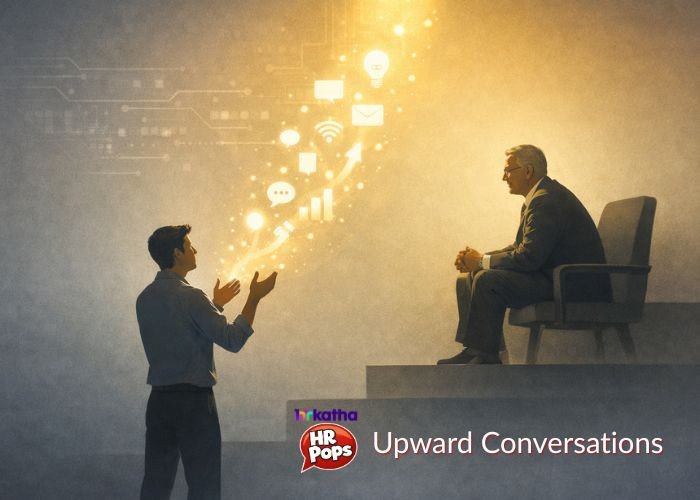
What is the meaning of ‘upward conversations’?
For decades, knowledge in organisations flowed from top to bottom.
Experience was presumed to mean expertise because, for much of the industrial era, the world changed slowly. Business models evolved gradually, technologies remained stable for long periods, and managerial wisdom accumulated over time. Seniority therefore carried authority almost automatically.
A leader with 25 years of experience in 1985 had largely worked within the same economic and technological logic that existed in 1965.
That assumption no longer holds.
Compare the world of the early 2000s with that of the 2020s. In barely two decades, technology has transformed communication, commerce, media, work, and even human behaviour itself. Entire industries have emerged, disappeared, or reinvented themselves.
In such a world, experience still matters, but it is no longer sufficient.
Younger employees often understand digital behaviour, emerging technologies, online culture, and shifting workforce expectations more intuitively than senior leaders responsible for managing them. Expertise now moves in multiple directions.
This is the context in which organisations began embracing what later became known as “reverse mentoring” — a workplace practice where younger or less senior employees mentor older or more experienced colleagues.
But the idea today is larger than mentoring.
It reflects the rise of upward conversations – the growing recognition that insight, relevance, and learning can no longer flow in only one direction.
Initially associated with technology and digital literacy, the concept has since expanded into areas such as workplace culture, diversity, leadership behaviour, and generational expectations.
Where did the idea come from?
The concept gained prominence in the late 1990s when Jack Welch introduced reverse mentoring at General Electric.
At the time, many senior executives lacked familiarity with the internet and digital tools reshaping business. Younger employees understood them instinctively. Pairing junior staff with senior leaders was less about progressive culture and more about strategic necessity.
Over time, the idea evolved beyond technology to bridge generational gaps, strengthen inclusion, and keep leadership connected to changing employee expectations.
Its appeal lay in the fact that it challenged a deeply embedded assumption: that expertise always sits higher in the hierarchy.
Why is it relevant for HR?
Upward conversations have become increasingly relevant because today’s workplace is more multi-generational, digital, and culturally fluid than ever before.
Baby Boomers and early Gen X leaders largely built careers in structured, hierarchical organisations. Gen Z employees often enter the workplace with very different assumptions around flexibility, communication, authority, wellbeing, and purpose.
The challenge for HR is creating environments where those perspectives can surface constructively rather than collide silently.
When younger employees question rigid workplace structures, outdated communication styles, or performative flexibility policies, they are often signalling shifts that leadership has not yet fully recognised.
That makes upward conversations strategically important.
For HR, they help leaders stay connected to digital trends and changing employee expectations. They strengthen inclusion by giving younger or underrepresented employees greater voice and visibility. They can also improve engagement by making junior employees feel heard rather than merely managed.
When Gen Z employees point out that mandatory office mandates contradict an organisation’s stated commitment to flexibility, that is upward learning at its most useful — and often its most uncomfortable.
The uncomfortable reality
Many organisations claim to encourage upward conversations whilst carefully controlling them.
Executives are generally willing to learn about social media trends, collaboration tools, or Gen Z preferences. These are useful but relatively safe discussions.
The dynamic changes when the conversation moves beyond technology and into power, culture, or leadership behaviour.
A junior employee explaining digital trends is welcomed. A junior employee explaining why leadership feels disconnected or why workplace policies feel performative is harder to accommodate.
This is the contradiction at the centre of many workplace listening initiatives. Organisations promote upward learning whilst maintaining downward control.
Junior employees are encouraged to “speak openly” to leaders who still influence their careers and progression. Unsurprisingly, many moderate what they say. Conversations become polite rather than fully candid.
As a result, upward dialogue sometimes becomes symbolic – evidence that leadership is listening, even if little actually changes.
What makes it work?
For upward conversations to work meaningfully, organisations must tolerate a degree of discomfort.
Senior leaders must be willing to hear perspectives that challenge their assumptions, not merely reinforce their curiosity. HR must create enough psychological safety for junior employees to speak honestly without fearing professional consequences.
Most importantly, the conversations must lead to visible action. Employees quickly recognise whether leadership is truly listening or simply performing openness.
The takeaway
The rise of upward conversations reflects a fundamental shift in modern work: knowledge, insight, and cultural awareness are no longer tied neatly to seniority.
But the idea also exposes a tension many organisations struggle to resolve. Companies increasingly want the appearance of openness and adaptability. They are often less comfortable with the implications of genuinely sharing influence.
For HR, the challenge is ensuring that upward conversations become more than symbolic modernity.
Because if employees are invited to speak upward but not challenge upward, the hierarchy has not really changed.
Organisations may now invite upward conversations. The real test is whether they are prepared to be changed by them.