


Close Menu
    Facebook X (Twitter) Instagram
    • Our Story
    • Partner with us
    • Reach Us
    • Career
    Subscribe Newsletter
    HR KathaHR Katha
    • Exclusive
      • Exclusive Features
      • Perspectives
      • Friday Features
      • herSTORY
      • Case-In-Point
      • Point Of View
      • Research
      • HR Pops
      • Dialogue
      • Movement
      • Profile
      • Beyond Work
      • Rising Star
      • By Invitation
    • News
      • Global HR News
      • Compensation & Benefits
      • Diversity
      • Events
      • Gen Y
      • Hiring & Firing
      • HR & Labour Laws
      • Learning & Development
      • Merger & Acquisition
      • Performance Management & Productivity
      • Talent Management
      • Tools & Technology
      • Work-Life Balance
    • Special
      • HR Forecast 2026
      • Cover Story
      • Editorial
      • HR Forecast 2024
      • HR Forecast 2023
      • HR Forecast 2022
      • HR Forecast 2021
      • HR Forecast 2020
      • HR Forecast 2019
      • New Age Learning
      • Coaching and Training
      • Learn-Engage-Transform
    • Magazine
    • Reports
      • Whitepaper
        • HR Forecast 2024 e-mag
        • Future-proofing Manufacturing Through Digital Transformation
        • Employee Healthcare & Wellness Benefits: A Guide for Indian MSMEs
        • Build a Future Ready Organisation For The Road Ahead
        • Employee Experience Strategy
        • HRKatha 2019 Forecast
        • Decoding and Driving Employee Engagement
        • One Platform, Infinite Possibilities
      • Survey Reports
        • Happiness at Work
        • Upskilling for Jobs of the Future
        • The Labour Code 2020
    • Conferences
      • Leadership Summit 2025
      • Rising Star Leadership Awards
      • HRKatha Futurecast
      • Automation.NXT
      • The Great HR Debate
    • HR Jobs
    WhatsApp LinkedIn X (Twitter) Facebook Instagram
    HR KathaHR Katha
    Home»Exclusive Features»Research»The $9.6 trillion shrug
    Research

    The $9.6 trillion shrug

    Why people with jobs worry about work almost as much as people without them
    mmBy Dr. Prajjal Saha | HRKathaJuly 15, 2026Updated:July 15, 20264 Mins Read336 Views
    Share LinkedIn Twitter Facebook WhatsApp
    Gallup_Having job doesn't stop worries abo
    Share
    LinkedIn Twitter Facebook WhatsApp

    Ask more than 1,40,000 people across 107 countries what troubles them most about their nation, and work emerges as one of the world’s defining anxieties. A median of 10 per cent name work-related issues as their country’s biggest problem, second only to the economy. The headline number is unsurprising. What sits beneath it is not.

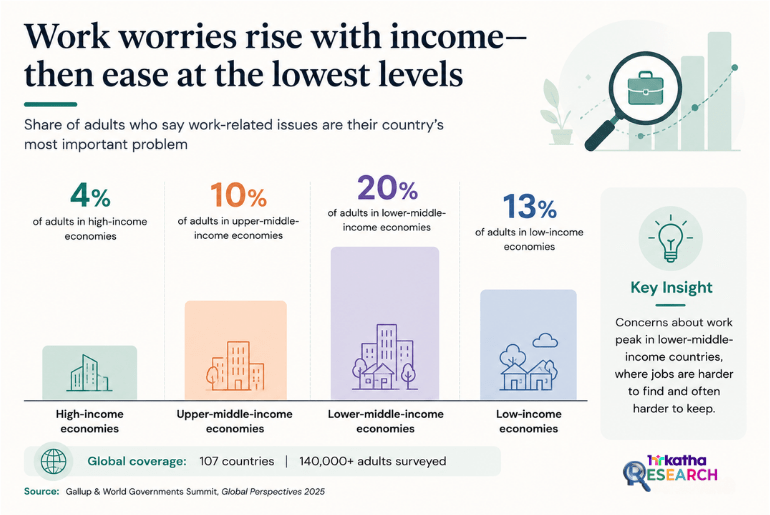
    The broad patterns behave as expected. Countries with higher unemployment produce more citizens who call work their nation’s chief problem: South Africa, where joblessness tops 30 per cent, leads the rankings, alongside Lesotho and Gabon. The relationship is real, if not tight (r=0.49). Income tells a more textured story. Just 4 per cent of adults in high-income economies name work as the top issue. That climbs to 10 per cent in upper-middle-income countries and 20 per cent in lower-middle-income ones, before easing back to 13 per cent among the poorest nations, where hunger and shelter crowd work out of the conversation entirely.
    Hidden cost of disengagement_Gallup Study on world's most important problems

    At the national level, the numbers track intuition. At the individual level, they stop doing so.
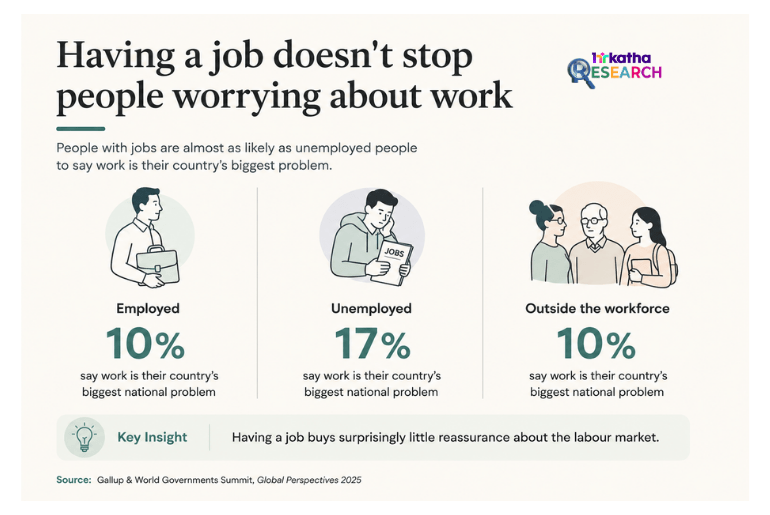
    Among the unemployed, 17 per cent call work their country’s biggest problem, hardly a surprise. But people who already hold jobs are just as likely to say the same thing as people who have left the workforce altogether: retirees, students, carers with no plans to return. Both groups land at 10 per cent, identical to the global average. Having a job buys almost no reassurance about the state of the labour market.

    The pattern holds under a second cut. Gallup also measured employee engagement, whether people feel motivated and valued in their work. Logic suggests the disengaged should worry most about the country’s job prospects. Instead, engaged employees are marginally more likely than the actively disengaged to name work as a national problem (9 per cent versus 8 per cent). Job security explains almost none of this gap. What’s left looks like a collective verdict on the labour market itself, held even by people whose own jobs are secure and satisfying: employment and good work have become separate propositions. A country can create jobs while leaving large numbers of its workers unconvinced that those jobs offer pay progression, stability or a route forward.
    Gallup study_work worries rise with income_research story

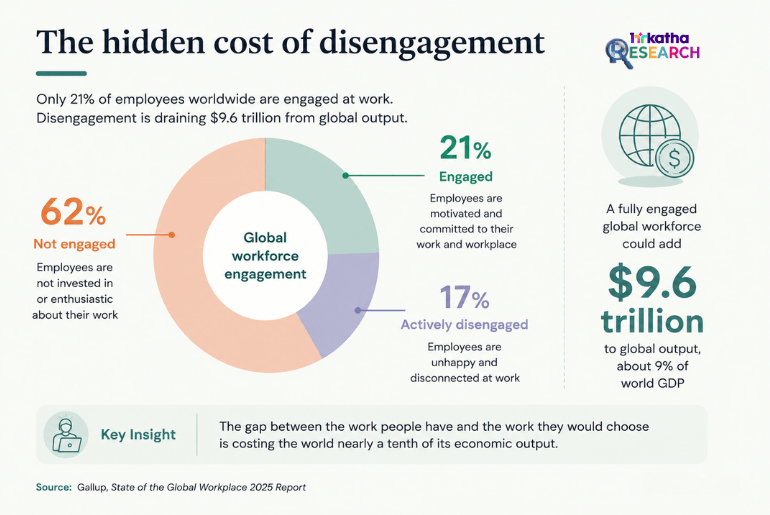
    That verdict carries a price. Gallup’s separate State of the Global Workplace research puts engagement at just 21 per cent worldwide, with 62 per cent of employees not engaged and 17 per cent actively checked out. The firm estimates that a fully engaged global workforce would add $9.6 trillion to output, roughly 9 per cent of world GDP. The gap between the work people have and the work they would choose is costing the planet nearly a tenth of its economic output, a number that rivals many conventional macroeconomic problems without receiving comparable policy attention.

    Finland shows what this looks like inside a single, prosperous country. Work ranks as its top national concern for 17 per cent of adults, more than four times the high-income median and matching the share who cite the economy outright. Unemployment has climbed steadily since mid-2023 to 10.3 per cent by October 2025, the highest in over a decade. More tellingly, optimism about finding work collapsed over the same stretch: 68 per cent of Finns thought it was a good time to find a job in 2022; by 2025, only 22 per cent did. Finland typically tops global happiness rankings. Its workforce anxiety shows that high wellbeing offers no shelter from a labour market in decline.

    Unemployment remains the statistic governments watch most closely, largely because it offers a simple readout of labour-market health. This survey suggests it has become an incomplete one. The larger share of discontent now sits with people who technically have work and complain about it anyway, a form of labour-market failure that conventional employment figures were never built to capture.

    concerns about work Employee employer Having a job doesn't stop people from worrying about work hidden cost of disengagement HR Human Resources job worries labour-market health people who technically have work and complain about it anyway The $9.6 trillion shrug unemployment Unemployment remains the statistic governments watch most closely unemployment stats unemployment worries Why people with jobs worry about work almost as much as people without them work is one of the world’s defining anxieties Work is top national concern work-related issues are biggest problem Workforce
    Share. LinkedIn Twitter Facebook WhatsApp
    mm
    Dr. Prajjal Saha | HRKatha

    Dr. Prajjal Saha is a business journalist and the editor-publisher of HRKatha. He writes on the realities of work and organisations, offering a clear-eyed view of how companies translate intent into action—often revealing the gap between the two. With over 25 years of experience, he focuses on interpreting workplace trends and leadership decisions in a way that is both insightful and accessible. He founded HRKatha in 2015 to create a platform for credible, insight-driven analysis of the evolving workplace.

    Leave A Reply Cancel Reply

    Related Posts

    HDFC Pension appoints Hetal Javeri-Nandu as CHRO

    July 15, 2026

    DCM Shriram elevates Aditi Gujral to VP & group talent head

    July 15, 2026

    HR Perspectives by Kundan Kumar: “Diversity creates real value only when it is underpinned by inclusion”

    July 15, 2026

    Did Meta use AI to make layoff decisions?

    July 15, 2026
    zoha
    Editorial

    The interview was never measuring what we thought it was

    I was speaking recently to the HR Head of a mid-sized IT company about hiring.…

    You outsourced the creche. Not the responsibility

    There is a particular kind of trust between an employer and an employee who leaves…

    EDITOR'S PICKS

    The $9.6 trillion shrug

    July 15, 2026

    HR Perspectives by Kundan Kumar: “Diversity creates real value only when it is underpinned by inclusion”

    July 15, 2026

    India’s clean energy boom has a talent problem

    July 14, 2026

    Career portfolio mindset: Why careers are beginning to look like investment portfolios

    July 14, 2026
    Latest Post

    HDFC Pension appoints Hetal Javeri-Nandu as CHRO

    Movement July 15, 2026

    HDFC Pension has appointed Hetal Javeri-Nandu as its chief human resources officer (CHRO), strengthening its…

    DCM Shriram elevates Aditi Gujral to VP & group talent head

    Movement July 15, 2026

    DCM Shriram has appointed Aditi Gujral as vice president & group talent head, effective June…

    The $9.6 trillion shrug

    Research July 15, 2026

    Ask more than 1,40,000 people across 107 countries what troubles them most about their nation,…

    HR Perspectives by Kundan Kumar: “Diversity creates real value only when it is underpinned by inclusion”

    Perspectives July 15, 2026

    Merck Life Science sits at the intersection of science, technology and commerce, supplying the tools,…

    Asia's No.1 HR Platform

    Facebook X (Twitter) Instagram LinkedIn WhatsApp Bluesky
    • Our Story
    • Partner with us
    • Career
    • Reach Us
    • Exclusive Features
    • Cover Story
    • Editorial
    • Dive into the Future of Work: Download HRForecast 2024 Now!
    © 2026 HRKatha.com
    • Disclaimer
    • Refunds & Cancellation Policy
    • Terms of Service

    Type above and press Enter to search. Press Esc to cancel.