


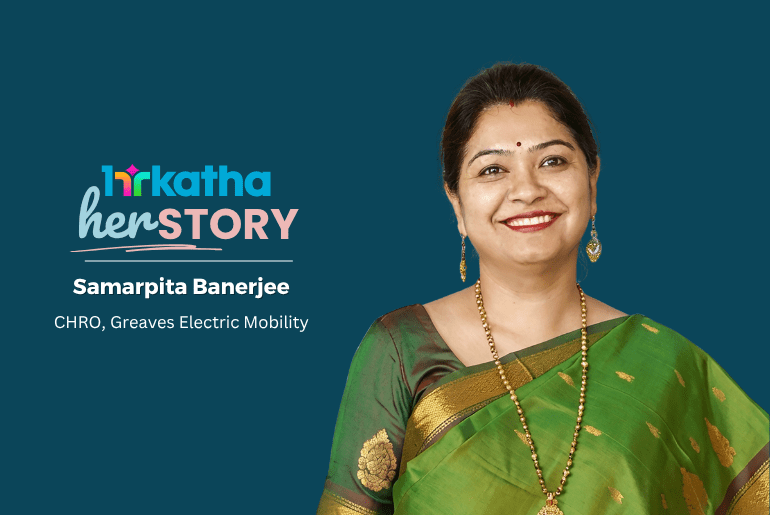
Courageous keeper of secrets
Terminations, performance issues, salary inequities, leadership failures, personal crises. Samarpita Banerjee has carried information about all of them, often alone.
It was one of the first things about HR that surprised her. The confidentiality that makes the function trustworthy can also make it isolating in ways nobody quite warns you about.
Initially, HR was largely about procedures, policies and talent management to her. Those things still matter. But she gradually realised there was far more to the profession than systems and processes. HR was equally about relationships, responsiveness and understanding how deeply people were connected to business performance.
The organisations that outperform, she observed, tend to be those that create environments where employees can express themselves freely, develop and learn.
But another lesson stayed with her more strongly: HR requires courage.
The courage to tell a powerful leader something they may not want to hear. The courage to stand between a business decision and its human consequences. And sometimes, the courage to say something is not right when accepting it would be far more convenient.
Most people enter HR wanting to help people. Banerjee discovered that doing so meaningfully sometimes requires a backbone no job description mentions.
That realisation changed how she saw the profession. HR, for her, was no longer simply the function managing people. It could help determine whether an organisation became resilient, culture-driven and competitive.
Fighting for her own growth
There was another contradiction Banerjee encountered along the way. HR was entrusted with developing talent across the organisation, yet HR professionals themselves could sometimes find their own leadership development pushed to the end of the queue.
For Banerjee, that meant learning not to wait.
She began seeking mentors, raising her hand for opportunities and, in effect, becoming her own sponsor.
“As women, we should know nobody is coming to rescue our career. But with the right people beside and enough belief in ourselves, we will not need rescuing,” she states emphatically.
Being seen primarily as “the people person” presented another challenge. Empathy and an instinct for people were genuine strengths, but Banerjee realised they could also become a box if they were the only capabilities others associated with an HR leader.
She deliberately widened her understanding of finance, operations, transformation agendas and future business growth. The objective was not to become less people-oriented, but to ensure that her understanding of people could be applied to the questions the business itself was trying to solve.
It helped her move towards a role where she could contribute to the growth of the business, not only the growth of its people.
It also reinforced something she now believes deeply: leadership sometimes requires expanding other people’s perceptions of you, as well as your own perceptions of yourself.
“Listening, collaborating and empathy have always been thought of as soft skills,” she observes. “In reality, they are strategic competencies that play a crucial role in leading organisations through challenges.”
“Nobody is coming to rescue your career. With the right people beside you and enough belief in yourself, you will not need rescuing.”
Trusted, not just liked or respected
“Leadership does not mean picking between whether you are liked or being respected, but rather being someone who is trusted,” Banerjee believes.
For her, trust is built through consistency, fairness and authenticity, particularly when decisions become difficult.
She has faced enough of those moments: initiating organisational change, holding firm in an uncomfortable conversation, or balancing a business decision against genuine human need.
Such situations taught her to move beyond the emotion of the moment and consider what would serve both the organisation and its people over the longer term.
“It pays to gain different perspectives from trusted mentors, business leaders, and people within the organisation,” she points out.
Experience has also changed her understanding of respect. It does not come from always having the answers or keeping everyone comfortable. It comes from remaining open-minded about how a conclusion is reached, treating people with dignity and staying anchored to values when doing so becomes difficult.
People may still disagree with a decision. But Banerjee believes disagreement need not destroy trust if people know the process was thoughtful and unbiased.
That, for her, is one of the harder disciplines of leadership: making difficult choices without becoming closed to the possibility that there is still something to learn.
What culture really rewards
One principle is non-negotiable for Banerjee: people should feel respected, valued and able to contribute, irrespective of role or level.
She believes people do their best work when they feel heard, trusted and connected to something larger than themselves.
At Greaves Electric Mobility, one manifestation of that philosophy is visible on the factory floor. Women account for nearly 70 per cent of the shopfloor workforce at its EV manufacturing facility.
For Banerjee, the number matters not simply as a diversity metric, but because manufacturing has historically offered women far fewer such opportunities. It represents an attempt to challenge assumptions about who belongs in particular jobs and allow ability and commitment to determine opportunity.
Her definition of culture, however, goes beyond policies and programmes.
Culture is also found in an organisation’s unwritten rules: what gets rewarded, what gets tolerated and what gets quietly punished, irrespective of what the poster on the wall might say.
It reveals itself in everyday behaviour. In how leaders listen. In how teams work together. In how people are treated when things go wrong, not merely when everything is going well.
For Banerjee, that is why inclusion, trust and belonging ultimately matter to performance. When people feel respected and supported, engagement and innovation have firmer ground on which to grow.
“Confidence always comes after the experience, not vice versa.”
Stop treating employees as averages
One HR assumption Banerjee would like organisations to discard is that people leave primarily for money.
Compensation matters, certainly. But she believes loyalty is shaped by the broader experience of work: whether the work feels meaningful, whether managers are effective, whether people can develop, and whether their contribution is genuinely acknowledged.
Reducing motivation to compensation alone can therefore prevent organisations from seeing what is actually driving people away.
The same problem appears when organisations treat employees as one homogeneous group.
Workplaces have traditionally relied heavily on policies designed for everyone at once. But employees differ enormously in motivation, career stage, personal circumstances and aspirations. What matters to someone entering the workforce may bear little resemblance to what matters to an employee further into a career and managing very different responsibilities outside work.
For Banerjee, the future of people management will therefore require organisations to become better listeners and more thoughtful creators of individual experiences.
Sometimes the starting point is surprisingly simple: stop assuming and start listening.
Quick fire round
One thing you wish people understood about being a woman in HR leadership?
Gender does not determine leadership. What defines a leader is the capacity to engender trust, cope with complexity, and unite people towards a common goal.
If not HR, what career path would you have pursued?
A data scientist, someone who turns raw data into decisions, using statistics, machine learning and analytical models to find patterns that help organisations predict, optimise and act more intelligently.
What energises you most about your work?
Shaping cultures where people flourish.
Best investment you’ve made in yourself?
My network of mentors and a lifelong learner mindset.
One skill you’re currently working on developing?
I am learning to become fluent in people analytics. I want to walk into any business conversation and translate human challenges into metrics that leaders act on: attrition costs, productivity loss, time-to-hire impact, engagement-to-revenue correlation. The HR professionals who will matter most in the next five years are the ones who can make the invisible cost of people decisions visible.
Building capability for what comes next
At Greaves Electric Mobility, Banerjee sees preparing for the future as both a business and a people challenge.
“To take GEML to new heights, our brilliant minds have an important role to play, and therefore, upskilling is one of our top priorities in this rapidly changing environment,” she shares.
As the industry evolves, the organisation is expanding its learning and development efforts across job profiles, with capability building and leadership development forming an important part of that work.
For Banerjee, future readiness is less about predicting precisely which skills will matter several years from now and more about creating a workforce capable of continuing to learn as those requirements change.
The objective is straightforward: give people the skills, mindset and support to grow with the business rather than discover, after the business has changed, that they have been left behind.
Talk to people outside HR
Banerjee has a simple piece of advice for young HR professionals: do not spend all your time talking to other HR professionals.
Conversations with colleagues in finance, operations, sales, technology and other functions deepen an HR professional’s understanding of how the business actually works. That understanding, she believes, eventually shows up in the quality of HR decisions.
She also advises newcomers to resist the pressure to have an immediate answer to every problem. Some of the best HR professionals she has encountered do not necessarily speak the most. They listen exceptionally well.
The ability to ask the right questions, remain curious and understand a situation before trying to solve it can be more valuable than having a ready response.
Reliability matters too. Talent and capability will take a professional only so far if colleagues cannot depend on them to follow through. Careers, Banerjee believes, are ultimately built on credibility more than titles.
And there is one more thing she would tell those waiting to feel ready before accepting an opportunity.
“Confidence always comes after the experience, not vice versa,” she says.
The experiences that build confidence, after all, are often the ones that require saying yes before certainty arrives.
1 Comment
Very Good coverage and rocked..