



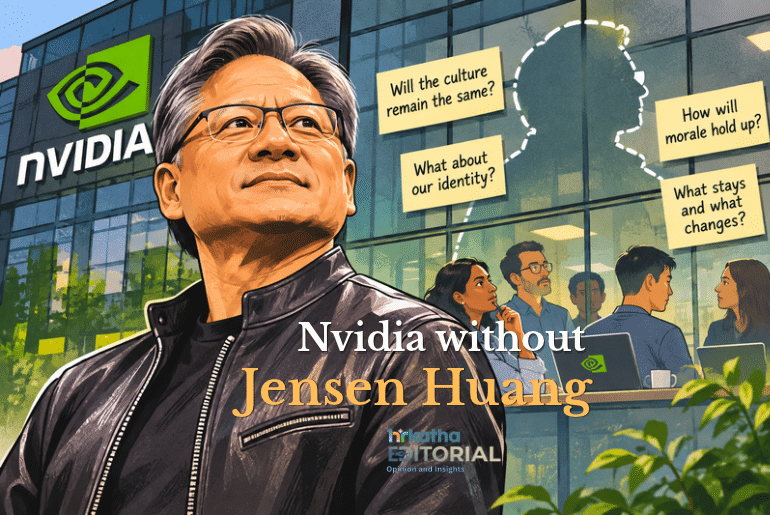
Jensen Huang co-founded Nvidia in 1993. For thirty-three years, he was its chief executive and, to an unusual degree, its public identity. He articulated the company’s strategy, appeared on stage at product launches with the kind of charisma that made technical announcements feel like cultural events, and championed the vision for graphics processing, artificial intelligence and accelerated computing that defined what Nvidia became.
On 12 November, Nvidia announced his resignation, effective immediately.
The announcement offered no explanation. The departure followed reports concerning Huang’s personal relationships, including alleged relationships involving employees, and questions about potential national-security implications. Nvidia had initiated an independent investigation. Colette Kress, its chief financial officer, became interim CEO while the board began searching for a permanent successor.
The business questions followed quickly. Would strategy change? Would customers stay? Would the product roadmap hold? These were reasonable concerns, and the board moved to establish leadership continuity. But underneath them was a question less easily answered.
What happens to an organisation when the person who defined its identity is no longer there?
The founder as cultural shorthand
A charismatic founder gives an organisation something that no strategy document or values statement can easily replicate: a living interpretation of what the company stands for. Employees know what the leader believes. They observe how decisions are made, what behaviour is rewarded, what risks are encouraged and what lines are not crossed. The leader’s personality becomes a shorthand for the organisation’s culture.
This can be enormously effective. A strong personality can align thousands of employees across geographies, functions and generations around a shared purpose. The clarity it provides is real. The commitment it generates is genuine.
But there is a hidden vulnerability. When the leader becomes the principal interpreter of the organisation’s culture, employees may never learn to distinguish between the values of the institution and the preferences of the individual. The culture and the person become difficult to separate, in employees’ minds, in the company’s public image and sometimes in the organisation’s own understanding of itself.
That distinction becomes critical when the leader leaves, particularly under controversial circumstances.
When employees lose more than a leader
Many people join organisations because they believe in their leaders. They build careers, make professional sacrifices and develop identities partly around that belief. When a founder exits unexpectedly, employees may experience something more complicated than uncertainty about their next reporting relationship.
Their pride in the organisation and their admiration for its founder may suddenly pull in different directions.
At Nvidia, that conflict has become visible. According to WIRED, an internal suggestion-box post urging the board to consider employee sentiment attracted more than 1,600 comments, many supporting Huang’s return. The figure represents comments, not necessarily 1,600 different employees, and cannot establish the views of the wider workforce.
One employee reportedly wrote, “If you believe in the mission, bring back THE boss.” Another argued that Huang deserved a second chance because of what he had contributed to the company.
The reactions reveal something important. Employees were not necessarily defending every aspect of the founder’s conduct. Some were struggling to reconcile the person they had admired professionally with the circumstances surrounding his departure.
A more personal account came from Nvidia robotics engineer Darrell Dai, who publicly explained his decision to leave the company. He acknowledged that he did not have all the facts and could not prejudge the investigation. His difficulty lay partly in being unable to understand a decision that profoundly affected the organisation he had helped build.
For Dai, Huang’s vision and the engineering culture he shaped had been important reasons to remain. His departure changed that calculation.
These accounts are individual experiences, not evidence of company-wide sentiment. But they illustrate something conventional succession planning rarely captures: when employees identify strongly with a founder, losing that leader can unsettle their own sense of belonging.
Business must go on. But what about morale?
There is an unavoidable reality: business cannot stop because its most celebrated leader has departed. Meetings proceed, projects stay on schedule and the new leadership emphasises that the company’s direction remains unchanged.
But operational continuity and employee confidence are not the same thing. An organisation can function efficiently while its people privately question its future.
That distinction became evident at Nvidia’s first company-wide meeting after Huang’s departure. According to WIRED, employees had submitted around 700 questions, with compensation emerging as their biggest concern, followed by demands for greater transparency from the board. Interim CEO Colette Kress responded by announcing that salary increases and additional equity would arrive earlier than planned.
The episode was revealing. Employees may have been wrestling with the loss of a leader they admired, but they were also thinking about their own futures. Would the company remain the same place to build a career? Would the rewards and opportunities that had attracted them continue?
Leadership continuity could be announced immediately. Employee confidence would have to be earned.
That gap between visible performance and invisible confidence is precisely why HR cannot measure the health of a transition solely by whether business targets are being met.
The immediate effects may be emotional: disbelief, disappointment, anxiety or even anger. Employees discuss what happened, seek explanations and compare their understanding of the organisation with what its leadership is now saying.
The longer-term effects are more difficult to detect. A talented employee may begin considering opportunities elsewhere. A manager may become reluctant to take the risks once encouraged by the founder. Teams may gradually change how they make decisions, collaborate or challenge authority.
None of these consequences is inevitable. Some employees may welcome a different leadership style. Others may discover that their attachment was always to the work and their colleagues rather than to the founder.
The important point is that cultural repercussions do not necessarily arrive together. The emotional shock can be immediate, while the organisational consequences may emerge only through decisions made over subsequent months. By the time employee turnover rises or innovation slows, the original event may no longer be regarded as the cause.
What survives when the founder does not?
Culture does not necessarily collapse when a founder leaves. Sometimes it becomes more visible.
Practices sustained by personal authority must now stand on their own merits. Employees and managers discover which values they genuinely share, which rules they follow because they believe in them and which habits existed because one powerful individual expected them.
The departure becomes a form of cultural audit.
At Nvidia’s first post-Huang company meeting, co-founder Chris Malachowsky offered a different perspective. He argued that the company’s culture had never depended on values displayed on posters, but on how employees behaved, worked together and approached their responsibilities. His confidence was that these habits would endure.
That may prove to be Nvidia’s greatest institutional strength. But it also raises a question that cannot be answered by reassurance alone: are those habits sufficiently embedded across the organisation to survive without the person most closely associated with them?
An organisation may discover that its institutional culture is stronger than its dependence on one individual suggested. Or it may discover that certain behaviours, decisions and relationships were held together largely by the founder’s presence.
Some practices that contributed to the company’s success may have been inseparable from the founder’s personal authority and cannot simply be transferred to a successor. Recognising that is not necessarily an admission of failure. It is an acknowledgement that individual leadership and institutional capability are different things.
Yet a company such as Nvidia was never built by one person alone.
Thousands of engineers, researchers, managers and other employees developed the technologies, working relationships and institutional knowledge that made its success possible. A celebrated founder may have provided direction, but the organisation’s capabilities were built collectively.
When one individual dominates the public identity of a company, those contributions can become less visible.
A founder’s departure may therefore create an unexpected opportunity. Employees may begin recognising how much of what they admired about the organisation was created and sustained by people who remain.
The question is whether they have been given sufficient authority and confidence to carry it forward.
HR’s responsibility is not simply reassurance
In the aftermath of a founder’s departure, HR’s immediate instinct may be to reassure employees. Operations will continue. Strategy remains intact. Leadership is committed to the company’s future.
Such communication is necessary, but it addresses only part of the problem.
The deeper responsibility is to help employees distinguish between what should be preserved and what may need to change.
Some practices will have contributed genuinely to the company’s performance and deserve to survive. Others may have depended on one individual’s preferences or authority in ways that are no longer appropriate or sustainable.
HR must also recognise that employees will not experience the transition uniformly. Those who admired the founder may feel a sense of loss. Others may have reservations about aspects of the previous culture. Still others may care principally about whether their work, careers and teams remain secure.
None of these responses should become a test of organisational loyalty.
There is a difficult balance to maintain. Employees should not be expected to renounce their professional experiences or achievements because the person who shaped them has become controversial. Equally, admiration for a founder cannot become a reason to disregard legitimate concerns or compromise an independent investigation.
Gratitude for what was built and honest examination of what happened can coexist.
Beyond communication, HR must help the organisation develop something more durable than personal loyalty. Managers should be able to explain organisational values without invoking the founder’s authority. Employees should be able to question decisions without wondering what the former chief executive would have wanted. The next leader should inherit functioning institutions, not merely a network of personal allegiances.
This takes time. Culture is not rewritten by announcing a new set of values. It changes through the decisions employees see being made, the behaviour leaders tolerate and the opportunities people have to exercise independent judgement.
The real measure
Nvidia’s immediate challenge is to maintain business continuity while navigating a leadership transition. Its longer-term challenge is to establish what the company stands for when the person who defined it is no longer in the room. The two challenges will not necessarily move at the same pace.
The broader lesson extends well beyond Nvidia.
An organisation’s culture ultimately belongs to the people who practise it, not merely to the person who gave it its original shape. The real test begins when employees must decide which values they will uphold without looking towards the founder for approval.
Perhaps the real measure of a founder’s achievement is not how closely an organisation resembles them while they are in charge. It is how confidently it can remain itself after they have gone.