


Company: CodeCraft Labs (fictitious), a 400-person tech startup building AI-powered developer tools, recently valued at Rs 600 crore.
Background:
CodeCraft Labs prides itself on being “radically different.” The founders believe traditional corporate structures breed mistrust, politics, and inequality. They’ve eliminated job titles, flattened hierarchies, and encouraged open dialogue.
Now they want to take it further.
The proposal
The CEO and half the leadership team want to implement full salary transparency—publishing everyone’s compensation internally on the company intranet. Their argument: “If we’re paying people fairly, we should have nothing to hide. Transparency eliminates suspicion, reduces pay gaps, and holds us accountable.”
They point to companies like Buffer and GitLab that have done this successfully. They believe it’s the next logical step in building a “truly equitable” culture.
The pushback
The other half of leadership is deeply uncomfortable. The CFO warns: “We’ll create resentment, not trust. People will compare themselves constantly. High earners will be resented. Low earners will feel exposed. And we’ll lose negotiating power in hiring.”
The Head of Engineering adds: “Some of our best engineers are introverts who’d hate being publicly identified as top earners. Some took pay cuts to join us early and are now earning less than newer hires doing similar work. Making that public will destroy morale.”
HR has conducted an anonymous employee survey. The results are split almost exactly 50-50. Younger employees overwhelmingly support it. Senior employees and women, surprisingly, are more hesitant—many citing “privacy concerns” and “fear of judgement.”
The dilemma
Should HR support full salary transparency—betting that openness will build trust and fairness, even if it causes short-term discomfort? Or advise against it—protecting privacy and avoiding comparison culture, but reinforcing the perception that the company has something to hide?
What’s really at stake
This isn’t just about salaries. It’s about whether radical transparency is a principle worth the human cost—or whether some information, even in the most open cultures, is better left private. And whether the company is willing to lose people over an ideological experiment.
What HR leaders said
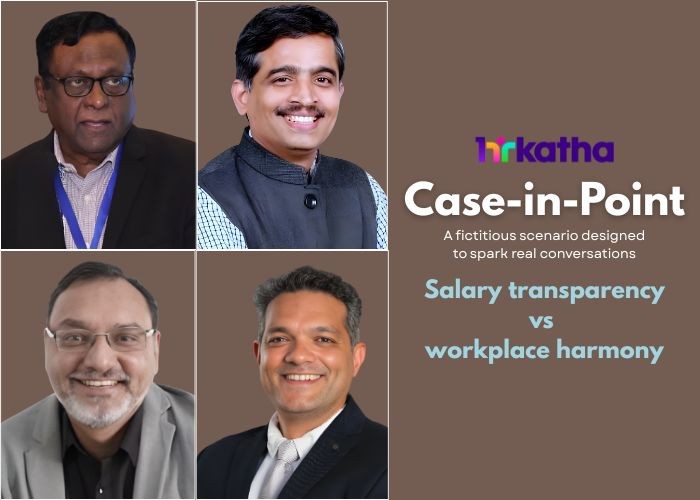
P Dwarakanath, Former executive chairman, GSK
“This is not about salaries or rewards—it’s about human psychology, power, fairness, transparency, privacy, and trust.
 The CEO’s argument rests on beliefs: if pay is fair, it can withstand sunlight; transparency reduces bias and pay gaps; opacity breeds suspicion. It’s morally attractive. But there’s a hidden assumption we tend to forget—compensation is emotional and comparative, not rational.
From my experience, when I give someone fair compensation, they accept it. Then they discover a colleague got 0.5% more, and all happiness disappears. Social comparisons are always upward, not downward. People ask, ‘Why is he earning more?’ Very few say, ‘Good for him, he deserves it.’
Dangerous areas include new hires earning more than loyal employees, negotiation-based differences, and star performers paid disproportionately. Transparency exposes not just pay—it exposes every inconsistency accumulated over time. If compensation architecture isn’t already clean and formula-driven, you’re lighting a match in a dry forest.
The survey shows younger employees support transparency; senior employees and women hesitate due to privacy and judgement concerns. This isn’t accidental. Research shows greater social penalties around compensation, especially in environments with negotiated pay.
My recommendation: go phased, not full disclosure. Publish salary bands by role and level. Publish compensation philosophy and criteria for progression. Audit and fix internal inequities first. Build trust without triggering comparison shock.
Once you introduce a people policy, it’s difficult to withdraw later. Don’t rush. Unless you’re culturally mature from top to bottom, this can create disaster.”
Balachandar N, Former CHRO, Ola
“I would not do it.
Consider the employee lifecycle: Where do you source from—premier or not-so-premier colleges and companies? Is the source homogeneous or heterogeneous? Usually organisations can distinguish; employees struggle to.
 How is evaluation at hiring? How transparent is compensation fixing—what philosophy, what process? How do you distinguish?
Post-hiring, how do you measure performance? How transparent are goals set and evaluated? Managers vary—some are tough, others lenient. That’s another dimension to fixing salary.
Outliers and non-performers are easy to distinguish. But the large part of the workforce are worker bees, difficult to distinguish. What values do you promote? How do you align senior leadership that’s split on the subject? Power and politics are part of human systems.
Skills and craft are personal. Hence compensation is personal. Whilst the organisation can explain the process, it’s not easy to explain judgement or how you distinguish people. Employees come with their own biases and past experiences.
Compensation is also based on company lifecycle, industry standards, business cycles, demand and supply of skills, ability to pay—all dynamic and needing constant tracking. All this lends itself to subjectivity. We don’t have a rubric for objective salary fixing. Hence, not tenable.”
Sharad Verma, VP & CHRO, Iris Software
“Salary transparency is not an ideology—it’s a design choice. And like any design choice, its success depends on the maturity of the underlying system.
 Radical transparency works in companies where compensation logic is already consistent, defensible, and explainable. If pay decisions are driven by clear role architectures, skill levels, and market benchmarks, transparency simply reveals fairness. But if legacy decisions, negotiation gaps, or ad-hoc exceptions exist—as they usually do in fast-growing startups—full disclosure can amplify perceived inequities overnight.
The mixed employee response is not surprising. Younger employees see transparency as a fairness tool. Senior employees view it through the lens of privacy, social comparison, and judgement. Both concerns are valid.
My advice to CodeCraft would be to treat transparency as a journey, not a switch. Start with publishing salary bands, pay philosophy, and the logic behind compensation decisions. Fix obvious anomalies. Give managers training and tools to explain pay confidently. Only when the system is structurally fair should the company consider individual-level disclosure.
Transparency without consistency creates anxiety. Consistency with gradual transparency builds trust.
If done thoughtfully, salary transparency can become a powerful cultural signal of fairness and accountability. But if rushed, it becomes a social experiment at the expense of employee dignity and trust.”
Vaibhav Date, Head -HR, Bajaj Finserv Asset Management
“Salary remains one of the most contested aspects of the employee–employer relationship. Not because it’s merely about money, but because it’s about meaning.
 In my years as a consultant conducting large-scale employee engagement surveys across India, one powerful insight emerged: employees rarely assess salary fairness in absolute terms. They assess it comparatively. They anchor their sense of fairness to peers they know, observe, and informally evaluate.
For most employees, salary represents far more than a pay cheque. It becomes a proxy for self-worth, a signal of status, a scoreboard of relative value. Employees often hold a higher internal valuation of themselves than what their salary reflects. That’s human nature. We see our effort, our stress, our invisible contributions. We discount others’ unseen work.
So when salaries are revealed, people don’t ask, ‘Is this objectively fair?’ They ask, ‘Why am I not where I believe I should be—relative to them?’ Fairness is relational, not numerical.
Transparency doesn’t reveal fairness. It reveals how people feel about fairness. In practice, transparency triggers powerful psychological dynamics: social comparison intensifies, high performers become targets of quiet resentment, underpaid employees feel publicly humiliated. Collaboration can subtly erode.
The real issue lies deeper—in whether the compensation system itself is coherent, defensible, and consistently applied. Any transparency without structural clarity amplifies dissatisfaction.
A smarter path is graded transparency: clarify and correct inconsistencies, publish the compensation philosophy, increase structural visibility about how movement across bands happens, but keep individual conversations private and developmental—not performative.
Full transparency doesn’t automatically create fairness. But graded transparency—of philosophy, structure, and process—builds psychological safety and trust.”
Your turn
What would you do? Share your response in the comment box or share on LinkedIn with #HRKathaCaseInPoint