



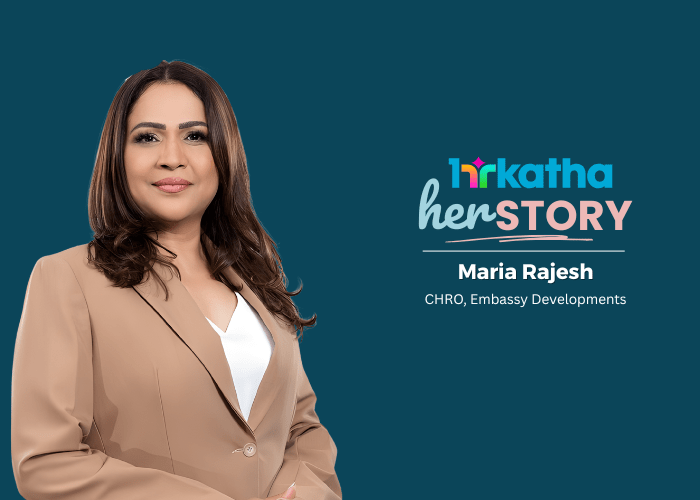
Moving beyond administrative support
Maria Rajesh’s career has been shaped by a sustained curiosity about people and organisational dynamics.
Early on, she found herself drawn to understanding how individuals, teams, and leaders come together to create meaningful impact. That curiosity gradually evolved into a deeper conviction: HR delivers its greatest value not as an administrative function, but as a strategic partner in shaping organisations through people.

Over the years, working across industries, she has seen how leadership, talent practices, and culture are not merely people priorities, but business imperatives. When designed thoughtfully, they unlock innovation, strengthen resilience, and enable the agility required for long-term performance.
Today, as CHRO at Embassy Developments, Rajesh leads with a philosophy shaped by experience: sustained performance and integrity speak louder than perception, but leaders must consciously create environments where diverse perspectives can thrive.
Making space for merit and potential
In the early stages of her career in real estate, HR perspectives—particularly from women leaders—were not always given equal weight in operational and site discussions.
Rather than pushing back directly, Rajesh chose a different approach.
“I focused on linking talent and culture insights directly to business outcomes,” she says.
Over time, that shift changed how HR was perceived. It began to be seen not as a support function, but as a strategic contributor to decision-making.
The experience reinforced an important distinction.
Inclusion is not just about representation. It is about ensuring that diverse voices are heard, valued, and integrated into decisions. It also underscored the need to actively address unconscious bias and ensure that opportunities are guided by merit and potential.
HR creates the most value when it moves beyond support to shaping organisations through people.
Preserving trust
Some of the most difficult moments in HR arise during periods of change – restructuring, transformation, or shifts driven by market realities.
In these moments, the decision itself is only part of the challenge. How it is communicated matters just as much.
For Rajesh, transparency, consistency, and respect are non-negotiable.
“Transparent, consistent, and respectful communication preserves trust, even when decisions are difficult,” she emphasises.
When organisations lead with these principles, they do more than navigate change. They reinforce a culture of trust and engagement that sustains performance over time.
Respect and psychological safety
Respect, both for individuals and for differing perspectives, sits at the core of Rajesh’s leadership approach.
When people feel valued for what they bring, trust and collaboration follow naturally. This, in turn, strengthens a sense of belonging across the organisation.
Equally important is psychological safety – the ability for employees to share ideas, challenge viewpoints constructively, and participate in open dialogue without hesitation.
“When respect and psychological safety are embedded in the culture, collaboration, innovation, and accountability tend to follow naturally,” says Rajesh.
Embedding HR in strategy
For Maria Rajesh, strategic HR is fundamentally about alignment.
It is about ensuring that talent, culture, and performance systems are closely connected to business priorities and long-term organisational goals. Every people initiative – whether leadership development or performance management – must translate into measurable business impact.
This requires HR leaders to understand the business as deeply as they understand people.
It also calls for building fair, objective, and data-driven systems that unlock the potential of diverse teams, whilst anticipating future workforce needs and evolving ways of working.
When HR is fully embedded in strategy, it moves beyond support. It becomes a central driver of transformation, enabling growth, agility, and sustained success.
When respect and psychological safety are embedded, collaboration and innovation follow.
Gratitude for a mentor
Rajesh credits much of her growth to her first HR mentor.
From them, she learnt that leadership must balance clarity with empathy, and that decisions must consider both people and business outcomes. They also instilled the importance of credibility, consistency, and trust built over time.
“Leadership involves lifting others, creating opportunities, and ensuring diverse voices are heard,” she reflects.
Those principles continue to shape how she leads today.
Quick fire round
What’s the best career advice you’ve ever received?
Build credibility through consistency.
One thing you wish people understood about being a woman in HR leadership?
Leadership is defined by capability, not gender.
Morning ritual that sets you up for success?
Quiet reflection and planning the day ahead.
If not HR, what career path would you have pursued?
Something still centred on understanding people and organisations – perhaps organisational psychology.
What energises you most about your work?
Seeing people and organisations grow together.
Curiosity and learning
Her advice to young women entering HR is straightforward: “Stay curious and keep learning.”
“Building confidence through continuous learning and diverse experiences early in one’s career can significantly accelerate leadership readiness,” she says.
She encourages them to believe in their capabilities and take on challenging roles. As organisations increasingly recognise the value of diverse leadership, opportunities to grow are expanding.
Consistency, integrity, and a willingness to learn, she believes, will always open doors.