


Pharmaceutical companies operate under a particular kind of pressure. Science moves fast. Regulation moves slowly. The cost of getting people decisions wrong is measured not just in business outcomes but in patient impact. At Novo Nordisk, a company committed to defeating diabetes and other serious chronic diseases, the people agenda is not separate from the mission. It is an extension of it.
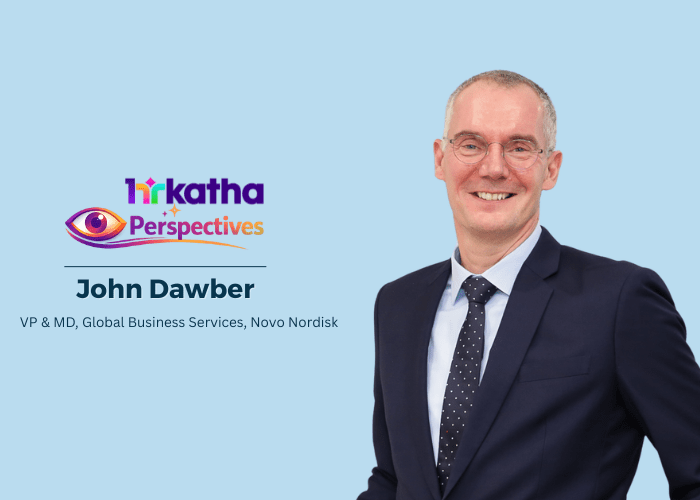
John Dawber leads Global Business Services at Novo Nordisk, a function that sits at the intersection of science, operations and global collaboration. In conversation with HRKatha, he explains why the best talent he has worked with would not have survived an algorithmic filter, why representation without influence is not diversity, and why taking time early almost always saves time overall.
Hire for growth trajectory, not today’s skills
Are you hiring for skills that exist today, or the capacity to learn what does not yet exist?
At Novo Nordisk GBS, we value deep technical and scientific capability, but we no longer see skills as static assets. What matters far more is learning agility: curiosity, adaptability and the ability to work across disciplines as roles evolve.
We reinforce this through academic partnerships and internal development models that emphasise continuous learning rather than fixed career paths.
There is also a caution worth noting. AI is highly effective at matching CVs to job descriptions, but far less effective at assessing potential, judgement and growth trajectory. Some of the best leaders I have worked with would never have passed an algorithmic filter early in their careers. That is a risk HR must take seriously and a reminder that human judgement remains indispensable.
“The faster you make that exchange, the more effective a leader you will become.”
Consistent in intent, flexible in delivery
Can a single culture genuinely serve five generations simultaneously?
I do not believe one employee experience fits all, and it should not. What must remain shared is purpose.
Purpose acts as the anchor. How individuals connect to it varies by life stage, expectations and personal priorities. Some seek rapid growth and visible impact. Others value flexibility, stability or depth of expertise.
The leadership challenge is not choosing between consistency and personalisation. It is being consistent in intent and flexible in delivery. Organisations that insist on uniformity in the name of fairness often confuse it with equity.
“Judgement matters as much as process.”
Build continuity, buy perspective
Is it still realistic to develop senior leaders internally?
We are deliberate about doing both, and being clear about why.
Internal development builds deep institutional understanding, particularly in a regulated, science-led environment. Leaders who grow within the organisation develop judgement, trust and a strong connection to purpose.
At the same time, external hiring introduces capabilities and perspectives that may not exist internally, especially in rapidly evolving areas such as digital and analytics.
The balance is not accidental. It is intentional.
“Representation alone does not automatically translate into voice, impact or decision-making power.”
Representation is not the same as influence
What is the one systemic barrier to diversity you are working to address?
The most persistent gap is between representation and influence.
Many organisations have made progress on representation. But that does not automatically translate into voice or decision-making power. The real work begins after people enter the room.
What makes this harder is not policy but behaviour. Unconscious bias, ingrained habits and hierarchical dynamics continue to shape outcomes across geographies and cultures.
Inclusion cannot be episodic. It must be visible in everyday decisions: how meetings are run, how dissent is handled and how potential is recognised.
“Internal development builds continuity. External hiring accelerates change.”
AI in a science-led organisation
How do you position AI as an enabler rather than a threat?
We position AI as an enabler, but also recognise that capability does not automatically justify use.
AI supports areas such as literature reviews, safety surveillance and documentation. Critical decisions remain human.
Resistance often comes from experienced experts, which is understandable. We address this through a human-in-the-loop approach, where expertise is augmented rather than replaced.
Adoption improves significantly when AI becomes tangible in daily work rather than an abstract concept. The shift from theory to application changes perception.
In regulated environments, judgement matters as much as process. Knowing when to standardise and when to adapt defines credibility.
“Consistent in intent, flexible in delivery.”
The backpack you carry
What shaped you most as a people leader?
My leadership philosophy has been shaped by experiences across cultures in the UK, Denmark, Japan, Thailand and India.
In Japan, I saw how hierarchy can slow exceptional talent. That reinforced the importance of accelerating potential rather than managing tenure.
During COVID-19 in Thailand, I experienced the same uncertainty as my team. That changed my understanding of empathy. It is not an add-on. It is foundational to performance.
The balance between speed and thoughtfulness has been a constant theme. Speed is often rewarded, but the most important decisions require context, listening and care. Taking time early almost always saves time later.
If I could tell my younger self one thing, it would be this: let go of ego early and replace it with genuine care for people.
“Some of the best leaders I have worked with would never have survived an algorithmic filter.”