



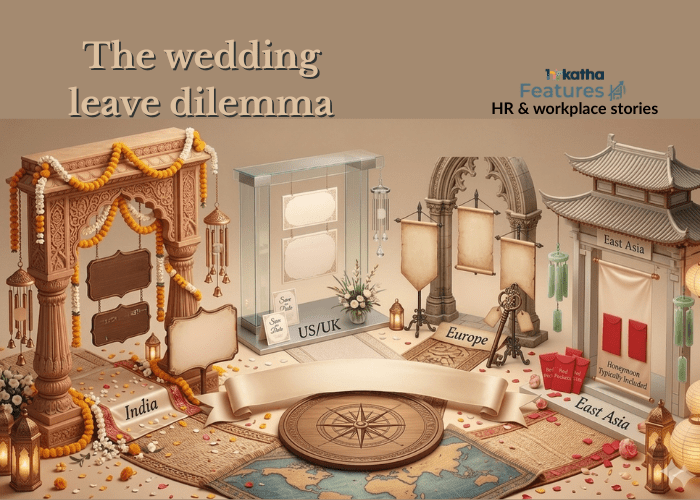
A manager at a Mumbai technology firm opens her leave calendar for November. Three team members have requested the same week off, not for Diwali, but for a colleague’s wedding.
The bride works in finance, two floors up. The absences would leave critical client deliverables exposed. Yet denying them risks appearing culturally tone-deaf in a workplace where attendance is almost expected.

This scene repeats itself across India every wedding season. As multinational firms expand here, what was once an accepted cultural norm now collides with global leave frameworks built for societies where weddings last hours, not days. The question is no longer whether Indian wedding culture will adapt. It will not, at least not soon. The real question is whether corporate policy can stretch without snapping.
When one day isn’t enough
For global managers, the arithmetic is baffling.
“Weddings in India are not just one-day events. They are week-long celebrations filled with rituals, travel, and extended family obligations,” says Yusuf Cementwala, vice president and head-HR, Maybank India.
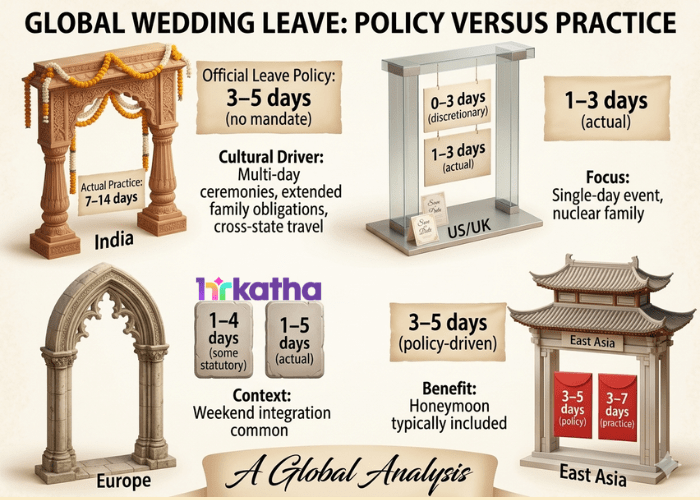
An employee’s own wedding can easily require 7 to 10 days. Pre-wedding ceremonies, the multi-day main event, and post-wedding rituals quickly add up. Add travel, and two weeks is not unusual.
Elsewhere, the contrast is stark. In the United States and the United Kingdom, marriage leave is minimal or discretionary. Even in countries with formal provisions, the duration rarely exceeds a few days. India operates on a different cultural scale. Weddings unfold across multiple days, often in multiple locations. Attendance is not optional. It is expected.
That expectation extends beyond the individual. Siblings, close family members, even extended relatives often require similar commitments.
“Employees often expect more than the standard two to three days of marriage leave. The challenge for HR leaders is to respect these cultural realities whilst ensuring business continuity,” Cementwala notes.
“Weddings in India are not just one-day events. They are week-long celebrations filled with rituals, travel, and extended family obligations,”
Yusuf Cementwala, VP & head-HR, Maybank India
When one wedding becomes many absences
The real strain is not just duration. It is multiplication.
In India’s relationship-driven workplaces, a wedding rarely affects just one employee.
“A colleague’s wedding often leads to multiple team members taking time off or stepping away early, creating clustered absences that strain business continuity, particularly in lean teams,” Cementwala explains.
Suryameet Roy, CHRO & president – HR, J M Baxi Group, frames the tension clearly. “Weddings in India are deeply cultural events. At the same time, organisations operate in highly interdependent and time-sensitive environments where continuity cannot be compromised.”
The problem intensifies during wedding season, roughly November to February, when auspicious dates cluster and ceremonies peak. Unlike predictable global holidays that affect entire offices at once, Indian wedding leave is scattered. It hits different teams at different times.
During peak periods, some organisations see 15 to 20 per cent of staff on leave in a given week, often double the usual rate. The disruption is uneven, harder to plan, and harder to absorb.
“We don’t create exceptions for weddings per se, but we enable flexibility through structured frameworks.”
Suryameet Roy, CHRO & president – HR, J M Baxi Group
The sustainability question
India hosts an estimated 10 million weddings annually, with the industry valued at roughly Rs 4.5 lakh crore. For companies with large Indian workforces, that translates into recurring pressure on team capacity.
“Extended leave needs to be viewed through the lens of business impact rather than tradition alone,” Roy argues. In leaner, performance-driven environments, prolonged absences carry disproportionate weight. Roles that require continuity, especially in operations and client delivery, are particularly exposed.
Shomendra Roy, SVP and head HR at Reliance Project Management Group, Reliance Industries, puts it bluntly. “Extended wedding leave is widely accepted in India. But is it still sustainable in today’s leaner environments?”
That question sits at the heart of the dilemma.
 The global policy trap
Global frameworks offer simplicity. Standardised leave policies applied uniformly across geographies. Most multinational firms provide two to seven days of marriage leave worldwide.
“While consistent, they rarely capture the depth of Indian weddings,” Cementwala observes.
The mismatch is not just about duration. It is about assumptions. Western policies treat weddings as discrete events. Indian weddings are extended, layered, and socially embedded.
Other cultural adaptations such as Lunar New Year in China or Ramadan in the Middle East are easier to accommodate because they are predictable and collective. Indian weddings are neither. They are individual and dispersed across the calendar.
“Without localisation, rigid policies risk disengagement or unplanned absenteeism,” Cementwala warns.
The result is what HR leaders call “shadow leave”. Informal arrangements bridge the gap between policy and reality, often inconsistently and without transparency. Employees exhaust official leave and then find workarounds. Managers look the other way. The system functions, but not honestly.
“Extended wedding leave is widely accepted in India. But is it still sustainable in today’s leaner environments?”
Shomendra Roy, SVP & head HR, Reliance Project Management Group, Reliance Industries
What actually works
The organisations navigating this best avoid both extremes. Neither rigid uniformity nor unchecked flexibility holds.
Structured flexibility proves more sustainable.
Pawan Kumar, CHRO, Rinac India, sees planning as the real lever. “Marriage leave is usually planned in advance, allowing teams to redistribute work and maintain continuity.”
The solution, he argues, is structural rather than situational. “A combination of global standards and local flexibility works best. It ensures consistency while keeping policies relevant to cultural realities.”
“Where planning is thorough, disruption is minimal,” he adds. “Longer leaves simply need to be forecast early.”
Cementwala outlines a similar approach. A baseline of three to five days of marriage leave, combined with earned leave where required, supported by advance planning and clear communication.
Advance notice becomes critical. Roy of Reliance Industries emphasises strict planning, detailed handovers, and cross-training. Employees get flexibility, but with responsibility.
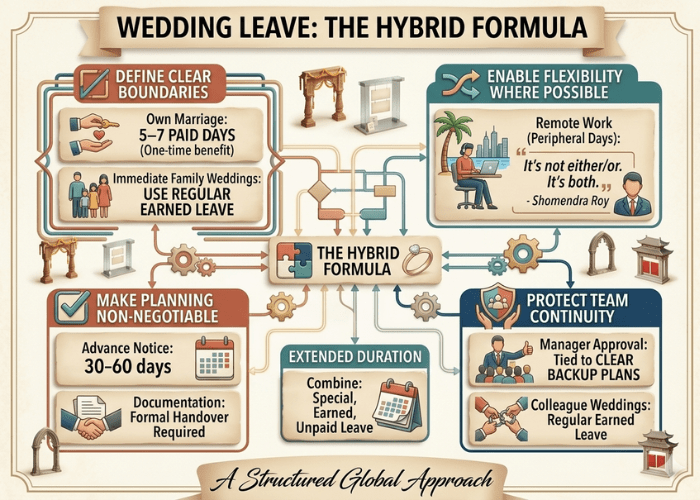
Clear boundaries prevent policy creep. Special leave is typically limited to an employee’s own wedding. Family weddings are treated as regular leave. Exceptions may exist, but they are documented, not normalised.
The hardest decisions emerge with clustered absences. “Business continuity is non-negotiable,” says Suryameet Roy. Managers must prioritise, stagger approvals, and at times decline requests, even for the same event.
Behind these policies lies operational infrastructure. Mandatory handovers, cross-training, temporary support during peak periods, and selective remote work make flexibility sustainable. Without these safeguards, extended leave becomes difficult to manage.
“Marriage leave is usually planned in advance, allowing teams to redistribute work and maintain continuity.”
Pawan Kumar, CHRO, Rinac India
The compromise that holds
What emerges is not a neat solution, but a workable one.
“We don’t create exceptions for weddings per se, but we enable flexibility through structured frameworks,” says Roy of J M Baxi Group. “It is about mutual accountability.”
That principle cuts both ways. Organisations acknowledge cultural realities. Employees accept operational constraints.
“A combination of global standards and local flexibility works best,” Kumar notes.
The wedding leave debate is less about days off and more about how organisations interpret culture when it becomes operationally inconvenient. The answer is not elegant. It is negotiated.
An uncomfortable balance between empathy and efficiency.
Not perfect. But in global workplaces, it may be the only model that holds.