



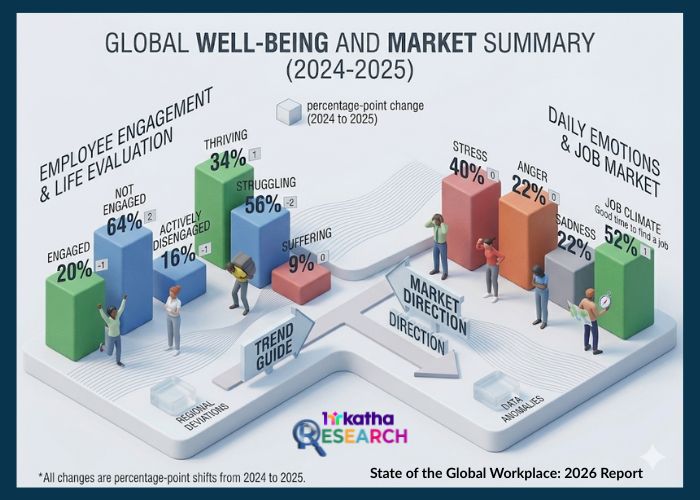
There is a number at the centre of Gallup’s 2026 State of the Global Workplace report that should disturb every board, every HR director and every policymaker with an interest in economic growth. Global employee engagement has fallen to 20 per cent – its lowest level since 2020, and this is the first time in Gallup’s tracking history that it has declined for two consecutive years.
The cost is not abstract. Low engagement cost the global economy approximately $10 trillion in lost productivity last year. That is 9 per cent of global GDP, erased not by recession or conflict, but by the quiet, cumulative effect of workers who are present but not particularly invested in what they are doing.

The question is not whether this matters. It is why it is happening – and whether the answer changes what organisations should do next.
The manager collapse
The explanation that emerges from the data is both specific and uncomfortable. The decline in global engagement is not being driven primarily by frontline workers. It is being driven by managers.
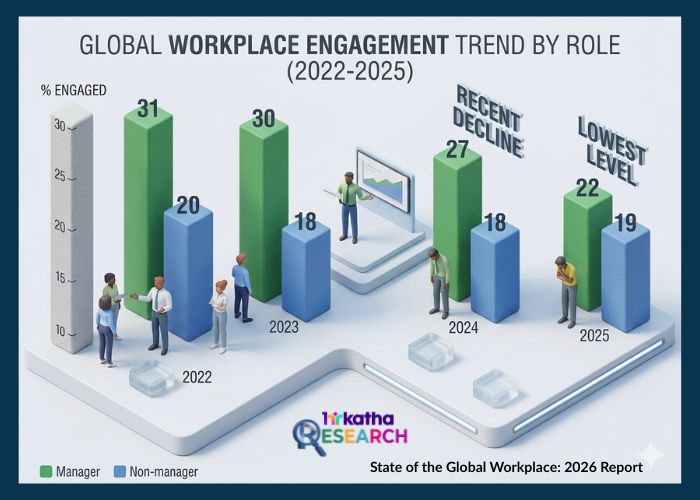
In 2022, 31 per cent of managers were engaged at work, compared with 20 per cent of non-managers — an eleven-point premium reflecting the motivational reality of responsibility and control. By 2025, manager engagement had fallen to 22 per cent, while non-manager engagement stood at 19 per cent. The premium has effectively disappeared.
The trajectory is stark. Manager engagement dropped nine points between 2022 and 2025, with the sharpest single-year fall — five points — occurring between 2024 and 2025. Individual contributor engagement also declined but has shown a slight recovery. The divergence matters. Something is happening specifically to managers.
South Asia and the flattening effect
The regional data sharpens the picture further. South Asia — driven largely by India — recorded the steepest decline in manager engagement in 2025, falling eight points in a single year. Overall engagement in the region dropped five points.
Gallup’s interpretation is cautious but clear. The percentage of managers in South Asia declined alongside engagement levels, suggesting that organisations are cutting management roles while expanding the span of control for those who remain.
The consequences are predictable. Fewer managers means larger teams. And larger teams make management harder. Gallup’s own research shows that manager engagement declines as team sizes grow. A manager responsible for twelve people faces a fundamentally different job from one managing six.
Flattening organisations may reduce cost on paper. In practice, it often transfers the burden onto the managers who remain.
The AI complication
Artificial intelligence (AI) does not simplify this equation. It intensifies it.
Gallup’s Q1 2026 workforce data shows that the strongest driver of AI adoption is not the technology itself, but managerial support. Among frequent AI users, 79 per cent strongly agree their manager actively supports its use. Among infrequent users, only 46 per cent say the same.
The multiplier effect is striking. Employees who feel supported by their manager are 8.7 times more likely to say AI has transformed how work gets done, and 7.4 times more likely to say it helps them focus on what they do best.
Yet, fewer than one-third of employees in AI-enabled organisations strongly agree their manager supports its use. A similar pattern appears globally.
Managers are the lever. Most organisations have not equipped them to pull it.
This creates a compounding problem. Organisations are reducing management layers, increasing spans of control, and asking remaining managers to lead technological change — all while engagement among those managers is falling.
The best-practice gap
Not all organisations are struggling.
Among best-practice organisations — those that treat engagement as a long-term strategic priority — 79 per cent of managers are engaged. That is nearly four times the global average.
These organisations are not defined by sector or geography. They are defined by intent. Engagement is not treated as an annual metric. It is managed deliberately.
The gap between 22 per cent and 79 per cent is not marginal. It is structural.
What it means for India
For Indian organisations, the timing is uncomfortable. The IT sector has already shed mid-level roles, increasing spans of control for remaining managers. The workforce is operating under sustained pressure.
Gallup’s finding that manager capability can offset larger team sizes offers some optimism. However, that requires investment — not just in tools, but in the human skills of coaching, prioritisation and connection.
While AI may assist managers, it cannot replace them.
The unanswered question
Global engagement at 20 per cent. A $10 trillion cost. Manager engagement at 22 per cent. No region improving.
These are not isolated signals. These numbers describe a system under strain — one in which the people responsible for translating strategy into execution are themselves increasingly disengaged.
The question is no longer whether manager engagement matters.
It is whether organisations are willing to treat managers as a strategic asset — or continue to treat them as a layer to be optimised away.
The cost of getting that answer wrong is already visible.