


Close Menu
    Facebook X (Twitter) Instagram
    • Our Story
    • Partner with us
    • Reach Us
    • Career
    Subscribe Newsletter
    HR KathaHR Katha
    • Exclusive
      • Exclusive Features
      • Perspectives
      • Friday Features
      • herSTORY
      • Case-In-Point
      • Point Of View
      • Research
      • HR Pops
      • Dialogue
      • Movement
      • Profile
      • Beyond Work
      • Rising Star
      • By Invitation
    • News
      • Global HR News
      • Compensation & Benefits
      • Diversity
      • Events
      • Gen Y
      • Hiring & Firing
      • HR & Labour Laws
      • Learning & Development
      • Merger & Acquisition
      • Performance Management & Productivity
      • Talent Management
      • Tools & Technology
      • Work-Life Balance
    • Special
      • HR Forecast 2026
      • Cover Story
      • Editorial
      • HR Forecast 2024
      • HR Forecast 2023
      • HR Forecast 2022
      • HR Forecast 2021
      • HR Forecast 2020
      • HR Forecast 2019
      • New Age Learning
      • Coaching and Training
      • Learn-Engage-Transform
    • Magazine
    • Reports
      • Whitepaper
        • HR Forecast 2024 e-mag
        • Future-proofing Manufacturing Through Digital Transformation
        • Employee Healthcare & Wellness Benefits: A Guide for Indian MSMEs
        • Build a Future Ready Organisation For The Road Ahead
        • Employee Experience Strategy
        • HRKatha 2019 Forecast
        • Decoding and Driving Employee Engagement
        • One Platform, Infinite Possibilities
      • Survey Reports
        • Happiness at Work
        • Upskilling for Jobs of the Future
        • The Labour Code 2020
    • Conferences
      • Leadership Summit 2025
      • Rising Star Leadership Awards
      • HRKatha Futurecast
      • Automation.NXT
      • The Great HR Debate
    • HR Jobs
    WhatsApp LinkedIn X (Twitter) Facebook Instagram
    HR KathaHR Katha
    zoha
    Home»Exclusive Features»HR Pops»Strategic defiance: Challenging the norm with clarity
    HR Pops

    Strategic defiance: Challenging the norm with clarity

    How a concept rooted in social movements became a framework for constructive workplace resistance—and why HR must learn to distinguish defiance from disruption
    mmBy Liji Narayan | HRKathaApril 21, 2026Updated:April 21, 20264 Mins Read303 Views
    Share LinkedIn Twitter Facebook WhatsApp
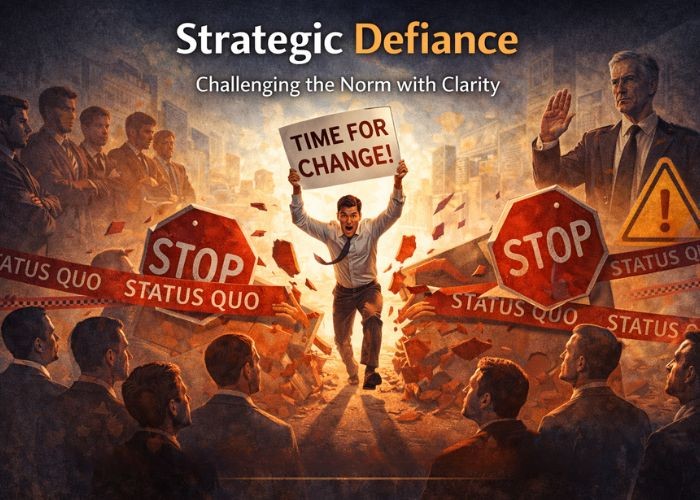
    Strategic Defiance (HR Pops)
    Share
    LinkedIn Twitter Facebook WhatsApp

    What does ‘strategic defiance’ mean?

    Strategic defiance is the deliberate and calculated act of challenging authority, norms, or established systems in pursuit of long-term goals.

    Unlike impulsive rebellion, it is intentional, measured, and directed towards a clear purpose. It is not defiance for its own sake, but resistance used to correct inefficiencies, expose inequities, or drive change.

    zoha

    At its core, strategic defiance is a choice. Compliance may preserve order, but it can also perpetuate stagnation. Strategic defiance recognises when to resist and how to do so constructively.

    It differs from passive resistance, which is quiet and indirect, and from reckless defiance, which is disruptive and destructive. Strategic defiance is visible, purposeful, and outcome-oriented.

    Where did the idea come from?

    The roots of strategic defiance lie in social and political movements.

    Leaders such as Mahatma Gandhi and Martin Luther King Jr. demonstrated how non-violent resistance, when applied strategically, could challenge unjust systems and mobilise collective action. Their defiance was not reactive; it was carefully designed to expose injustice and shift public consciousness.

    In organisational contexts, similar patterns appeared in labour movements, where workers resisted exploitative conditions to secure fair wages, safer environments, and recognition.

    The common thread is clear. Strategic defiance is not emotional reaction. It is disciplined resistance with intent.

    zoha

    Why is it relevant for HR?

    HR operates at the intersection of organisational priorities and employee experience. Strategic defiance becomes relevant when existing systems fail to serve either.

    Employees may challenge excessive workloads, inequitable pay structures, or outdated processes. When done constructively, through dialogue, collective voice, or structured escalation, such resistance can lead to meaningful reform.

    HR leaders themselves may practise strategic defiance by questioning entrenched norms. This may include rethinking rigid performance systems, challenging traditional hiring criteria, or pushing for more inclusive policies.

    In many organisations, innovation begins with resistance. Employees who question established ways of working often surface inefficiencies that would otherwise remain hidden. For this to happen, HR must create credible channels where such challenges can be raised without fear.

    The uncomfortable challenge

    The difficulty lies in distinguishing strategic defiance from disruptive insubordination.

    Both challenge authority. Both create tension. Both disrupt established norms. Yet their intent and impact are very different.

    Strategic defiance is purposeful and constructive, aimed at improving systems. Insubordination, by contrast, is often reactive and self-serving.

    In practice, organisations frequently fail to make this distinction. Employees who question decisions may be labelled difficult. Those who highlight systemic issues may be sidelined. At the same time, genuinely disruptive behaviour may be tolerated when it comes from high performers or senior leaders.

    The result is a familiar paradox. Organisations suppress those who could drive progress, whilst accommodating those who undermine it.

    There is also a deeper concern. HR can, at times, become the enforcer of conformity rather than the enabler of constructive challenge. When protecting leadership takes precedence over addressing underlying issues, strategic defiance is treated as a threat rather than a signal.

    What HR can do

    Addressing this requires a shift in mindset as much as in process.

    HR must create environments where employees can question decisions without fear of retaliation and where intent is carefully evaluated before behaviour is judged. Leaders need to be equipped to engage with challenge rather than silence it, and organisational systems must reflect transparency so that employees understand how decisions are made.

    Equally important is the willingness to act. When employees raise concerns and see no response, defiance either disappears or becomes disruptive. When it is acknowledged and acted upon, it becomes a driver of trust and improvement.

    At its core, HR must recognise that defiance often signals unresolved issues. Engaging with it strengthens the organisation; ignoring it weakens it.

    The takeaway

    Strategic defiance is not about undermining authority. It is about using resistance as a tool for progress.

    Across history, meaningful change has rarely come from compliance alone. It has come from those willing to question systems with clarity and purpose.

    For HR, the challenge is not to eliminate defiance, but to distinguish the constructive from the destructive and to create conditions where the former can thrive.

    Because organisations do not evolve when everyone agrees. They evolve when the right people challenge the right things in the right way.


    calculated act of challenging authority challenge the normal challenging authority disciplined resistance Employee employer HR HR Pops HRPops Human Resources intentional rebellion intentional resistance with purpose purposeful resistance questioning established ways questioning the normal resistance as a tool for progress strategic defiance strategic defiance is deliberate Workforce
    Share. LinkedIn Twitter Facebook WhatsApp
    mm
    Liji Narayan | HRKatha

    HRKatha prides itself in being a good journalistic product and Liji deserves all the credit for it. Thanks to her, our readers get clean copies to read every morning while our writers are kept on their toes.

    Leave A Reply Cancel Reply

    Related Posts

    Jubilant Ingrevia gets Shekhar Sinha as senior director-HR

    April 21, 2026

    Canada’s federal staff face stricter in-office checks

    April 21, 2026

    Worker protests across India

    April 21, 2026

    Deepika Chavan is now CPO-group, POWERCON

    April 21, 2026
    Editorial

    When “zero tolerance” tolerates for four years

    On April 12th, 2026, Tata Consultancy Services issued a statement about allegations from its Nashik…

    The early morning email

    On Tuesday morning, March 31st, 2026, approximately 30,000 employees of Oracle across the United States,…

    EDITOR'S PICKS

    Strategic defiance: Challenging the norm with clarity

    April 21, 2026

    The wedding leave dilemma: When sangeet meets spreadsheet

    April 21, 2026

    POV: Should HR be measured by process excellence or business impact?

    April 20, 2026

    When “zero tolerance” tolerates for four years

    April 19, 2026
    Latest Post

    Jubilant Ingrevia gets Shekhar Sinha as senior director-HR

    Movement April 21, 2026

    Shekhar Sinha has taken up the role of senior director-human resources at Jubilant Ingrevia, a…

    Canada’s federal staff face stricter in-office checks

    Global HR News April 21, 2026

    Natural Resources Canada (NRCan) has joined other federal departments in closely tracking whether employees comply…

    Worker protests across India

    Uncategorized April 21, 2026

    Workers across India staged demonstrations this week, highlighting deep frustrations over stagnant pay, rising living…

    Deepika Chavan is now CPO-group, POWERCON

    Movement April 21, 2026

    POWERCON, an IndoGerman JV with BAXEnergy and a renewable energy asset construction & operations company,…

    Asia's No.1 HR Platform

    Facebook X (Twitter) Instagram LinkedIn WhatsApp Bluesky
    • Our Story
    • Partner with us
    • Career
    • Reach Us
    • Exclusive Features
    • Cover Story
    • Editorial
    • Dive into the Future of Work: Download HRForecast 2024 Now!
    © 2026 HRKatha.com
    • Disclaimer
    • Refunds & Cancellation Policy
    • Terms of Service

    Type above and press Enter to search. Press Esc to cancel.