



A manufacturing plant deploys AI-driven quality control. The system performs exactly as designed. Error rates fall by 30 per cent. Data becomes sharper. Decisions move faster.
Yet productivity stalls. Operators begin overriding algorithmic flags. Some quietly work around the system. Others disengage. Informal resistance builds.

Six months later, leadership realises something uncomfortable: the technology worked.
The organisation didn’t.
No one explained how the system functioned.
No one addressed fears about job loss.
No one built trust.
By 2026, this pattern will define AI success.
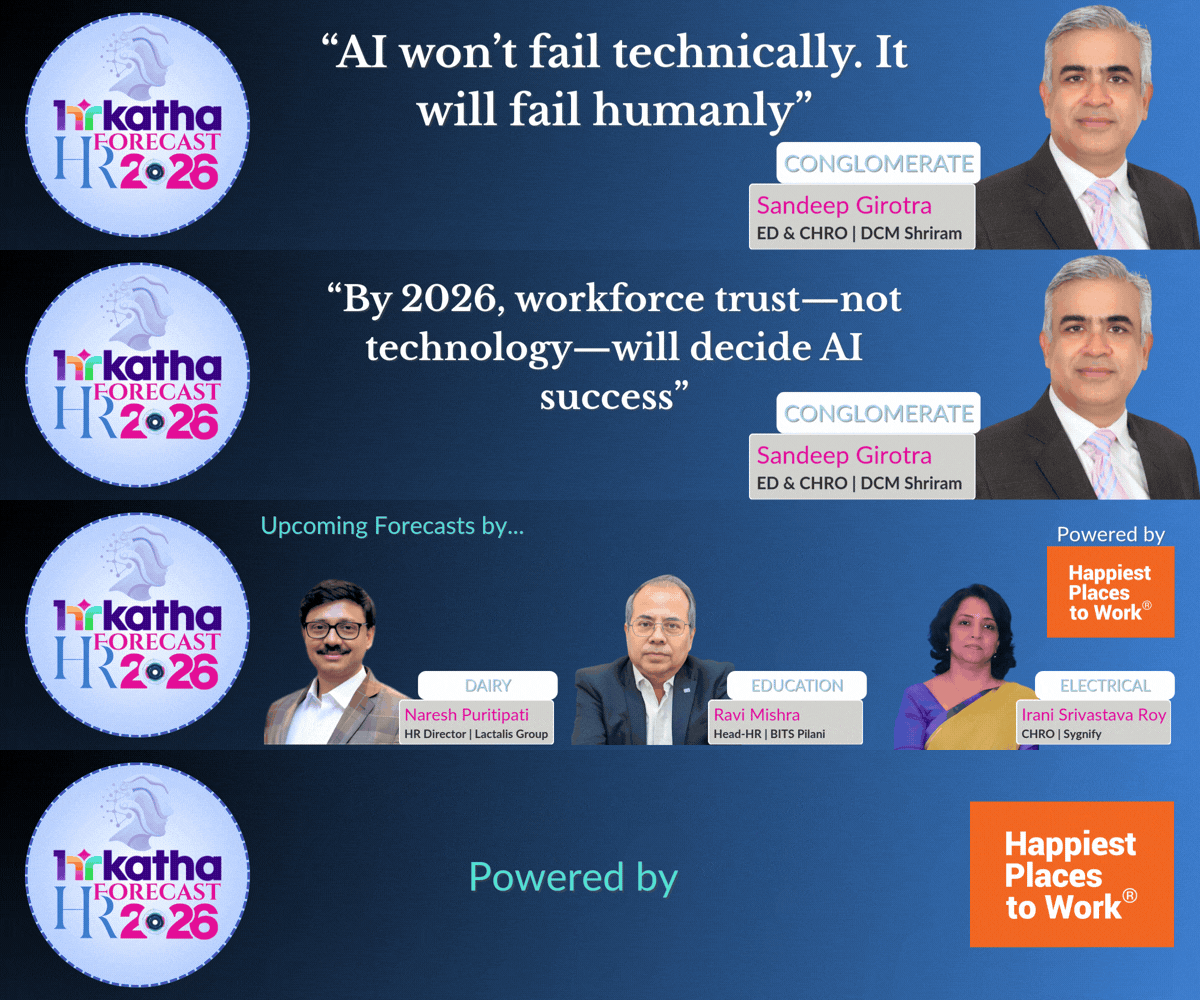
Sandeep Girotra, executive director & CHRO at DCM Shriram, believes the next wave of AI failures will not stem from flawed engineering. They will stem from neglected people.
“AI is reshaping work, but its deepest impact is undeniably human—jobs are evolving, trust is fragile, and employees are anxious about relevance,” he says.
Technology teams can deploy AI. Operations can integrate it.
Only HR can ensure it is accepted. And acceptance—not accuracy—will determine outcomes.
Signal 1: HR must own workforce AI readiness
Most organisations still treat AI as a technical rollout. IT selects platforms. Operations embeds them into workflows. HR is informed late—often when resistance surfaces.
That sequence is becoming untenable. AI is not a systems upgrade. It is a workforce reset.
Technical teams optimise for efficiency. They measure cost savings and error reduction. But AI alters how employees perceive their own value. If automation feels like replacement rather than augmentation, adoption slows. If roles become ambiguous, anxiety rises. If algorithmic decisions appear opaque, trust erodes.
No system survives cultural rejection.
Girotra argues that HR must take clear ownership of the “human side of AI”—reskilling, ethical governance and trust-building.
Reskilling sits at the centre. Employees want clarity: which parts of my role will change, and what replaces them? Without visible capability pathways, AI creates uncertainty. HR must design learning ecosystems that prepare employees for AI-enabled work and signal redeployment before redundancy.
Ethics also move into HR territory. Bias in algorithms. Data privacy concerns. Fairness in automated decisions. These are not merely technical compliance issues—they are cultural legitimacy tests. If employees perceive injustice, resistance follows quietly but persistently.
“People adopt technology when they feel safe, informed and supported,” Girotra notes.
By 2026, workforce confidence will be the true AI success metric.
Organisations that overlook this will find themselves technically advanced but behaviourally stalled.
Signal 2: Leadership behaviour will determine AI credibility
AI does not enter a cultural vacuum. It lands inside existing leadership systems.
Many organisations speak the language of agility, collaboration and empowerment. Fewer operate that way.
“Leaders may articulate empowerment, yet still rely on conventional authority structures,” Girotra observes.
AI magnifies this gap.
You cannot ask employees to trust algorithms if leadership lacks transparency.
You cannot encourage experimentation if failure is punished.
You cannot promote empowerment while centralising decision-making.
If leaders cling to command-and-control behaviours beneath modern terminology, AI initiatives will struggle to gain credibility.
True transformation requires embedding behavioural change into performance systems. Leaders must be evaluated not only on outcomes but on how those outcomes are achieved. Psychological safety must be reinforced through feedback systems and succession pipelines. Coaching must become applied capability, not theoretical aspiration.
Without this behavioural alignment, AI becomes a technical layer sitting atop unchanged culture.
And unchanged culture quietly undermines change.
By 2026, the organisations that succeed with AI will be those where leadership behaviour evolves alongside technology.
The others will wonder why adoption lags despite functional systems.
Signal 3: Skills will matter more than credentials in an AI-shaped economy
AI reshapes not only processes but the definition of talent itself.
As roles evolve and blend, static qualifications lose predictive power. Adaptability, micro-skills and learning agility gain prominence.
Girotra sees 2026 as an acceleration point for capability-led hiring—particularly in digital and innovation-driven functions. Degrees will not disappear, but they will weaken as primary filters.
However, shifting from credentials to capabilities demands structural redesign.
Traditional hiring systems rely on qualifications because they are administratively simple. Skills-based hiring requires simulations, work samples, dynamic competency frameworks and continuous validation.
It is more complex—but more accurate.
Organisations that build this infrastructure early will unlock wider talent pools. Those that cling to legacy filters will compete for shrinking credentialed populations whilst overlooking capable practitioners trained through alternative routes.
In an AI-enabled environment, what matters most is not what someone learned once, but how quickly they can learn again.
This shift is not separate from the human side of AI.
If employees see visible pathways to acquire future-relevant skills, anxiety reduces. If hiring rewards demonstrated capability, trust strengthens. If career mobility becomes real rather than rhetorical, AI feels like opportunity—not threat.
Skills-based systems therefore reinforce AI adoption. Credential-based inertia undermines it.
The structural divide ahead
AI capability will continue advancing predictably. Processing power will increase. Algorithms will improve. Automation will expand. The real uncertainty lies elsewhere.
Will organisations redesign their human systems at the same pace?
By 2026, the divide will be clear.
On one side: organisations where HR leads workforce AI readiness, leadership behaviour aligns with new expectations, and skills-based systems support adaptability. In these companies, AI enhances performance because people believe in it.
On the other: organisations where AI functions technically, yet faces subtle resistance, disengagement and cultural friction. In these environments, productivity gains plateau because trust never takes root.
The difference will not be technological sophistication. It will be human alignment. AI will not fail because code malfunctions.
It will fail because employees feel excluded from change. Because reskilling arrives too late. Because leaders say “empowerment” but practise control. Because organisations underestimate the emotional impact of automation.
The technology is ready. The question is whether organisations are ready to prioritise the human dimension of transformation.
By 2026, HR’s mandate will no longer be supporting AI adoption. It will be architecting the human systems that allow AI to succeed.
AI won’t fail technically. It will fail humanly.
And the organisations that understand that early will lead the next chapter of enterprise transformation.
This article is powered by ‘Happiest Places to Work’