



There is a condition spreading through the global workforce that has no clean diagnosis. Workers are learning constantly, adapting continuously and still falling behind.
The 2026 Human Progress Report by ETS, based on 32,558 adults across 18 countries, puts a number on the scale of the problem: 93 per cent of workers report experiencing at least one significant barrier to professional success in the past year.

That is not a rounding error. It is a near-universal condition.
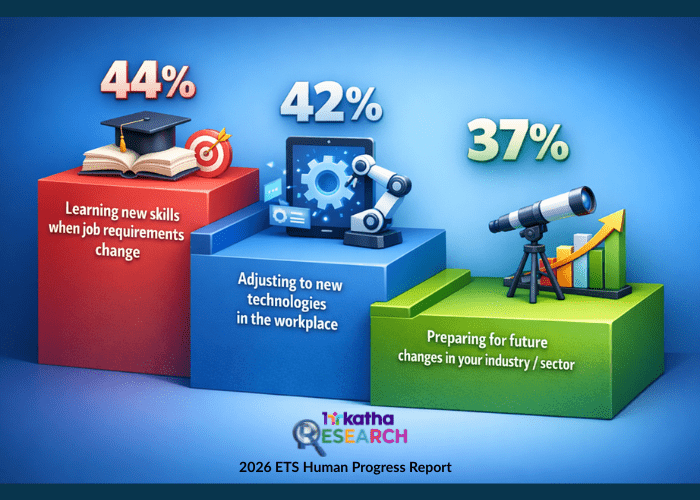
The barriers themselves are revealing. The three most cited are learning new skills when job requirements change (44 per cent), adjusting to new technologies (42 per cent) and preparing for future changes before they arrive (37 per cent). Taken together, these are not separate problems. They are different expressions of the same underlying reality: the pace of change at work has outrun the pace at which most people can adapt to it.
The disruption cascade
Workplace disruption is no longer episodic. It cascades.
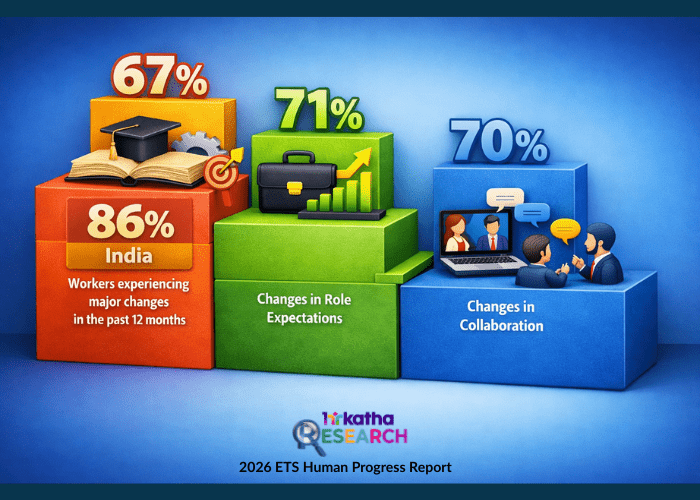
Some 67 per cent of workers report at least one major workplace change in the past year.
Among those experiencing changes in technology, 71 per cent also report shifts in role expectations, while 70 per cent report changes in how they collaborate.
Change does not arrive in isolation. It compounds.
Workers learning a new tool are not simply learning a new tool. They are simultaneously adjusting to new expectations, new workflows and new ways of working, while continuing to deliver on existing responsibilities.
This cascading effect helps explain why adaptation feels harder than ever, even as learning efforts increase.
The pattern is most pronounced in emerging economies. India reports disruption levels as high as 86 per cent, followed by Kenya and Vietnam (85 per cent) and Nigeria (83 per cent). In high-income countries, the figure drops to 55 per cent – still significant, but markedly lower.
The difference is not exposure to change. It is the capacity to absorb it.
The adaptability paradox
The report’s most striking finding is not the scale of disruption. It is how workers are responding, and how little it seems to be helping.
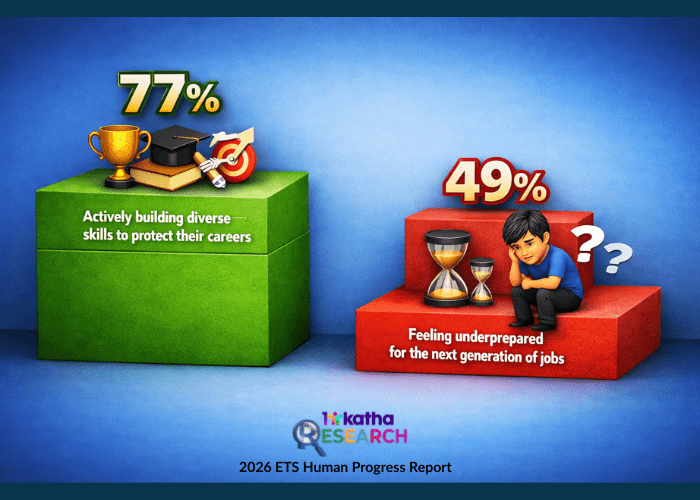
Some 77 per cent of workers say they are proactively building new skills. Yet 49 per cent say they still feel underprepared for the next generation of roles.
The effort is real. The confidence it produces is not.
This is the adaptability paradox. Workers are not resisting change. They are responding to it.
But the environment is moving faster than individual effort can keep up.
By the time a skill is learned, demand has shifted. By the time a tool is mastered, a newer one is already reshaping the role.
The result is a new baseline: a workforce defined less by confidence and more by the persistent sense of catching up. Some 69 per cent of workers say they have no clear picture of what jobs will look like in 2035.
They are adapting to a future they cannot clearly see.
The generation and geography gap
The burden of disruption is uneven, and the patterns challenge common assumptions. Younger workers are experiencing more disruption, not less. Some 75 per cent of Gen Z and 74 per cent of Millennials report significant workplace change.
The assumption that younger workers are inherently more adaptable because they are digital natives appears overstated. Being comfortable with technology as a consumer is not the same as adapting to its continuous reinvention at work.
Geography matters as well. Workers in middle-income countries report disruption at 78 per cent, compared with 55 per cent in high-income markets.
In India, the scale of the challenge is particularly stark. 98 per cent of workers report at least one barrier to professional success, suggesting disruption is not episodic but constant. For Indian employers and institutions, that figure is not a warning. It is a description of the present.
The credential illusion
One response to uncertainty has been certification. Some 80 per cent of workers hold at least one credential, with similarly high levels across sectors. It is an understandable response. When the future feels uncertain, a credential feels like evidence of preparation.
Yet credentials are not resolving the problem.
Certification, it appears, is neither scarce nor sufficient.
What workers lack is not proof of learning, but clarity on what to learn next, and whether that learning will remain relevant long enough to matter.
What the system is failing to provide
The report points to a structural gap that individual effort cannot close.
Workers are willing to learn. But many lack direction. Some 36 per cent say identifying which skills to prioritise is itself a major barrier.
In a labour market where signals about future demand are fragmented and fast-moving, the problem is not motivation. It is navigation.
This has direct implications for employers. Organisations that treat learning as a periodic intervention rather than a continuous system are misaligned with the reality their workforce is facing.
The 44 per cent of workers who say jobs are changing faster than they can learn are not failing individually. They are operating in systems that were not designed for this speed of change.
The unanswered question
The report leaves one question unresolved.
Who is responsible for closing the gap between the pace of change and the capacity to adapt to it?
Workers are trying. Employers are investing. Institutions are updating.
But none of it, yet, is happening a the speed the data suggests is necessary.