



Diversified manufacturing groups present HR with a particular kind of complexity. Businesses within the same conglomerate operate in entirely different markets, with distinct talent profiles, competitive pressures and definitions of performance. The challenge is not just managing people, but designing systems that work across that variation without becoming so elaborate that they collapse under their own weight.
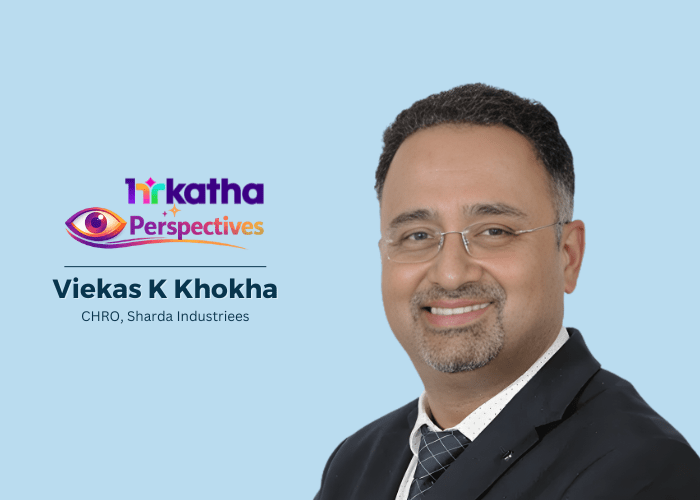
Viekas K Khokha has spent his career moving deliberately across industries. In conversation with HRKatha, he explains why attitude consistently outperforms expertise, why the bell curve debate misses the real issue, and why simplicity is the one capability HR undervalues most.

Hire for attitude, build the rest
Are you hiring for skills that exist today, or the capacity to learn what does not yet exist?
Every time I have moved into a new industry, I have faced the same expectation: hire from within the sector. And every time, I have questioned it. Technical skills can be built. What is far harder to cultivate is the mindset to learn.
In every organisation I have led, we created internal academies to bridge this gap—structured programmes combining foundational learning, hands-on exposure and mentoring. The premise was simple: if someone has the right attitude, curiosity and openness, the technical depth will follow.
Future-ready talent is defined less by what someone knows today and more by how they approach tomorrow. Adaptability consistently proves more valuable than accumulated expertise.
“Technical skills can always be built. What is far harder to cultivate is the mindset to learn.”
Beyond the bell curve
What works better than traditional appraisals when trying to align reward with real contribution?
Before moving away from something, it is worth understanding why it existed. The bell curve was designed to distribute limited rewards across a workforce. The real issue was never distribution – it was calibration.
If an organisation achieves an outcome, the harder question is how to assess each individuals contribution to it. When that calibration is strong, rigid models become less relevant. When it is weak, no system produces fairness.
What organisations need to measure is the journey of performance – progress, contribution and impact. Rewards then align more naturally, without forcing artificial categorisation.
“The shift is not away from measuring performance. It is towards measuring it more honestly.”
Not everyone can keep pace
How do you scale meaningful development across an organisation rather than concentrating it at the top?
Leadership development cannot be treated as a standalone intervention. It has to align with business direction.
Everything begins with strategic clarity. Once that is defined, organisations can identify the behaviours and capabilities required. Training then becomes a response—not a starting point.
There is also a pragmatic reality that is rarely stated openly. Not everyone can adapt at the pace required. That is not failure—it is mismatch. Organisations must address this honestly, while ensuring fairness and dignity in transitions.
“Training is not the starting point. It is a response to clearly identified needs.”
Manager or individual contributor
How do you decide who should lead people and who should remain an individual contributor?
The idea that people leave managers oversimplifies the issue. Culture and systems shape employee experience just as much.
The more persistent mistake is assuming strong individual contributors will naturally become strong managers. Managing people requires a fundamentally different orientation.
The real question is not whether someone is a manager or an individual contributor. It is whether they are in the right role. Both paths should carry equal value and clarity.
“The question is not whether someone is a manager or an individual contributor. It is whether they are in the right role.”
HR as a business driver
What is most misunderstood about HR—and what differentiates a great HR leader?
HR cannot operate independently of the business. Without understanding product, customer and context, interventions remain disconnected from reality.
And then there is simplicity. As systems become more complex, they become harder to implement. The real skill lies in solving complex people and business problems with clarity and practicality.
That combination—business depth and simplicity—is what separates an effective HR leader.
“HR cannot create impact unless it is deeply embedded in the business.”
Sales taught me people
What shaped you most as a people leader—and what would you tell your younger self?
My early experience in sales shaped how I approach HR more than anything within the function. Being close to customers and frontline teams built a perspective that stayed with me.
It made me more accessible and grounded. I try to treat employees with the same seriousness I would give a customer.
If I had to advise my younger self: understand the business before trying to change it. Stay close to the people doing the work. Build trust through consistent, small actions.
“Leadership is not defined by frameworks. It is defined by the experience you create for others.”