

Close Menu
    Facebook X (Twitter) Instagram
    • Our Story
    • Partner with us
    • Reach Us
    • Career
    Subscribe Newsletter
    HR KathaHR Katha
    • Exclusive
      • Exclusive Features
      • HR Pops
      • herSTORY
      • Perspectives
      • Point Of View
      • Case-In-Point
      • Research
      • Dialogue
      • Movement
      • Profile
      • Beyond Work
      • Rising Star
      • By Invitation
    • News
      • Global HR News
      • Compensation & Benefits
      • Diversity
      • Events
      • Gen Y
      • Hiring & Firing
      • HR & Labour Laws
      • Learning & Development
      • Merger & Acquisition
      • Performance Management & Productivity
      • Talent Management
      • Tools & Technology
      • Work-Life Balance
    • Special
      • Cover Story
      • Editorial
      • HR Forecast 2024
      • HR Forecast 2023
      • HR Forecast 2022
      • HR Forecast 2021
      • HR Forecast 2020
      • HR Forecast 2019
      • New Age Learning
      • Coaching and Training
      • Learn-Engage-Transform
    • Magazine
    • Reports
      • Whitepaper
        • HR Forecast 2024 e-mag
        • Future-proofing Manufacturing Through Digital Transformation
        • Employee Healthcare & Wellness Benefits: A Guide for Indian MSMEs
        • Build a Future Ready Organisation For The Road Ahead
        • Employee Experience Strategy
        • HRKatha 2019 Forecast
        • Decoding and Driving Employee Engagement
        • One Platform, Infinite Possibilities
      • Survey Reports
        • Happiness at Work
        • Upskilling for Jobs of the Future
        • The Labour Code 2020
    • Conferences
      • Leadership Summit 2025
      • Rising Star Leadership Awards
      • HRKatha Futurecast
      • Automation.NXT
      • The Great HR Debate
    • HR Jobs
    WhatsApp LinkedIn X (Twitter) Facebook Instagram
    HR KathaHR Katha
    Home»Exclusive Features»Research»What employees want and what CEOs think they want
    Research

    What employees want and what CEOs think they want

    mmBy Prajjal Saha | HRKathaMay 20, 20154 Mins Read2931 Views
    Share LinkedIn Twitter Facebook
    Share
    LinkedIn Twitter Facebook

    Despite the fact that Indian CXOs fail to gauge their employees’ needs, the Indian workforce is among the happiest lot in the world. SucessFactors, a SAP company, identifies these gaps.

    What will be the workforce like in the year 2020? It will be as diverse as one has ever seen. First, there will multiple generations at work together, which means that there will be people with different skills, experiences, habits and motivation levels. There will be more freelancers and contractual employees who may even outnumber the full-timers.

    According to Workforce2020, a global survey done by SucessFactors, a SAP company, and Oxford Economics, around 80 per cent of the Indian companies revealed that they were increasingly using contingent, intermittent, seasonal, or consultant employees, and the global figure for the same was 83 per cent.

    Around 24 per cent of the Indian companies voted for a change in HR policy due to the changing dynamics at the workplace. The change would be in terms of compensation, training and HR technology.

    So are the Indian companies geared up to adapt to these changing workplace?

    The study revealed 64 per cent of respondents from India said that workforce issues drive strategy at the board level in their respective companies, and around 58 per cent of the Indian respondents claimed that their respective companies have execution plans for achieving their vision of workforce management, while 25 per cent of the respondents said their respective companies would implement this vision for their workforce in three years.


    Around 23 per cent of Indian companies use quantifiable metrics and benchmarking for workforce development; 37% know how to extract meaningful insights from that data.

    However, when it comes to understanding the millennial generation at workplace, there is a lot to catch up for the Indian companies. When Indian executives were asked to give their opinion on the millennials, around 42 per cent believed that millennials will consider leaving their job due to lack of learning and development. However, when millennials were asked about the same, only 2 percent of the respondents said that they have done so.

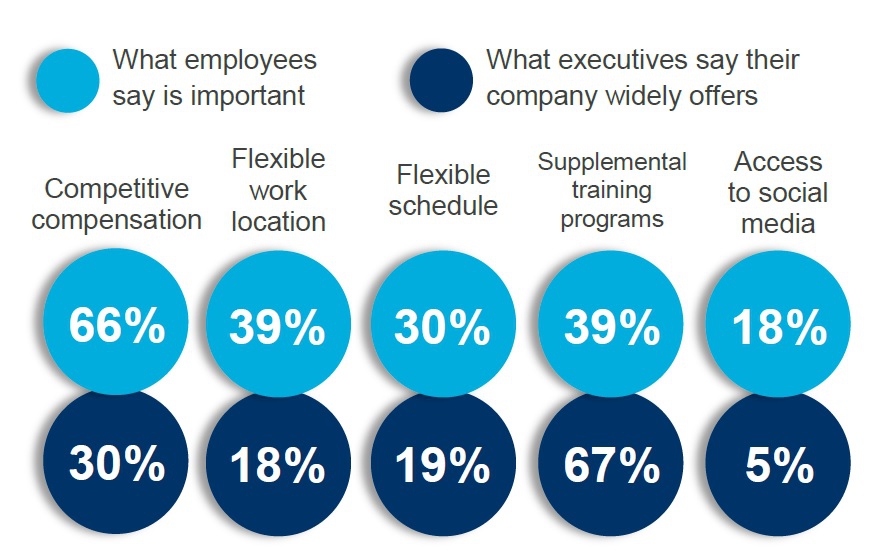
    There seemed to be a gap even while understanding the employees’ need for Indian companies. For instance, while 66 per cent of the employees said that competitive compensation was important, only 30 per cent of the Indian companies claimed that they offer the same. Similarly despite more employees wanting flexible work location and flexible timings, very few companies offered these facilities.

    Indian companies lay too much focus on supplemental training programmes, but fewer employees are in favour of this. This implies that the entire effort would go futile. In fact, only 32 per cent of employees said that their company provides the right tools to help them grow and improve job performance.

    However, the positive aspect was that even when there was a gap in understanding the needs of employees, more than 54 per cent of Indian employees are satisfied or very satisfied with their jobs. In comparison, in China, only 35 per cent of employees were satisfied.

    On this front Malaysia tops the list highest satisfaction level among employees with 59 per cent of the respondents claiming that are satisfied or very satisfied with their jobs. Australia was at par with India, while the other two countries where above 50 per cent respondents have claimed satisfaction are South Africa and Switzerland.


    Interestingly, all countries in the Americas (both North & South) except the US have recorded low satisfaction level among employees. Chileans were most unsatisfied with only 22 per cent employees claiming that there were happy with their jobs. Brazilians come next with 23 per cent, followed by Columbia (24 per cent), Mexico (25 per cent) and Canada (27 per cent). In the US, only 33 per cent employees claimed they were happy.

    When it came to leadership issues, both the senior executives and the workforce of Indian companies seem to be on the same tangent. Both agree that leadership was lacking—and companies were not focused enough on developing future leaders.

    Only 17 per cent of Indian executives said that their company plans for succession and continuity in key roles and 27 per cent said that that when a senior person left the company the tendency was to fill the role from within the organisation. Around 38 per cent of executives said that their plans for growth were being hampered by lack of access to the right leaders.

    The survey included executives and employees from across sectors be it banking, insurance, public sector, healthcare, public services and consumer goods. While one hands the CXOs and functional heads of companies including the vice-presidents were interviewed, the front line employees, and business managers and line managers were also part of the respondent team.

    Employee Satisfaction Oxford Economics SAP Sucessfactors Workforce2020
    Share. LinkedIn Twitter Facebook
    mm
    Prajjal Saha | HRKatha

    Dr. Prajjal Saha, editor and publisher of HRKatha since 2015, leverages over 25 years of experience in business journalism, writing, and editing. He founded HRKatha to provide insightful analysis on the evolving workplace. With expertise spanning HR, marketing, distribution, and technology, Saha has a deep understanding of business dynamics. His authorship of the acclaimed Marketing White Book highlights his versatility beyond HR. A trusted voice across industries, his clear and thoughtful commentary has earned him a reputation for thought leadership, making him a reliable source of knowledge and insights for professionals navigating the complexities of the business world.

    3 Comments

    1. sanjay karthikeyan on May 21, 2015 10:00 am

      Excellent article, i agree to most of your points most of the leaders do not know how to handle the current generation employees. More over they do not know what they require

      Reply
    2. S C Narang on May 21, 2015 1:13 pm

      This is a very incisive study to find out gap between perceptions of employees and senior management about certain important metric of HR ,job satisfaction, remuneration and training. I hope the study is made available to corporate sector to carry out course correction.

      Reply
    3. D.Elangovan on May 23, 2015 12:35 pm

      Most of the Indian Employee lie about their satisfaction levels. At least the canada and other countries they can be honest or afford to be honest about their satisfaction levels

      Reply
    Leave A Reply Cancel Reply

    Related Posts

    India’s Succession Paradox: Plans Double in Success, Yet 91% Ignore AI

    December 10, 2025

    The 85% invisibility: Why India’s neurodiverse talent stays hidden

    December 3, 2025

    India’s Employability Paradox: Women surge ahead as polytechnics collapse

    November 26, 2025

    SAP faces sharp drop in employee trust as cloud and AI pivot accelerates

    November 25, 2025

    EMPLOYEE FINANCIAL WELLNESS HUB

    Beyond the bonus: Why financial literacy matters more than pay rises

    A Rs 10,000 disappears with alarming speed in urban India: transport, meals, utilities, occasional entertainment.…

    The hidden cost of financial anxiety

    A young software engineer in Bengaluru earns Rs 12 lakhs annually—double what her parents made…

    EDITOR'S PICKS

    POV: Should AI be allowed to make final hiring decisions without human intervention?

    December 15, 2025

    India’s right to disconnect: The harsh reality behind the social media buzz

    December 14, 2025

    The “No” that saves HR Leaders their sanity

    December 12, 2025

    herSTORY: Padmaja Palekar, people experience global mobility manager-Asia, Unilever

    December 11, 2025
    Latest Post

    Employee alleges lack of empathy over period pain; Reddit post sparks debate

    News December 15, 2025

    A woman has alleged workplace insensitivity at a Mumbai-based mental health non-governmental organisation (NGO) after…

    Delhi govt restricts late office hours for women employees

    News December 15, 2025

    The Delhi government has issued fresh guidelines restricting late office hours for women employees, allowing…

    PIB debunks claim on DA, pay commission benefits for retired Central govt employees

    News December 15, 2025

    A viral WhatsApp message claiming that retired Central government employees would no longer be eligible…

    OpenAI removes equity vesting cliff for employees

    News December 15, 2025

    OpenAI has ended its policy requiring employees to complete a minimum tenure before their equity…

    Asia's No.1 HR Platform

    Facebook X (Twitter) Instagram LinkedIn WhatsApp Bluesky
    • Our Story
    • Partner with us
    • Career
    • Reach Us
    • Exclusive Features
    • Cover Story
    • Editorial
    • Dive into the Future of Work: Download HRForecast 2024 Now!
    © 2025 HRKatha.com
    • Disclaimer
    • Refunds & Cancellation Policy
    • Terms of Service

    Type above and press Enter to search. Press Esc to cancel.