



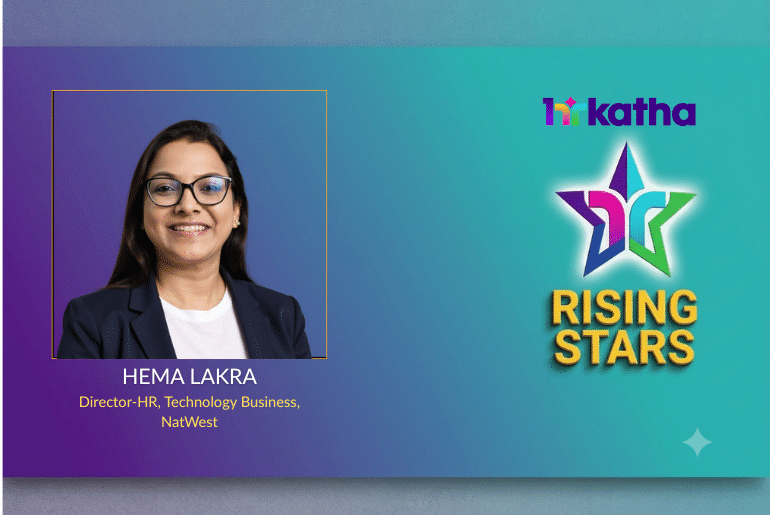
Hema Lakra’s interest in people and organisations began with Economics. What fascinated her was the relationship between economic trends, business decisions and human behaviour, and how changes in one could influence the others.
That curiosity eventually took her into HR, where she has spent more than two decades working with organisations through different stages of change.
Today, as director, HR, Technology Business, at NatWest, Lakra brings that perspective to a function where technological and organisational priorities are continually evolving.
Her experience of leading large-scale transformations has reinforced a belief that may seem counterintuitive in senior leadership: credibility does not require having every answer.
Sometimes it begins with acknowledging that you do not.
Trust through transformation
Large-scale change tests the relationship between employees and leadership.
Structures change, priorities shift and decisions affecting people’s careers are often made before every consequence can be fully understood.
Lakra has learnt that one of the hardest parts of transformation is maintaining engagement and trust while employees are trying to make sense of what the changes mean for them.
The temptation for leaders can be to project certainty, even when the situation remains fluid.
Lakra takes a different view.
She believes transparency about what is known, what remains uncertain and why decisions are being made is more valuable than offering reassurance that cannot yet be supported.
Listening matters equally. Employees may accept that an organisation cannot answer every question immediately, but they are less likely to accept feeling excluded from the conversation altogether.
For Lakra, trust is therefore not something leaders establish before a transformation and then draw upon. It has to be maintained throughout the process, particularly when the news is difficult.
Managers are where strategy becomes real
Asked what she would prioritise on her first day as a CHRO, Lakra does not begin with a new policy or an ambitious HR programme.
She would focus on manager effectiveness.
“The quality of leadership that employees experience every day has the greatest impact on engagement, performance, development, and retention,” she says.
It is an observation that places responsibility for employee experience much closer to the everyday workplace.
An organisation may have a well-designed people strategy, but employees encounter that strategy largely through their immediate managers: how expectations are communicated, how feedback is delivered, whether concerns are taken seriously and whether development opportunities are made available.
That is why Lakra believes investment in managerial capability and accountability should be a priority.
The argument becomes especially important during transformation. Senior leadership may determine the direction of change, but managers are often the people employees turn to when they want to understand what that direction means for their work.
If managers lack the confidence or capability to handle those conversations, even a carefully planned transformation can lose credibility at the point where employees experience it.
Explaining the difficult decision
Lakra applies the same emphasis on credibility when HR must communicate decisions that employees may not welcome.
Her starting point is that people deserve to understand the reasoning behind a decision, even when they disagree with the outcome.
That requires more than delivering a carefully-prepared message. It means allowing concerns to surface, responding respectfully and being consistent about the principles guiding the decision.
But transparency also has limits.
HR professionals regularly handle information that cannot be disclosed, whether because of confidentiality, individual privacy or organisational obligations.
“I am always honest about what I can share, what I cannot share, and why,” she says. “Consistency and integrity are fundamental to building trust.”
For Lakra, the distinction is important. Openness does not mean revealing everything. It means being truthful about the boundaries of what can be discussed rather than creating an impression of certainty or completeness that does not exist.
Employees may still be disappointed by the decision. What matters is whether the process gives them reason to believe they have been treated fairly.
Performance without losing the human connection
Lakra believes effective organisations must be able to demand high performance without losing sight of the people expected to deliver it.
“The most successful organisations I’ve seen are those that balance high performance with genuine care for people,” she says.
That balance requires an environment where employees can challenge ideas, express concerns and contribute without feeling that disagreement is unwelcome.
It also influences how she thinks about generational differences.
While employees at different career stages may have distinct expectations around flexibility, development or ways of working, Lakra is cautious about treating generations as entirely separate groups.
She sees several common expectations across the workforce: meaningful work, opportunities to grow, flexibility and leadership that demonstrates genuine concern.
For HR, the challenge is not to create a different organisational culture for every demographic group. It is to recognise individual needs while maintaining a shared sense of purpose and belonging.
The skills behind better judgement
Lakra identifies business acumen, analytical thinking and change leadership as three capabilities HR professionals increasingly need.
Business understanding helps HR recognise the commercial consequences of people decisions. Data allows professionals to challenge assumptions and examine outcomes more rigorously. Change leadership helps translate those insights into action when circumstances are uncertain.
But she sees their value in combination rather than isolation.
Data without business context can produce technically sound but impractical recommendations. Business understanding without evidence can reinforce assumptions. And neither achieves much if HR cannot help people navigate the changes that follow.
Her own leadership philosophy reflects that combination of knowledge and humility.
Colleagues and team members who challenged her thinking have taught her that experience does not eliminate the need to remain curious.
“Some of the best ideas emerge when you are willing to learn from those around you,” she says.
It is also why she measures professional satisfaction less by the programmes she has introduced than by what people have achieved through them.
Her greatest reward, she says, comes “from seeing individuals, teams, and leaders grow and achieve more than they thought possible.”
Quick Takes
Her personality in three words: Authentic, curious and optimistic.
Preferred retention tool: Career growth, because purpose and opportunity create lasting commitment.
Engagement driver: Recognition. People rarely forget how valued they felt.
A surprising skill that makes her better at her job: Her fascination with economics and human behaviour, which helps her examine people challenges through both a business and human lens.
What she hopes readers take away: Every career is a learning journey, and growth often happens outside one’s comfort zone.
Why she is a Rising Star
Lakra’s leadership philosophy is built around a demanding form of transparency: acknowledging uncertainty while remaining accountable for difficult decisions. Her experience of transformation has taught her that trust depends less on projecting confidence than on explaining what is known, listening to concerns and treating people consistently. Her emphasis on manager effectiveness extends that thinking beyond senior leadership to the everyday interactions shaping employee experience. What distinguishes Lakra is her recognition that organisational change ultimately depends on the quality of leadership people encounter, particularly when the answers are incomplete.
Rising Stars is HRKatha’s editorial series profiling the next generation of HR leaders shaping the future of the profession. The series features winners and finalists of the HRKatha Rising Star Leadership Awards alongside emerging professionals whose work, ideas and leadership potential deserve wider recognition.
