



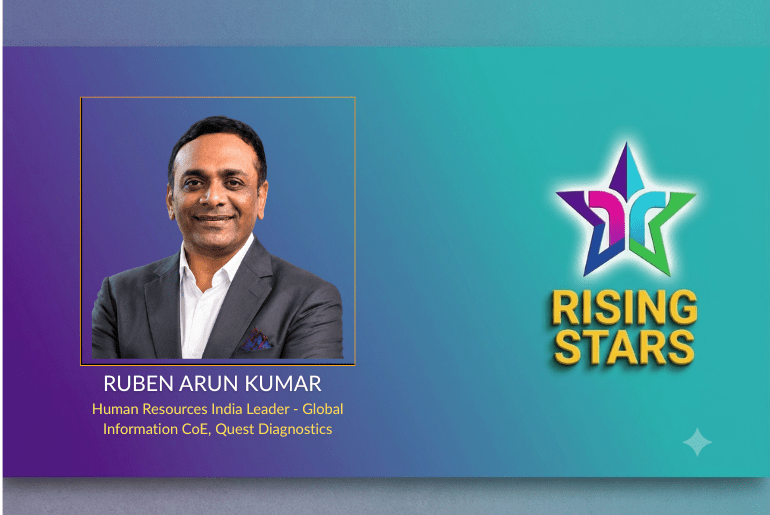
Finalist | HRKatha Rising Star Leadership Award 2025
After more than two decades in HR, Ruben Arun Kumar has arrived at a deceptively simple view of what makes the function effective. It is not the number of processes it owns or policies it administers, but whether people trust it enough to seek its counsel before a problem becomes a crisis.

Asked how colleagues would describe him, Kumar chooses three words: calm, composed, dependable. They may sound more like personality traits than leadership credentials, but they reveal something about how he sees HR’s role. Influence, in his view, is built less through authority than through the confidence that someone will listen carefully, exercise judgement and remain dependable when interests collide.
Kumar is a finalist for the HRKatha Rising Star Leadership Award 2025. His career reflects a shift taking place within the function itself: away from HR as an administrator of people processes and towards HR as a trusted advisor to both the business and its people.
Relationships as the foundation
Asked what he would tell his younger self, Kumar does not reach for a skill, certification or technical competency. He starts with relationships.
Lead with empathy. Invest deliberately in people. Build trust before you need to draw on it.
For Kumar, relationships are not the softer counterpart to HR’s more serious work. They are what make that work possible. Difficult conversations become easier when credibility already exists. Employees are more likely to speak candidly, while leaders are more willing to hear uncomfortable advice from someone whose judgement they trust.
That becomes particularly important when business priorities and employee expectations pull in different directions. Kumar does not assume that the two can always be neatly reconciled. HR’s job, as he sees it, is to understand what each side needs, make the trade-offs visible and help arrive at decisions that the organisation can defend and people can understand.
Trust does not remove difficult decisions. It makes them easier to navigate honestly.
Fifteen minutes, no agenda
One of the clearest expressions of Kumar’s philosophy is also one of the simplest: informal 15-minute conversations with employees without a predetermined agenda.
Most interactions with HR happen because something has happened. Someone is being hired, onboarded, appraised, promoted or is preparing to leave. The conversation arrives with a process attached to it. Kumar wanted to create interactions that did not.
The short check-ins gave employees space to talk without waiting for a formal HR moment. Over time, he found that these low-stakes conversations made the function more approachable and helped concerns surface earlier rather than remaining hidden until a review cycle or a problem forced them into the open.
There is nothing technologically sophisticated about the intervention. That is precisely what makes it instructive. Sometimes improving employee experience does not require another platform or programme. It requires making conversation easier before it becomes necessary.
Facilitator, not referee
When employees and senior leaders disagree, Kumar resists the temptation to define HR’s role as choosing which side is right. He prefers to act as a facilitator: understand both positions on their own terms, separate the underlying issue from the emotion surrounding it and look for enough common ground to move the conversation forward.
That does not mean neutrality at any cost. HR still has to uphold policy, fairness and organisational standards. Nor does empathy mean avoiding an unpopular decision.
Kumar applies the same principle to compliance. Being approachable and enforcing policy are not opposing responsibilities. Flexibility can exist where circumstances justify it, but not at the expense of integrity or consistency.
From administration to advice
Kumar expects technology and data to absorb an increasing share of the transactional work that once occupied HR teams. But rather than making the human side of the function less relevant, he believes that shift will place a greater premium on judgement.
When systems can process information, generate insights and automate routine workflows, the value of the HR professional moves elsewhere: interpreting what the data means, coaching leaders through difficult choices, navigating change and understanding the human consequences that a dashboard cannot fully capture. That is why he sees the function evolving from administrator to advisor and coach.
The transition requires continuous learning, but Kumar does not confine that learning to courses or certifications. Professional communities, industry conversations, networking and reconnecting with peers all form part of how he keeps his thinking current. Just as importantly, he sees credibility within a profession as something that should circulate: experienced practitioners should contribute to the communities from which they themselves continue to learn.
The value of telling the story
For someone who places considerable emphasis on listening, Kumar also recognises the importance of being heard. Given a choice between spreadsheets and storytelling, he chooses storytelling.
It is not because he discounts data. His argument is that data becomes useful only when someone can explain what it means and why others should act on it. As HR becomes more analytical, the ability to translate numbers into a compelling business and people narrative becomes more important rather than less.
Quick Takes
Spreadsheets or storytelling: Storytelling, because stories inspire action and bring data to life.
A surprising skill that makes him better at HR: Leading with compassion.
Dinner with any HR leader, living or dead: Dave Ulrich. He would ask how HR leaders can remain strategic business partners while preserving human connection in an increasingly AI-driven workplace.
Feedback preference: Scheduled when thoughtful reflection is useful, but immediate when the moment demands it.
Retention lever, career growth or compensation: Career growth first. Compensation matters, but as an enabler rather than a substitute for growth.
Why he is a Rising Star
Kumar represents a form of HR leadership that is easy to underestimate because much of it happens away from large programmes and visible transformation agendas. Its currency is trust.
Across employee conversations, leadership disagreements, compliance decisions and everyday relationship-building, the same operating principle appears: listen before judging, remain dependable when interests diverge and build enough credibility that people seek HR’s counsel rather than encounter it only when a process demands it.
His informal 15-minute employee conversations are a small but revealing example. The intervention did not depend on technology, a large budget or an elaborate framework. It worked by creating something organisations frequently claim to value but often struggle to institutionalise: access to HR before there is a problem to solve.
As automation takes over more of the function’s administrative work, that capability may become more valuable. HR professionals will still need data fluency and technological competence, but neither automatically creates trust, judgement or the ability to navigate a difficult conversation. Kumar’s calm, composed and dependable style is, on this evidence, less a personality trait than an operating philosophy: HR earns influence by becoming the person both employees and leaders are willing to speak to when the answer is not obvious.
Rising Stars is HRKatha’s editorial series profiling the next generation of HR leaders shaping the future of the profession. The series features winners and finalists of the HRKatha Rising Star Leadership Awards alongside emerging professionals whose work, ideas and leadership potential deserve wider recognition.
