


Close Menu
    Facebook X (Twitter) Instagram
    • Our Story
    • Partner with us
    • Reach Us
    • Career
    Subscribe Newsletter
    HR KathaHR Katha
    • Exclusive
      • Exclusive Features
      • Perspectives
      • Friday Features
      • herSTORY
      • Rising Stars
      • Case-In-Point
      • Point Of View
      • Research
      • HR Pops
      • Dialogue
      • Movement
      • Profile
      • Beyond Work
      • By Invitation
    • News
      • Global HR News
      • Compensation & Benefits
      • Diversity
      • Events
      • Gen Y
      • Hiring & Firing
      • HR & Labour Laws
      • Learning & Development
      • Merger & Acquisition
      • Performance Management & Productivity
      • Talent Management
      • Tools & Technology
      • Work-Life Balance
    • Special
      • HR Forecast 2026
      • Cover Story
      • Editorial
      • HR Forecast 2024
      • HR Forecast 2023
      • HR Forecast 2022
      • HR Forecast 2021
      • HR Forecast 2020
      • HR Forecast 2019
      • New Age Learning
      • Coaching and Training
      • Learn-Engage-Transform
    • Magazine
    • Reports
      • Whitepaper
        • HR Forecast 2024 e-mag
        • Future-proofing Manufacturing Through Digital Transformation
        • Employee Healthcare & Wellness Benefits: A Guide for Indian MSMEs
        • Build a Future Ready Organisation For The Road Ahead
        • Employee Experience Strategy
        • HRKatha 2019 Forecast
        • Decoding and Driving Employee Engagement
        • One Platform, Infinite Possibilities
      • Survey Reports
        • Happiness at Work
        • Upskilling for Jobs of the Future
        • The Labour Code 2020
    • Conferences
      • Leadership Summit 2025
      • Rising Star Leadership Awards
      • HRKatha Futurecast
      • Automation.NXT
      • The Great HR Debate
    WhatsApp LinkedIn X (Twitter) Facebook Instagram
    HR KathaHR Katha
    Home»Exclusive Features»HR Pops»Schrödinger’s labour law: When rights exist and don’t exist simultaneously
    HR Pops

    Schrödinger’s labour law: When rights exist and don’t exist simultaneously

    How a quantum physics thought experiment became shorthand for the gap between employment legislation and workplace reality—and why HR must collapse the paradox
    mmBy Liji Narayan | HRKathaJanuary 13, 20264 Mins Read14913 Views
    Share LinkedIn Twitter Facebook WhatsApp
    Schrödinger’s labour law
    Share
    LinkedIn Twitter Facebook WhatsApp

    What is Schrödinger’s labour law?

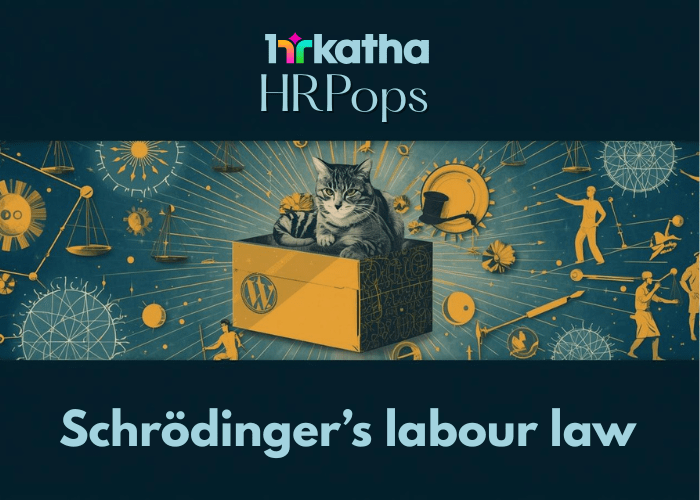
    In quantum theory, Schrödinger’s cat is both alive and dead until someone opens the box to check. Similarly, labour laws can feel like they both exist and don’t exist at the same time. On paper, employees may have rights to fair wages, safe working conditions, or reasonable hours. Yet, in practice, those rights may not be enforced consistently—or at all.

    Workers only discover if their rights “exist” when they challenge an employer or test the law in court. This paradox highlights the uncertainty many employees face: the law is written, but its reality depends on observation, enforcement, and context. Rights are simultaneously present and absent, depending on whether anyone looks closely enough.

    History

    The phrase “Schrödinger’s labour law” is not an official legal doctrine but an informal, witty way of describing the gap between legislation and lived experience. It emerged in academic discussions and HR commentary as a way to capture the frustration of employees and managers who see laws applied unevenly.

    In many countries, labour laws are comprehensive on paper, but enforcement agencies lack resources, political will, or capacity. Cultural practices may override formal rules. Employers may ignore regulations, betting—often correctly—that no one will check. The metaphor gained traction because it neatly captures the contradiction: rights are there, until they’re not.

    The concept resonates particularly in gig economies, informal sectors, and industries with weak unionisation, where employment protections are written but rarely exercised. It also applies in highly regulated environments where compliance is performative—policies exist to satisfy audits, not to protect workers.

    Why is it relevant for HR?

    For HR professionals, this concept is more than a clever analogy—it is a call to action. HR sits at the intersection of law, policy, and practice. If labour laws are treated as Schrödinger’s law, employees feel insecure, disengaged, and mistrustful. It is HR’s responsibility to ensure that rights are not just theoretical but actively upheld.

    HR can collapse the paradox by regularly reviewing policies to align with legal requirements and ensuring compliance. Communicating clearly to employees about their rights and protections ensures transparency. Applying rules fairly across all levels of the organisation ensures consistency. Building trust creates a culture where employees believe their rights are genuinely respected.

    In practice, HR must turn abstract laws into everyday reality. If the law mandates equal pay, HR should audit salaries and correct disparities proactively—not wait for complaints. If safety standards are required, HR should train staff and monitor compliance without prompting. If flexible working is a right, HR must ensure it’s accessible, not just mentioned in a handbook.

    The uncomfortable truth: HR as gatekeeper or enabler?

    Here’s where it gets uncomfortable: HR can be complicit in maintaining Schrödinger’s labour law. When HR shields management from legal accountability, deflects employee complaints, or prioritises organisational interests over worker protections, it keeps the box closed. Rights remain in superposition—simultaneously there and not there.

    Some HR departments treat compliance as a tick-box exercise, creating policies that look impressive but lack teeth. Others knowingly design ambiguous processes that discourage employees from exercising their rights—grievance procedures so byzantine that few bother, whistleblowing channels that lead nowhere.

    The question is: does HR open the box, or does it keep it shut?

    Progressive HR functions recognise that enforcing labour laws is not just legally prudent—it’s strategically smart. Employees who trust that their rights are protected are more engaged, loyal, and productive. Conversely, organisations that treat rights as theoretical face higher turnover, reputational damage and legal risk.

    Collapsing the paradox

    Schrödinger’s labour law reminds us that rights are meaningless if they remain theoretical. Just as Schrödinger’s cat forces us to question reality, this metaphor forces HR and organisations to confront the difference between what is written and what is lived.

    For employees, uncertainty about their rights erodes trust and morale. For HR, the challenge is to ensure that laws are not “alive and dead at the same time” but fully alive in practice. By doing so, HR professionals help create workplaces where fairness, respect, and compliance are not paradoxes but everyday truths.
    The box must be opened. And HR holds the key.

    Employee employer enforce rights properly enforcement gap between legislation and lived experience HR HR Pops Human Resources implementation insecurity Labour Laws law enforcement law implementation law is written no action no practice only in theory only written pops practice reality different Schrödinger’s labour law theory theory and practice Uncertainty Workforce Working Hours
    Share. LinkedIn Twitter Facebook WhatsApp
    mm
    Liji Narayan | HRKatha

    HRKatha prides itself in being a good journalistic product and Liji deserves all the credit for it. Thanks to her, our readers get clean copies to read every morning while our writers are kept on their toes.

    Leave A Reply Cancel Reply

    Related Posts

    Samsung Chennai Plant hosts Family Day for 8,000 employees and family members

    August 19, 2026

    Charles Schwab to expand India tech workforce to 2,000 by 2027

    August 19, 2026

    ICE bars employees from using Meta smart glasses over privacy concerns

    August 19, 2026

    Jyotirmoy Bhattacharya appointed head-HR, Mahindra Insurance Brokers

    August 19, 2026
    zoha
    Editorial

    Promotion decisions in most organisations are announcements dressed up as processes

    Organisations have spent decades making hiring more structured, more consistent and more defensible. The promotion…

    The certification that nobody questioned

    Every year, organisations spend considerable money and management time pursuing workplace certifications. Employees are surveyed,…

    EDITOR'S PICKS

    Getting a first job is getting harder. The economy is not even in recession

    August 19, 2026

    HR Perspectives by K.A. Narayan: “At the heart of leadership effectiveness is emotional intelligence”

    August 19, 2026

    Canon India’s biggest HR priority is keeping 24-year veterans future-ready

    August 18, 2026

    Bot sitting: When humans end up babysitting machines

    August 18, 2026
    Latest Post

    Samsung Chennai Plant hosts Family Day for 8,000 employees and family members

    News August 19, 2026

    Samsung’s Chennai Plant brought together more than 8,000 employees and their family members for a…

    Charles Schwab to expand India tech workforce to 2,000 by 2027

    News August 19, 2026

    US financial services firm Charles Schwab plans to expand its India technology centre workforce to…

    ICE bars employees from using Meta smart glasses over privacy concerns

    News August 19, 2026

    US Immigration and Customs Enforcement (ICE) has instructed employees not to use Meta’s camera-equipped smart…

    Jyotirmoy Bhattacharya appointed head-HR, Mahindra Insurance Brokers

    Movement August 19, 2026

    Jyotirmoy Bhattacharya has been appointed head – human resources development at Mahindra Insurance Brokers, after…

    Asia's No.1 HR Platform

    Facebook X (Twitter) Instagram LinkedIn WhatsApp Bluesky
    • Our Story
    • Partner with us
    • Career
    • Reach Us
    • Exclusive Features
    • Cover Story
    • Editorial
    • Dive into the Future of Work: Download HRForecast 2024 Now!
    © 2026 HRKatha.com
    • Disclaimer
    • Refunds & Cancellation Policy
    • Terms of Service

    Type above and press Enter to search. Press Esc to cancel.