


Close Menu
    Facebook X (Twitter) Instagram
    • Our Story
    • Partner with us
    • Reach Us
    • Career
    Subscribe Newsletter
    HR KathaHR Katha
    • Exclusive
      • Exclusive Features
      • Perspectives
      • Friday Features
      • herSTORY
      • Rising Stars
      • Case-In-Point
      • Point Of View
      • Research
      • HR Pops
      • Dialogue
      • Movement
      • Profile
      • Beyond Work
      • By Invitation
    • Brief News
      • Global HR News
      • Compensation & Benefits
      • Diversity
      • Events
      • Gen Y
      • Hiring & Firing
      • HR & Labour Laws
      • Learning & Development
      • Merger & Acquisition
      • Performance Management & Productivity
      • Talent Management
      • Tools & Technology
      • Work-Life Balance
    • Special
      • Editorial
      • HR Forecast 2026
      • Cover Story
      • HR Forecast 2024
      • HR Forecast 2023
      • HR Forecast 2022
      • HR Forecast 2021
      • HR Forecast 2020
      • HR Forecast 2019
      • New Age Learning
      • Coaching and Training
      • Learn-Engage-Transform
    • Studio
      • The CHRO Playbook
      • Quick HR Insights
      • The Corner Office
    • Reports
      • Whitepaper
        • HR Forecast 2024 e-mag
        • Future-proofing Manufacturing Through Digital Transformation
        • Employee Healthcare & Wellness Benefits: A Guide for Indian MSMEs
        • Build a Future Ready Organisation For The Road Ahead
        • Employee Experience Strategy
        • HRKatha 2019 Forecast
        • Decoding and Driving Employee Engagement
        • One Platform, Infinite Possibilities
      • Survey Reports
        • Happiness at Work
        • Upskilling for Jobs of the Future
        • The Labour Code 2020
    • Forums
      • HRKatha Inner Circle
      • HRKatha Futurecast
      • Leadership Summit 2025
      • Rising Star Leadership Awards
      • HRKatha Futurecast 2025
      • Automation.NXT
      • The Great HR Debate
    WhatsApp LinkedIn X (Twitter) Facebook Instagram
    HR KathaHR Katha
    Home»Exclusive Features»Friday Features»The exit interview: A shared fiction
    Friday Features

    The exit interview: A shared fiction

    Where honesty goes to die, and everyone pretends it matters.
    mmBy Dr. Prajjal Saha | HRKathaFebruary 27, 2026Updated:February 27, 20265 Mins Read33576 Views
    Share LinkedIn Twitter Facebook WhatsApp
    AI Created Image
    Share
    LinkedIn Twitter Facebook WhatsApp

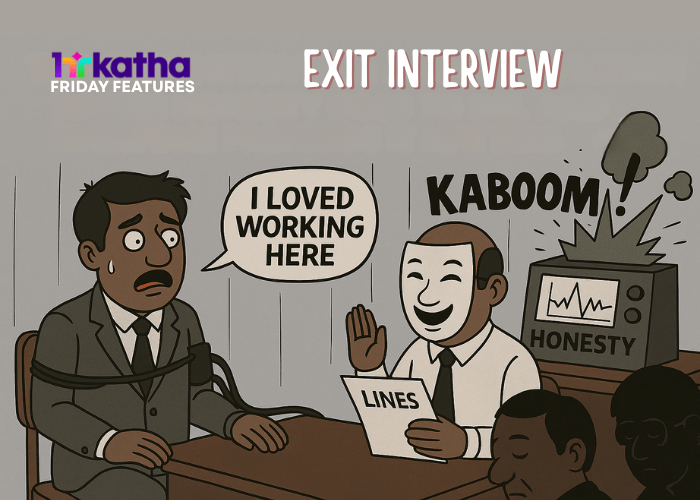
    There’s a peculiar theatre that plays out in every organisation when someone resigns. It’s called the exit interview—a carefully choreographed performance where both sides recite lines they don’t mean, ask questions they don’t want answered, and maintain the comforting illusion that truth is being exchanged.

    It isn’t.

    The employee has already mentally left. HR has already drafted the summary. And yet, for thirty minutes, they sit across from each other and perform sincerity with the discipline of trained actors.

    The employee edits the truth because burning bridges is unprofessional. HR edits the truth because admitting systemic problems is inconvenient. Somewhere in that exchange, a form gets filled, a box gets ticked, and everyone walks away unchanged, unenlightened, and slightly relieved it’s over.

    Welcome to the exit interview—the corporate ritual where feedback goes to be sanitised and honesty goes to die.


    What the employee says vs. what they mean

    “I’m looking for new challenges.”

    What they mean: My manager is exhausting, the work is stagnant, and I’ve been disengaged for months.

    Why they can’t say it: Because “I’m leaving due to micromanagement and existential boredom” doesn’t travel well in a small industry.


    “It’s a great opportunity for career growth.”

    What they mean: They’re paying me 40% more, and I won’t have to fake enthusiasm in Monday stand-ups.

    Why they can’t say it: Because admitting it’s about money sounds mercenary—even though everyone knows money is usually the point.


    “The culture just wasn’t the right fit.”

    What they mean: The culture was toxic positivity wrapped in passive aggression.

    Why they can’t say it: Because “culture fit” is corporate for “I couldn’t stand it here.”


    “I’m grateful for everything I’ve learnt.”

    What they mean: I’ve learnt exactly what kind of workplace to avoid next time.

    Why they can’t say it: Because sarcasm doesn’t belong in documentation that might resurface later.


    “It’s not about the money.”

    What they mean: It is absolutely about the money. And the respect. And watching leadership get bonuses during “budget constraints.”

    Why they can’t say it: Because HR will launch into a well-rehearsed speech about “total rewards,” and no one has the energy for that.


    What HR asks vs. what HR means

    “What prompted your decision to leave?”

    What HR means: Please give me something I can report that doesn’t implicate leadership.

    What HR hopes you’ll say: “New challenges.”

    What HR dreads you’ll say: “My manager is incompetent, and nobody holds anyone accountable.”


    “What could we have done to retain you?”

    What HR means: I have to ask this.

    What HR hopes you’ll say: Something vague and unactionable.

    What HR dreads you’ll say: A detailed list that requires budget, restructuring, and uncomfortable conversations upstairs.


    “How would you describe your relationship with your manager?”

    What HR means: Please don’t name names.

    What HR hopes you’ll say: “Professional.”

    What HR dreads you’ll say: “He publicly dismissed my ideas, then presented them as his own.”


    “Is there anything else you’d like to share?”

    What HR means: Please say no. I have three more today.

    What HR hopes you’ll say: “No, that’s all.”

    What HR dreads you’ll say: “Actually, yes. Let’s discuss favouritism, burnout, and why half the team is job-hunting.”


    “We value your feedback.”

    What HR means: This will be summarised into safe language and archived.

    What actually happens to the feedback: “Employee cited personal growth opportunities elsewhere.”

    Filed. Forgotten. Replaced.


    The dance of mutual dishonesty

    Here’s the uncomfortable truth: both sides know.

    The employee knows why they’re leaving.

    HR knows why people usually leave—because the themes are rarely original.

    But honesty is risky.

    For the employee: It could mean a bad reference, awkward final weeks, or future doors quietly closing.

    For HR: It means admitting something is broken—and being expected to fix it.

    Fixing things requires budget. Courage. Leadership buy-in. Accountability.

    It’s easier to perform professionalism.

    So the employee offers curated truth.

    HR nods empathetically.

    Everyone exits with dignity intact and reality untouched.


    What actually happens to exit interview data

    Week 1: HR compiles it.

    Week 2: HR sanitises it.

    Week 3: Leadership glances at it.

    Week 4: Someone says, “Interesting. Let’s monitor that.”

    Week 5–52: Nothing changes.

    Next year: “Why is attrition still high?”

    The problem isn’t lack of insight. Exit interviews surface patterns with painful consistency.

    The problem is action. Action requires admitting that the system—not just the individual—failed.

    Replacing people is easier than rethinking culture.


    The rare honest exit interview

    Occasionally, someone breaks script.

    They walk in and say it plainly:

    The favouritism.

    The overwork disguised as “passion.”

    The projects doomed by ego.

    The pay that hasn’t kept pace with reality.

    The room shifts.

    HR’s pen slows.

    And then one of two things happens:

    1. It’s watered down into something digestible.
    2. It’s reframed as misunderstanding.

    Either way, the system survives intact.

    Because organisations don’t really want honesty in exit interviews. They want reassurance.

    They want to hear that you’re leaving for reasons beyond their control.

    What they don’t want to hear is: “You could have kept me. You just chose not to.”


    So why do we keep doing them?

    For HR: It demonstrates due diligence and “listening culture.”

    For leadership: It provides plausible deniability.

    For employees: It offers closure—the hope that maybe their honesty might help someone else.

    It’s theatre. Just not the kind that changes the script.


    The bottom line

    The exit interview is a shared fiction.

    The employee pretends their reasons are forward-looking.

    HR pretends the feedback will drive change.

    And in the space between those performances, the truth evaporates.

    Six months later, someone else sits in the same chair, offering the same carefully curated answers, while HR takes the same notes that will lead to the same inaction.

    At least everyone stayed professional.

    Disclaimer: Any resemblance to real exit interviews, living or ignored, is completely intentional.

    What’s the biggest “professional” lie you’ve heard—or told—in an exit interview? Let’s compare scripts.

    Corporate processes corporate satire Employee Experience Exit Interviews HR commentary HR satire HRKatha LEAD leadership culture organisational behaviour people practices Prajjal Saha Stay Interviews Talent Management Workplace Culture Workplace humour
    Share. LinkedIn Twitter Facebook WhatsApp
    mm
    Dr. Prajjal Saha | HRKatha

    Dr. Prajjal Saha is a business journalist and the editor-publisher of HRKatha. He writes on the realities of work and organisations, offering a clear-eyed view of how companies translate intent into action—often revealing the gap between the two. With over 25 years of experience, he focuses on interpreting workplace trends and leadership decisions in a way that is both insightful and accessible. He founded HRKatha in 2015 to create a platform for credible, insight-driven analysis of the evolving workplace.

    Leave A Reply Cancel Reply

    Related Posts

    HR Perspectives by Arijit Pal Choudhury: “If succession planning begins when a role becomes vacant, you are already too late”

    November 18, 2026

    Lazy girl jobs: When doing your job became enough

    November 17, 2026

    From loyalty to ownership: Chai Kaapi bets on ESOPs to retain talent

    November 17, 2026

    Unilever elevates Meghna Menon to head people experience (TA | people partner)

    November 16, 2026
    zoha
    Editorial

    Companies owe their people more than what is legal

    When Canva announced a restructuring affecting 1,271 employees, or 22 per cent of its workforce,…

    Hard work built India’s global reputation. Availability cannot define its future

    I must have been in school when I first heard the slogan. I was passing…

    EDITOR'S PICKS

    66% of leaders allow AI to write to core systems without approval. Only 33% have fully implemented decision limits

    November 18, 2026

    HR Perspectives by Arijit Pal Choudhury: “If succession planning begins when a role becomes vacant, you are already too late”

    November 18, 2026

    Lazy girl jobs: When doing your job became enough

    November 17, 2026

    Birlasoft wants to measure skills by deployment, not learning hours

    November 17, 2026
    Latest Post

    Cellebrite cuts 85 jobs. Is India team impacted?

    Brief News November 18, 2026

    Digital intelligence and digital forensics company Cellebrite has announced a global workforce reduction of about…

    66% of leaders allow AI to write to core systems without approval. Only 33% have fully implemented decision limits

    Research November 18, 2026

    In two-thirds of the organisations surveyed, AI can update core business records without human approval.…

    India’s unemployment rate falls to 4.9% in October as female workforce participation rises

    Brief News November 18, 2026

    India’s unemployment rate among people aged 15 years and above declined to 4.9 per cent…

    Agilisium plans to expand Tamil Nadu workforce to 3,000 over next 3 years

    Brief News November 18, 2026

    Agilisium plans to increase its workforce in Tamil Nadu from nearly 900 employees to between…

    Asia's No.1 HR Platform

    Facebook X (Twitter) Instagram LinkedIn WhatsApp Bluesky
    • Our Story
    • Partner with us
    • Career
    • Reach Us
    • Exclusive Features
    • Cover Story
    • Editorial
    • Dive into the Future of Work: Download HRForecast 2024 Now!
    © 2026 HRKatha.com
    • Disclaimer
    • Refunds & Cancellation Policy
    • Terms of Service

    Type above and press Enter to search. Press Esc to cancel.