


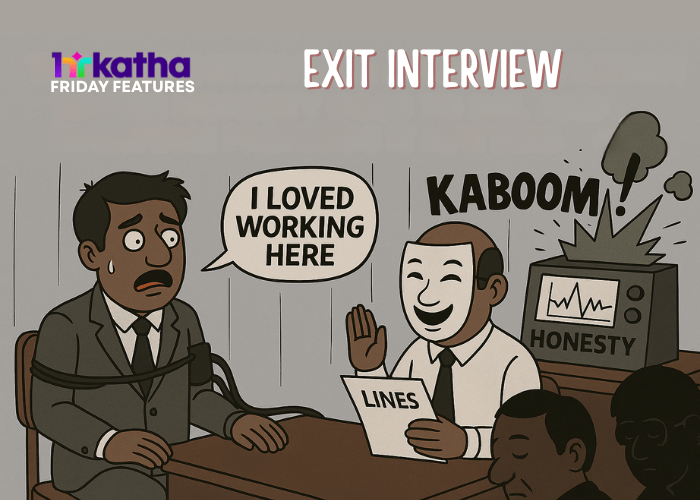
There’s a peculiar theatre that plays out in every organisation when someone resigns. It’s called the exit interview—a carefully choreographed performance where both sides recite lines they don’t mean, ask questions they don’t want answered, and maintain the comforting illusion that truth is being exchanged.
It isn’t.
The employee has already mentally left. HR has already drafted the summary. And yet, for thirty minutes, they sit across from each other and perform sincerity with the discipline of trained actors.
The employee edits the truth because burning bridges is unprofessional. HR edits the truth because admitting systemic problems is inconvenient. Somewhere in that exchange, a form gets filled, a box gets ticked, and everyone walks away unchanged, unenlightened, and slightly relieved it’s over.
Welcome to the exit interview—the corporate ritual where feedback goes to be sanitised and honesty goes to die.
What the employee says vs. what they mean
“I’m looking for new challenges.”
What they mean: My manager is exhausting, the work is stagnant, and I’ve been disengaged for months.
Why they can’t say it: Because “I’m leaving due to micromanagement and existential boredom” doesn’t travel well in a small industry.
“It’s a great opportunity for career growth.”
What they mean: They’re paying me 40% more, and I won’t have to fake enthusiasm in Monday stand-ups.
Why they can’t say it: Because admitting it’s about money sounds mercenary—even though everyone knows money is usually the point.
“The culture just wasn’t the right fit.”
What they mean: The culture was toxic positivity wrapped in passive aggression.
Why they can’t say it: Because “culture fit” is corporate for “I couldn’t stand it here.”
“I’m grateful for everything I’ve learnt.”
What they mean: I’ve learnt exactly what kind of workplace to avoid next time.
Why they can’t say it: Because sarcasm doesn’t belong in documentation that might resurface later.
“It’s not about the money.”
What they mean: It is absolutely about the money. And the respect. And watching leadership get bonuses during “budget constraints.”
Why they can’t say it: Because HR will launch into a well-rehearsed speech about “total rewards,” and no one has the energy for that.
What HR asks vs. what HR means
“What prompted your decision to leave?”
What HR means: Please give me something I can report that doesn’t implicate leadership.
What HR hopes you’ll say: “New challenges.”
What HR dreads you’ll say: “My manager is incompetent, and nobody holds anyone accountable.”
“What could we have done to retain you?”
What HR means: I have to ask this.
What HR hopes you’ll say: Something vague and unactionable.
What HR dreads you’ll say: A detailed list that requires budget, restructuring, and uncomfortable conversations upstairs.
“How would you describe your relationship with your manager?”
What HR means: Please don’t name names.
What HR hopes you’ll say: “Professional.”
What HR dreads you’ll say: “He publicly dismissed my ideas, then presented them as his own.”
“Is there anything else you’d like to share?”
What HR means: Please say no. I have three more today.
What HR hopes you’ll say: “No, that’s all.”
What HR dreads you’ll say: “Actually, yes. Let’s discuss favouritism, burnout, and why half the team is job-hunting.”
“We value your feedback.”
What HR means: This will be summarised into safe language and archived.
What actually happens to the feedback: “Employee cited personal growth opportunities elsewhere.”
Filed. Forgotten. Replaced.
The dance of mutual dishonesty
Here’s the uncomfortable truth: both sides know.
The employee knows why they’re leaving.
HR knows why people usually leave—because the themes are rarely original.
But honesty is risky.
For the employee: It could mean a bad reference, awkward final weeks, or future doors quietly closing.
For HR: It means admitting something is broken—and being expected to fix it.
Fixing things requires budget. Courage. Leadership buy-in. Accountability.
It’s easier to perform professionalism.
So the employee offers curated truth.
HR nods empathetically.
Everyone exits with dignity intact and reality untouched.
What actually happens to exit interview data
Week 1: HR compiles it.
Week 2: HR sanitises it.
Week 3: Leadership glances at it.
Week 4: Someone says, “Interesting. Let’s monitor that.”
Week 5–52: Nothing changes.
Next year: “Why is attrition still high?”
The problem isn’t lack of insight. Exit interviews surface patterns with painful consistency.
The problem is action. Action requires admitting that the system—not just the individual—failed.
Replacing people is easier than rethinking culture.
The rare honest exit interview
Occasionally, someone breaks script.
They walk in and say it plainly:
The favouritism.
The overwork disguised as “passion.”
The projects doomed by ego.
The pay that hasn’t kept pace with reality.
The room shifts.
HR’s pen slows.
And then one of two things happens:
- It’s watered down into something digestible.
- It’s reframed as misunderstanding.
Either way, the system survives intact.
Because organisations don’t really want honesty in exit interviews. They want reassurance.
They want to hear that you’re leaving for reasons beyond their control.
What they don’t want to hear is: “You could have kept me. You just chose not to.”
So why do we keep doing them?
For HR: It demonstrates due diligence and “listening culture.”
For leadership: It provides plausible deniability.
For employees: It offers closure—the hope that maybe their honesty might help someone else.
It’s theatre. Just not the kind that changes the script.
The bottom line
The exit interview is a shared fiction.
The employee pretends their reasons are forward-looking.
HR pretends the feedback will drive change.
And in the space between those performances, the truth evaporates.
Six months later, someone else sits in the same chair, offering the same carefully curated answers, while HR takes the same notes that will lead to the same inaction.
At least everyone stayed professional.
Disclaimer: Any resemblance to real exit interviews, living or ignored, is completely intentional.
What’s the biggest “professional” lie you’ve heard—or told—in an exit interview? Let’s compare scripts.