


AI is being deployed across organisations at speed.
But its success will not be determined by technology alone.
It will depend on how organisations manage its human impact.
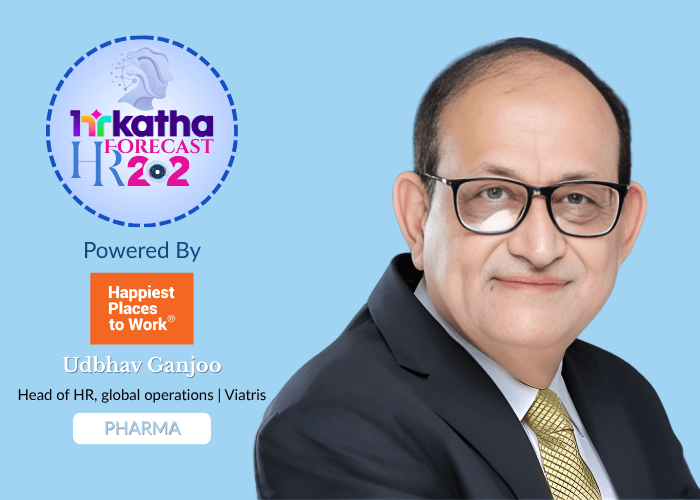
Udbhav Ganjoo, Head of HR for Global Operations, India, Emerging Asia and Access Markets at Viatris, believes that by 2026, HR will be expected to take clear ownership of this responsibility.
“Ownership of the human impact of AI cannot sit anywhere but HR,” he says.
Signal 1: HR will become the custodian of the human side of AI
As AI adoption accelerates, the most complex challenges are not technical—they are human.
Questions around job security, fairness and relevance are already surfacing across organisations.
“Rapid adoption of AI raises practical and emotional questions for employees—about job security, fairness in decisions, and whether their contribution still matters,” Ganjoo notes.
These concerns may not appear in dashboards, but they show up in engagement, attrition and resistance.
HR’s role, therefore, will be to ensure that AI adoption is accompanied by clarity and reassurance.
This requires transparent communication, honest workforce planning and clear articulation of what will change—and what will not.
“Vague assurances do more harm than good. People are remarkably resilient when they are told the truth and given support.”
Reskilling, in this context, must be continuous, practical and accessible—especially for mid-career employees who often feel most exposed.
At the same time, governance will become critical. As AI begins to influence hiring, performance and rewards, organisations will need clear principles around transparency, bias and accountability.
In 2026, organisations that manage this well will build trust.
Those that don’t may deploy AI successfully—but at a significant human cost.
Signal 2: Leadership will be redefined for a distributed world
Hybrid work is no longer an experiment. It is a structural reality.
But leadership capability has not always kept pace.
“Many leaders today are managing teams they don’t see regularly, across time zones and contexts they don’t fully understand,” Ganjoo observes.
Leading without physical proximity demands different skills—assessing performance, building trust and ensuring inclusion require more deliberate effort.
In response, leadership development will need to move beyond event-based programmes to sustained, real-world support.
Coaching will become central—not just for senior leaders, but for managers navigating complexity for the first time.
Peer learning and practical problem-solving will take precedence over theoretical frameworks.
“We will also need to rethink how we identify leadership potential. In virtual environments, influence shows up differently.”
In 2026, effective leadership will be defined less by polish and presence—and more by judgement, communication and the ability to hold teams together without constant oversight.
Signal 3: DEI will move from rhetoric to rigour
Globally, DEI has faced pushback. In India, the context is different.
Diversity is not an aspiration—it is an operational reality.
“2026 will test intent,” Ganjoo says.
Organisations that treated DEI as a surface-level initiative may scale back under pressure. Others will continue—not as a statement, but as a strategic necessity.
The shift will be in approach.
Less rhetoric. More rigour.
Leaders will be expected to engage with data—on hiring, pay equity and progression—and take corrective action.
Inclusion will move from standalone programmes into core people processes.
The lens will also expand beyond gender to include socio-economic diversity, regional representation, disability inclusion and broader access to opportunity.
In 2026, DEI will matter less as a label—and more as a practice.
Signal 4: Flexibility will replace uniformity—but within clear boundaries
With five generations in the workforce, one-size-fits-all policies are becoming increasingly ineffective.
But the answer is not unlimited flexibility.
“The real work lies in designing flexibility with discipline,” Ganjoo explains.
Organisations will move towards clear principles—around performance, conduct and accountability—supported by adaptable frameworks.
How individuals meet those expectations will vary. The expectations themselves will not.
This shift places greater responsibility on managers.
Policies alone will no longer be sufficient. Managers will need the judgement and confidence to make fair, context-driven decisions.
Technology can enable personalisation.
But culture will determine whether it feels equitable.
“Employees are far more accepting of differentiation when they understand the rationale behind it.”
Signal 5: In pharma, capability transformation will define the future
In the pharmaceutical sector, the defining HR challenge will be balancing transformation with compliance.
Few industries face such high regulatory scrutiny while navigating rapid scientific and digital change.
New capabilities are emerging in data, automation and analytics.
At the same time, deep regulatory knowledge remains critical.
“The priority will be reskilling and redeploying existing talent at scale,” Ganjoo notes.
This requires sustained investment and a willingness to support employees through difficult transitions.
But it also presents an opportunity.
Organisations that retain institutional knowledge while building new capabilities will be better positioned for the future.
Purpose will also play a key role. While pharma is closely linked to patient outcomes, many roles feel disconnected from that impact.
HR’s role will be to reconnect employees to that larger mission.
The trust imperative
Across these shifts—AI adoption, leadership transformation, DEI evolution, workforce flexibility and capability building—a common thread emerges.
Trust.
HR is no longer just enabling change.
It is responsible for how that change is experienced.
“Organisations that succeed will be those where people strategy supports innovation without compromising trust, quality or ethical standards.”
Three Strategic Imperatives
Own the Human Side of AI: Lead with transparency, reskilling and governance—ensuring AI adoption builds trust, not uncertainty.
Redesign Leadership for Reality: Shift from programme-based development to continuous coaching and real-world capability building for distributed teams.
Balance Flexibility with Discipline: Create adaptable frameworks anchored in clear principles—enabling personalisation without fragmentation.
The Human Test
The question for 2026 is not whether organisations will adopt AI.
It is whether people will trust how it is used.
Because technology can transform work.
But only people can sustain it.