


What does it mean?
For decades, careers resembled ladders. People climbed one rung at a time, usually within the same organisation or industry, accumulating experience, promotions, and tenure.
Today, careers increasingly resemble investment portfolios.
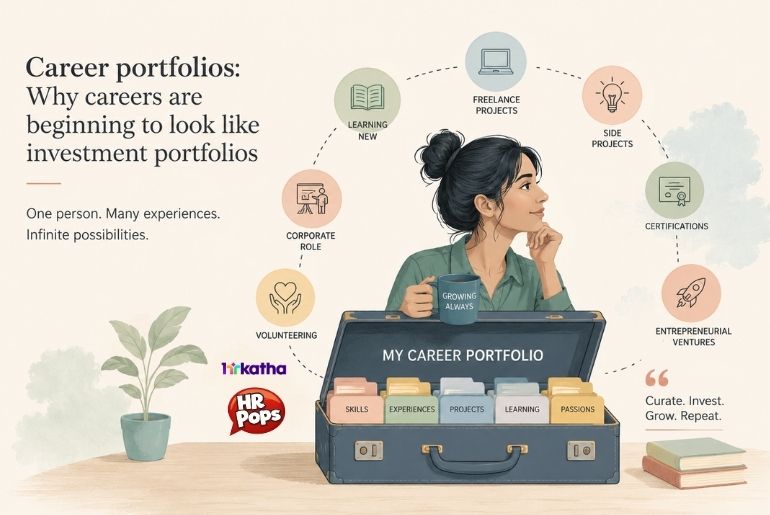
The career portfolio mindset encourages professionals to build a diverse mix of experiences rather than rely on a single employer, role, or career path. A full-time job may remain the anchor, but it increasingly sits alongside certifications, cross-functional projects, mentoring, freelancing, entrepreneurship, volunteering, or content creation.
The objective is not to collect jobs. It is to accumulate capabilities.
A traditional résumé tells employers where someone has worked. A career portfolio reveals what that person has learnt, built, and become.
Where did the idea come from?
The idea emerged during the economic upheavals of the 1980s and 1990s, when globalisation, restructuring, and automation began weakening the promise of lifelong employment.
British management thinker Charles Handy described this shift through the idea of the portfolio career. Instead of depending on one employer for identity and income, professionals would increasingly combine consulting, teaching, project work, entrepreneurship, and part-time roles.
At the time, the prediction appeared unconventional.
The internet proved him right.
Digital platforms allowed professionals to build reputations beyond their employers. Remote work, the gig economy, and online learning accelerated the trend. The pandemic reinforced it further as millions explored freelance work, side businesses, and new skills, not simply to earn more but to reduce dependence on a single source of employment.
Why is it relevant for HR?
The portfolio mindset challenges several assumptions that have shaped HR for decades.
Recruitment can no longer rely solely on linear career histories. Candidates increasingly arrive with experience gained through startups, independent consulting, creator platforms, open-source projects, or community leadership. These experiences often demonstrate capability as effectively as traditional job titles.
Learning and development is changing too. Employees are investing in skills that improve their long-term market value, not merely their prospects within one organisation. Internal mobility, cross-functional assignments, certifications, and stretch projects help employees expand their portfolios without leaving.
Retention is evolving in the same direction. Many professionals no longer measure career progress only through promotions or bigger teams. Variety, learning, and exposure often matter just as much. Organisations that provide continuous opportunities to grow are more likely to retain talent than those offering only hierarchical advancement.
The conversation is gradually shifting from career progression to career resilience.
The uncomfortable reality
The portfolio mindset is not transforming only careers. It is changing the workforce itself.
Organisations increasingly depend on a mix of permanent employees, consultants, freelancers, contractors, and gig workers. Talent is becoming a network rather than a payroll.
That creates new challenges for HR. Performance, learning, culture, inclusion, and engagement can no longer be designed exclusively for full-time employees. Capability increasingly exists both inside and outside organisational boundaries.
There is another trade-off.
Building a career portfolio can create resilience, but it can also produce constant pressure to keep learning, remain visible, and juggle multiple commitments. More opportunities often mean more complexity. Without clear boundaries, career portfolio mindset can become exhausting rather than empowering.
The takeaway
The career portfolio mindset reflects a fundamental shift in how professionals think about work. Careers are no longer built around one employer. They are built around transferable capabilities, continuous learning, and diverse experiences that strengthen long-term resilience.
For HR, the challenge is no longer simply retaining employees. It is creating workplaces where people can keep expanding their capabilities without feeling they have to leave in order to grow.
The question is no longer how to build employee loyalty. It is how to become an important investment within someone else’s career portfolio.