



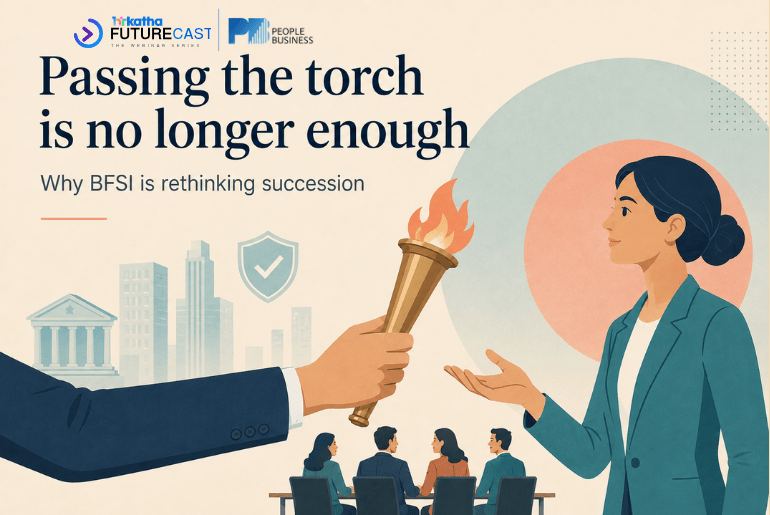
Succession planning has traditionally been built around a reassuring assumption: organisations know roughly what the next leader will be required to lead.
That assumption is becoming harder to sustain in banking, financial services and insurance.

The sector has always had compelling reasons to take leadership continuity seriously. Financial institutions operate in highly regulated environments, manage enormous amounts of risk and depend heavily on institutional trust. An unexpected leadership vacuum can therefore be considerably more consequential than an empty corner office.
But continuity is only half the problem now. The leader who succeeds today’s chief executive, business head or functional leader will inherit an organisation being reshaped by artificial intelligence, digital distribution, changing customer behaviour, new forms of competition and increasingly complex regulation.
The succession question is therefore changing from “Who can replace this leader?” to “Who can lead the organisation that comes next?”
It is this shift that will be at the centre of the next edition of HRKatha Futurecast, organised by HRKatha in association with People Business Consulting, on 21 August 2026. The live virtual discussion, ‘The Future of Succession in BFSI: Governance, Leadership Development & Future Readiness’, will bring together senior HR leaders from banking, financial services and insurance to examine how succession itself needs to change.
For decades, experience within the institution was itself an important qualification for advancement. It provided knowledge of customers, regulation, risk and the organisation’s operating culture. Those capabilities remain valuable, but they increasingly have to coexist with something more difficult to develop: the ability to lead through technological and business-model change.
The result is a peculiar succession challenge. Organisations must preserve institutional memory without allowing it to become institutional inertia.
“As the BFSI industry transforms rapidly, succession planning has evolved beyond leadership replacement. Today it is about building a future-ready leadership pipeline aligned to business strategy and growth,” says Priti Singh, chief people officer, Universal Sompo General Insurance.
For Singh, succession also requires organisations to intervene before potential becomes obvious. “Equally important is investing in talent to step into bigger roles, often before they see that potential in themselves,” she says.
That puts leadership development at the centre of succession rather than treating it as something that follows the identification of successors.
Anju Jumde, head-HR, Aditya Birla Money, describes succession readiness as an amalgamation of data and human judgement. “We forecast talent with numbers, and grow leaders with intent,” she says.
The distinction is useful. Organisations today possess considerably more data with which to identify performance, potential, mobility and capability. Yet succession remains stubbornly resistant to being reduced to an algorithm. A person who appears ready according to a talent matrix may respond very differently when given responsibility for a larger business, an unfamiliar market or a period of upheaval.
The difficulty becomes greater when the capabilities required of the role are themselves moving.
For Atul Mathur, EVP-HR, Aditya Birla Capital, succession planning in BFSI requires “building capability for a future which is continuously changing”.
That is the central paradox confronting succession planning today. Companies are attempting to prepare people for jobs whose future requirements they cannot predict with certainty.
It also changes what organisations mean by readiness. The traditional successor was often someone who had accumulated enough experience to step into the incumbent’s shoes. The future successor may instead need the judgement to decide when those shoes are no longer appropriate.
The workforce underneath these leadership pipelines is changing too. Younger professionals have different expectations of mobility, career progression and the time they are prepared to wait for larger responsibilities. A succession system designed around long organisational tenure therefore has to contend with the possibility that its most promising successors may leave before the position for which they are being prepared becomes available.
Succession consequently becomes as much a question of opportunity as identification. Organisations need to give prospective leaders sufficiently complex assignments, exposure and decision-making responsibility long before a vacancy emerges.
These questions will be examined by a panel that spans banks, insurers, financial-services companies and leadership advisory. It brings together Pallab Mukherji, chief people officer, Equitas Small Finance Bank; Jeeva Balakrishnan, CHRO, Cholamandalam Investment & Finance; Priti Singh, chief people officer, Universal Sompo General Insurance; Saba Adil, CHRO, Edelweiss Life Insurance; Atul Mathur, EVP-HR, Aditya Birla Capital; Dr Renjith PR, CHRO, Manappuram Finance; Dhanashree Thakkar, head-HR & distribution training, Bharti AXA Life Insurance; Anju Jumde, head-HR, Aditya Birla Money; Dr Sandeep Krishnan, CEO & partner, People Business Consulting; and Kartik Kesarker, director, People Business Consulting.
The discussion will look beyond the mechanics of succession planning to examine governance, leadership development, assessment of readiness and the capabilities BFSI organisations need to begin building before those capabilities become urgent.
For financial institutions, this is not merely a talent question. Leadership continuity is scrutinised by boards, regulators, investors and markets precisely because instability at the top can quickly become instability elsewhere.
The real test of a succession plan, then, may not be how many names appear on the chart, but how much confidence those names inspire when one of them suddenly has to take charge.
Dr Sandeep Krishnan, CEO & partner, People Business Consulting, argues that succession therefore needs to be understood well beyond the HR process. “Our experience of working with the BFSI industry shows leadership continuity is a regulatory expectation, market signal and a competitive advantage,” he says.
For Krishnan, the question worth examining is how leading institutions can build “succession pipelines that boards, regulators and investors trust”.
For Dr Prajjal Saha, founder and editor, HRKatha, that trust ultimately comes down to readiness. “Succession is one of those areas where organisations can have an impressive process and still discover, at the moment of truth, that they do not have enough leaders who are genuinely ready,” he says. “The more interesting question today is not whether there are names on a succession chart, but whether those people are being prepared for the organisation they may have to lead three or five years from now.”
HRKatha Futurecast: The Future of Succession in BFSI: Governance, Leadership Development & Future Readiness
Friday, 21 August 2026 | 12:30 PM – 1:30 PM IST | Live Virtual
