


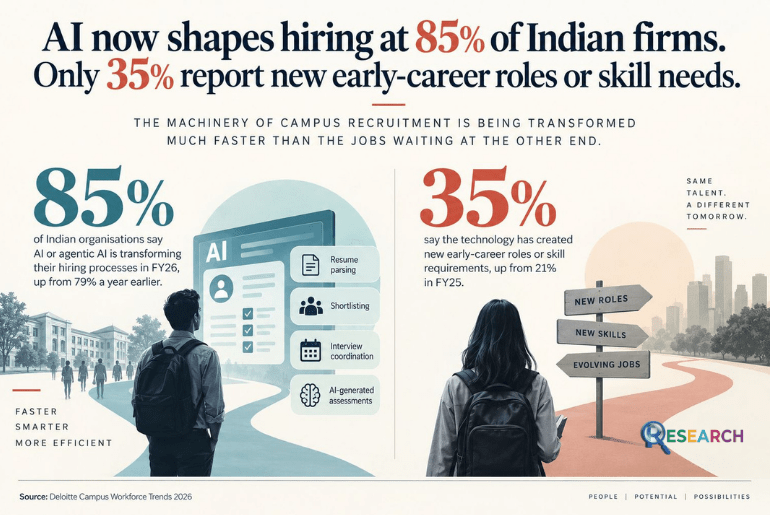
About 85 per cent of Indian organisations say AI or agentic AI is transforming their hiring processes in FY26, up from about 79 per cent a year earlier. Only 35 per cent say the technology has created new early-career roles or skill requirements, up from 21 per cent in FY25, according to Deloitte’s Campus Workforce Trends 2026 report.
The distance between those two numbers is more revealing than either statistic alone.
One measures how companies recruit; the other measures whether AI is beginning to create new early-career roles or alter the skills those roles require. Artificial Intelligence has moved rapidly through the machinery of campus hiring and much more slowly through the architecture of the entry-level job itself.
That is a useful corrective to the standard argument that AI will destroy old jobs while creating new ones. On Indian campuses, the first transformation visible at scale is neither. It is the transformation of the gate through which young people enter work.
AI has changed the gatekeeper
The changes to recruitment are substantial. AI-enabled resume parsing now infers skills from projects and maps certifications rather than simply matching keywords. Agentic systems build dynamic shortlists against role requirements, apply eligibility filters, coordinate interviews and assist recruiters with candidate scoring. Candidate-facing systems handle response timelines, nudges and recommendations, while simulations, hackathons and assessments are increasingly AI-enabled.
This goes beyond conventional recruitment automation. Some of these systems are beginning to make, or assist with, decisions recruiters previously made themselves.
But nearly all of it happens before somebody gets the job.
An organisation can completely redesign how it identifies, screens and assesses graduates without substantially changing the work those graduates go on to perform. The 35 per cent figure suggests that a second transformation is underway too, with new AI-enabled roles and skill requirements beginning to emerge. But changes to early-career roles and skill requirements remain far less widespread than changes to recruitment itself.
The recruitment system is becoming AI-native faster than the graduate job.
Skills are changing before jobs disappear
That does not mean entry-level work is standing still.
The report’s career-preference data points in the same direction. Among the roles identified for different degree cohorts are, product manager for AI-enabled products for MBA graduates, machine-learning engineer for BTech graduates, data scientist for MTech graduates and legal-tech specialist for law graduates.
Artificial Intelligence does not need a new job title to change a job. A business analyst who uses AI extensively is still called a business analyst. A product manager working on AI-enabled products remains a product manager. An engineer whose role increasingly demands machine-learning capability remains an engineer.
That makes the 35 per cent figure worth sitting with. It captures organisations reporting new roles or new skill requirements, yet still sits far below the proportion transforming recruitment.
The first effect of AI on graduate employment is, therefore, less about replacing job titles than changing what employers expect the person holding the title to know.
Companies are spending more to hire more selectively
None of this looks like employers retreating from campus recruitment.
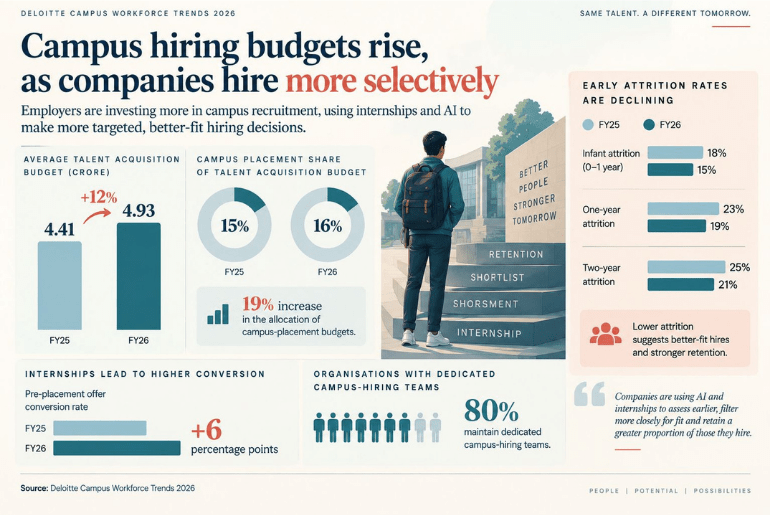
The average talent-acquisition budget among participating organisations rose from Rs 4.41 crore in FY25 to Rs 4.93 crore in FY26. Campus placement’s share of that budget increased from 15 to 16 per cent, representing a 19 per cent increase in the allocation of campus-placement budgets. Eighty per cent of participating organisations also maintain dedicated campus-hiring teams.
The additional investment coincides with greater selectivity rather than simply greater volume.
Pre-placement-offer conversion rose by about six percentage points year on year as employers leaned more heavily on internships to assess candidates before committing to full-time hires. The report describes hiring volumes being rationalised, conversion becoming more selective and specialised, skill-aligned profiles gaining preference over broader intake.
Retention has improved in parallel. Infant attrition fell from 18 to 15 per cent, one-year attrition from 23 to 19 per cent and two-year attrition from 25 to 21 per cent.
Put together, the numbers point towards a campus market built around more selective, pre-assessed hiring. Employers are assessing candidates earlier, filtering more closely for fit and retaining a greater proportion of those they eventually hire.
AI fits naturally into that model. Its immediate value to employers is less about eliminating graduate hiring than making the funnel more discriminating.
For students, a more efficient funnel is not automatically a more forgiving one.
Skills are changing faster than pay
If AI and digital capability are becoming this much more important, campus compensation does not show an equivalent acceleration.
Pay across major MBA and engineering categories grew at about 2 to 4 per cent CAGR between FY22 and FY26. The report contrasts that with broader India Inc salary increases of 7 to 9 per cent year on year.
What employers are paying for instead is differentiation.
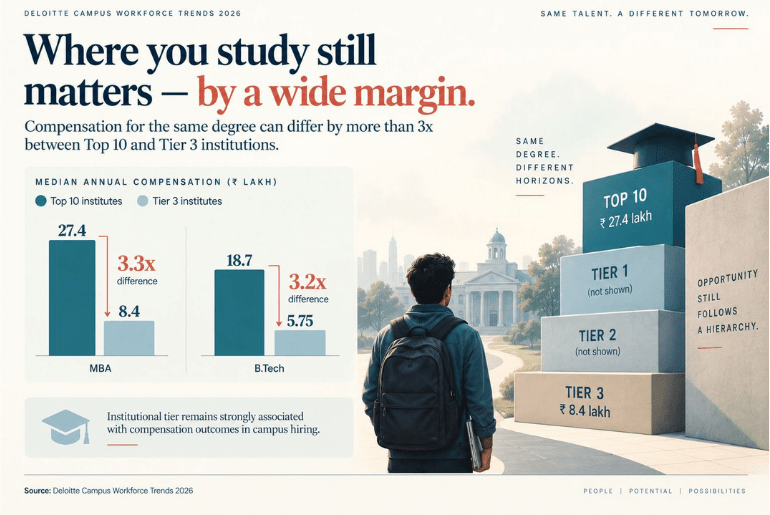
A Top 10 MBA graduate commands median annual compensation of Rs 27.4 lakh, compared with Rs 8.4 lakh at Tier 3 institutions, a 3.3-fold difference. For B.Tech graduates, the corresponding figures are Rs 18.7 lakh and Rs 5.75 lakh, a 3.2-fold gap. Internship stipends are wider still: Top 10 MBA students can receive Rs 1.8–1.9 lakh a month, compared with about Rs 26,000 at Tier 3.
The report says AI- and data-related capabilities attract the highest compensation premiums across disciplines. But the market is not responding with across-the-board salary inflation.
Employers are becoming more precise about whom they value. That is consistent with what is happening in recruitment itself: more sophisticated selection does not necessarily mean more hiring or more money. It means finer distinctions between candidates.
Credentials have not disappeared
That precision has not made the old campus hierarchy irrelevant.
The 3.3-fold spread in MBA compensation and 3.2-fold spread in engineering pay between Top 10 and Tier 3 institutions show that institute tier remains strongly associated with compensation outcomes in campus hiring. The same hierarchy appears before a graduate even receives a full-time offer: Top 10 MBA internship stipends are about seven times those at Tier 3 institutions.
That creates an interesting tension with the movement towards skills-first hiring.
Employers are increasingly prioritising learning agility, problem-solving, AI literacy and digital fluency rather than relying solely on academic indicators. Yet compensation continues to differ enormously according to where a student studied.
The two are not necessarily contradictory. But the numbers suggest that skills-first hiring is being added to the existing credential hierarchy rather than replacing it.
AI therefore introduces another layer of differentiation into a market that was already highly stratified.
The new entry-level bargain
Put these numbers together and India’s campus market looks less like one being hollowed out by AI than one being re-sorted by it.
Companies are spending more on campus recruitment. Retention is improving. Internship-to-hire pipelines are becoming more selective. AI and digital skills are becoming more important. None of that resembles a wholesale retreat from early-career talent.
But the bargain is changing.
The old campus model relied heavily on credentials as proxies. Institute, degree and academic record helped employers decide who deserved entry. Those proxies have clearly not disappeared; the compensation differences between institute tiers make that difficult to argue.
What AI adds is another layer of selection. Employers can assess more candidates, examine skills more closely, simulate work more cheaply and match people to roles with greater precision. At the same time, they are placing greater emphasis on AI literacy, learning agility and specialised capability, while average campus compensation continues to grow only moderately.
That creates an asymmetry worth watching. AI has already transformed how graduates are screened, assessed and selected across most participating organisations. Far fewer report that it has created new early-career roles or changed the skills those roles require.
For graduates, then, the first large-scale disruption from AI is happening before they enter the workplace, not after.
The job has not changed nearly as much as the gatekeeper has.