


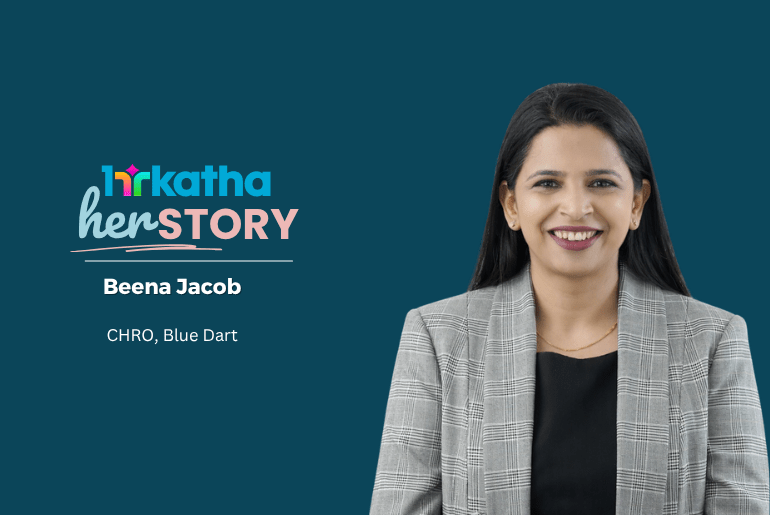
Walking into a room, Beena Jacob sometimes found herself expected to advocate for the people perspective alone, not challenge business assumptions or debate profitability. She chose to challenge that expectation, and in doing so, lower the barrier for every woman who would walk into that room after her.
From sales and marketing to operations, and then HR
For Beena Jacob, CHRO, Blue Dart, HR came after years spent on the business side, an experience she now considers one of her greatest strengths as a people leader.
She began in sales and marketing, learning firsthand how organisations create value for customers, drive growth and compete in dynamic markets. From there, she moved into operations, gaining an appreciation for execution, service delivery, productivity and the realities of managing large teams on the ground.
Later came strategic acquisitions and mergers, exposing her to organisation design, integration challenges, culture alignment and the complexities of leading change at scale.
Across those seemingly different roles, one factor kept resurfacing. Behind every successful strategy, transformation or integration were people.
Whether the challenge was building high-performing teams, navigating organisational change, integrating acquired businesses or driving operational excellence, Jacob saw that strategy alone was never the differentiator. What ultimately mattered was whether people could embrace, execute and sustain it.
That realisation eventually led her to HR.
Having worked across different parts of the business before making the transition gave her an end-to-end perspective she continues to rely on. It allows her to look at organisational questions through the lenses of customers, operations, growth and shareholder value, as well as people and culture.
“I can bridge the gap between business strategy and people strategy,” she believes.
Across her HR career, Jacob has led large-scale employee and industrial relations environments, navigated complex workforce challenges and built talent strategies supporting both growth and longer-term sustainability.
“The role of the modern CHRO extends far beyond talent management. It is about shaping organisational capability, enabling transformation, fostering resilience, and ensuring that people strategy becomes a competitive advantage,” she says.
Lowering the barrier
Early in her leadership journey, Jacob noticed an unspoken expectation in some of the rooms she entered.
As an HR leader, and a woman, she could sometimes be expected to advocate for the people perspective, rather than challenge a business assumption, debate profitability or take a position on operational outcomes.
“There can occasionally be an unconscious bias that women leaders, particularly in HR, are expected to be supportive contributors rather than decisive business leaders,” she admits.
Jacob chose not to treat that expectation as a limitation.
Her years in sales, operations and strategic business roles had given her the confidence and credibility to participate fully in conversations about growth, transformation and financial outcomes. She made it a point to demonstrate that understanding people and understanding the business were not competing capabilities.
Over time, that helped her challenge another familiar assumption about women in HR.
Women are often considered naturally suited to HR because of qualities such as empathy, collaboration and interpersonal ability. Jacob does not dismiss the value of those qualities. What she questions is the narrowness of the framing.
Modern HR leadership, particularly in an operationally demanding industry such as logistics, requires commercial understanding, decisiveness and the ability to navigate complex business trade-offs.
By consistently bringing both business insight and people expertise to the table, Jacob sought to widen perceptions of what an HR leader, and a woman leader, could contribute.
She has also tried to make that journey easier for those following her. As more women move into leadership roles, she wants them to be seen not merely as functional experts but as business leaders capable of owning commercial and operational outcomes.
That has meant creating opportunities for visibility, encouraging broader business exposure and helping women build the confidence to take ownership of strategic priorities.
For Jacob, the objective is larger than proving that an individual woman belongs in the room. It is to help create a culture where leadership is evaluated on impact, competence and results, so that the barrier is a little lower for the next woman who enters it.
Balancing employee and business interests
Every significant HR decision eventually touches someone’s life or career.
Some of Jacob’s toughest decisions have involved career outcomes, organisational restructuring and complex industrial relations matters.
“I remain guided by facts, fairness, and a balanced consideration of both employee and business interests,” she says.
The ideal outcome, for her, is one that works for both sides. But difficult decisions do not always produce perfect outcomes.
What matters then is whether the process retains integrity, whether people are treated with empathy and whether the decision protects the organisation’s long-term health.
That balance, rather than choosing reflexively between the employee and the business, is central to how Jacob approaches the role.
Real listening
Jacob does not believe people strategy and business strategy can operate as separate conversations.
HR cannot rely on policies and engagement dashboards without understanding the commercial reality of the organisation it serves. But she also believes organisations can become too dependent on the apparent precision of people data.
What deserves greater attention, in her view, is real listening.
A survey can reveal that something has shifted. It can identify a fall in engagement, dissatisfaction with a manager or concern about an organisational change. What it cannot always explain is why people feel that way, or what should be done about it.
That understanding requires conversation.
For Jacob, listening therefore becomes more than an engagement exercise. It is a way of understanding what lies underneath the numbers before deciding how the organisation should respond.
Four pillars of the future of work
“The way we look at the future of work is through four interconnected lenses: culture, business alignment, technology and capability building,” says Jacob.
The first is culture. Transformation, she believes, becomes sustainable only when people believe in the organisation they work for and are willing to move with it.
At Blue Dart, she points to the organisation’s recognition as a Great Place to Work for 15 consecutive years as one reflection of its investment in trust, inclusion and high performance.
The second pillar is business alignment. People priorities cannot run on a parallel track to business priorities. Whether the objective is growth, productivity, operational excellence, customer experience or transformation, HR initiatives need to contribute directly to what the business is trying to achieve.
“What often gets overlooked is that modern HR leadership is an intensely demanding business role.”
Technology and digitalisation form the third pillar.
Managing a workforce of nearly 50,000 employees requires continuously simplifying and modernising the employee experience. Jacob’s team is moving away from manual processes towards digital and self-service solutions that give employees easier access to information, services and decision-making tools.
The aim is not digitalisation for its own sake. It is to reduce administrative work and allow people to spend more time on work that creates value.
The fourth pillar is future-ready capability.
As technology and AI reshape work, Jacob believes the ability to learn, adapt and reskill will increasingly separate both successful organisations and successful careers from those that struggle to keep pace.
“It is HR’s responsibility to ensure that our people are equipped not just for the jobs of today, but for the opportunities and challenges that will emerge tomorrow,” she says.
The four pillars reinforce one another: culture creates the conditions for change, business alignment gives it direction, technology enables scale and efficiency, and capability building helps people continue to grow as work changes.
Quick fire round
One book that changed your perspective on leadership?
Good to Great by Jim Collins.
What’s the best career advice you’ve ever received?
Take risks.
If not HR, what career path would you have pursued?
Business development, and eventually, teaching.
Best investment you’ve made in yourself?
Continuous learning, and taking career risks.
Your definition of success today versus 10 years ago?
Inner peace is important.
Learn the business before you specialise
Jacob’s advice to young HR professionals reflects her own unconventional route into the function.
“Spend the first few years of your career learning the business before specialising in HR,” she advises.
That could mean taking opportunities in customer-facing, operational or commercial roles where young professionals can understand how organisations create value, manage costs, drive growth and deliver results.
“Learn how P&Ls work, understand business dynamics, and don’t be afraid to take on challenging assignments that push you outside your comfort zone.”
For Jacob, such exposure does more than add business vocabulary to an HR professional’s repertoire. It changes the questions they ask.
“Spend the first few years of your career learning the business before specialising in HR”
Understanding how the organisation makes money, where operational pressure originates and what customers value makes it easier to judge whether a people intervention is solving a genuine business problem.
It also gives HR professionals greater credibility when they eventually find themselves in the rooms where consequential business decisions are being made.
The most impactful HR professionals, in Jacob’s view, are therefore not simply people experts. They are business leaders who understand how people decisions and commercial outcomes shape one another.
It is the lesson embedded in her own journey from sales and marketing to operations, strategic business roles and eventually HR: sometimes the best preparation for becoming a people leader begins by learning how the business works.