



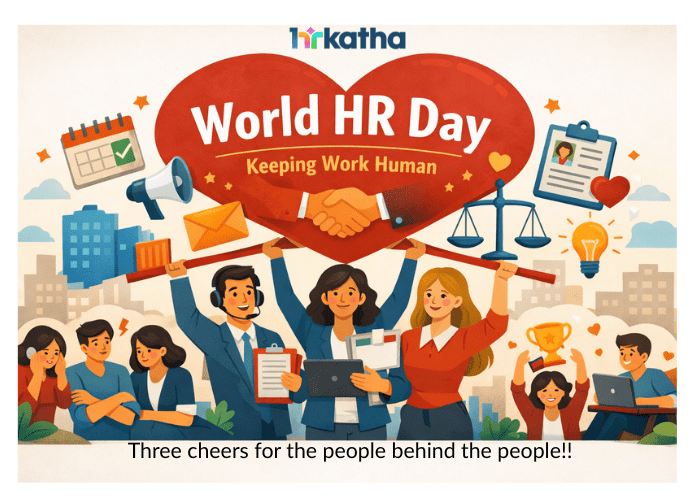
Without HR, workplaces would lose their balance, their culture, and probably their sanity too. Today is their day to be seen, heard, and appreciated.
Every workplace has its visible stars. Sales teams bring in revenue. Marketing builds perception. Finance keeps the numbers in line. Leadership gets applauded when the company succeeds.

Meanwhile, the Human Resources department quietly keeps the organisation from falling apart.
World HR Day is a reminder that behind every smooth onboarding, timely salary credit, resolved workplace conflict, promotion letter, wellness initiative, or policy update, there is usually an HR team making sure things function far more smoothly than people realise.
And unlike most functions, HR is noticed most when something goes wrong.
Employees rarely pause to appreciate HR when processes work perfectly. But let payroll get delayed by a day, an offer letter go missing, or a conflict escalate unchecked, and suddenly everyone remembers the department exists.
That is the paradox of HR. Good HR work is often invisible.
More than hiring and firing
For years, HR was seen largely as an administrative function – hiring people, processing paperwork, organising induction programmes, and ensuring compliance. In many organisations, that perception still survives. Ask employees what HR does, and the answers often range from recruitment and engagement activities to policy enforcement and event planning.
But the role has changed dramatically.
Today’s HR teams sit at the centre of organisational life. They are expected to understand business strategy whilst managing employee expectations. They are asked to maintain empathy without compromising accountability. They must support leadership decisions whilst remaining accessible to employees navigating stress, uncertainty, burnout, or conflict.
Very few functions operate under such constant tension.
Human resource professionals often become the bridge between what businesses need and what employees experience. When layoffs happen, HR communicates the decision. When teams struggle with burnout, HR steps in. When younger employees demand flexibility, purpose, or inclusion, HR is expected to translate those expectations into workable systems.
The function has evolved from managing processes to managing experiences.
The human role in a technology-driven workplace
That evolution has accelerated in recent years. Artificial intelligence now screens CVs, analytics predict attrition risks, and chatbots answer routine employee queries. Yet, technology has not reduced the importance of human judgment. If anything, it has made it more valuable.
Machines can process information. They cannot rebuild trust after conflict, calm an anxious employee, or sense when a team is quietly disengaging.
That still requires people.
And perhaps that is why HR matters more today than it did a decade ago. Modern workplaces are more complex, more diverse, and more emotionally demanding. Employees expect fairness, flexibility, growth, inclusion and wellbeing—not just salaries and job titles.
Organisations, meanwhile, expect agility, productivity, and constant adaptation.
And operating in the middle of these competing pressures every single day is HR.
Expectations have changed
The function is also carrying expectations it rarely carried before. Human resource leaders are now expected to shape culture, influence leadership behaviour, improve employee experience, strengthen learning systems, drive diversity initiatives, and help organisations navigate change at speed.
It is no longer simply about managing people. It is about helping organisations remain human whilst pursuing performance.
And yet, recognition for HR often remains understated.
When things go well, business leaders receive the credit. When things go badly, HR is often the first function employees question. It is not always an easy role to occupy. But most HR professionals continue because they understand something fundamental: organisations do not succeed through strategy alone. They succeed through people who feel trusted, supported, and able to do their best work.
Celebrating the people behind the workplace
World HR Day, therefore, is not just about appreciation. It is about acknowledgement.
Acknowledging the people who mediate difficult conversations. The people who step in during crises. The people who try to balance empathy with policy, business realities with employee expectations, and structure with humanity.
They may not always occupy the spotlight. In many organisations, they actively avoid it.
But without HR, workplaces would become far less stable, far less fair, and far less human.
And perhaps that is reason enough to celebrate them today.