


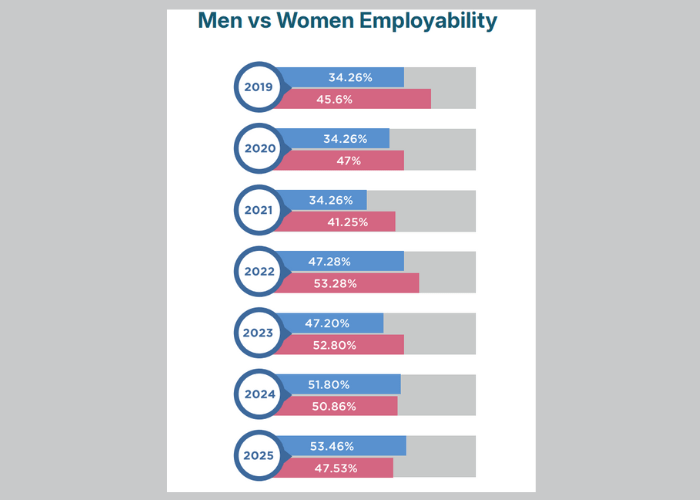
In 2020, just over a third of Indian men were considered employable. Women fared better at 47 per cent. By 2026, those figures will have inverted entirely: 54 per cent of women will be job-ready, compared to 51.5 per cent of men. This quiet revolution—a 20-percentage-point gain for women against a 17-point rise for men—represents one of the most significant workforce transformations in recent Indian history.
Yet buried within India’s overall employability improvement, from 46.21 per cent to 56.35 per cent over six years, lies a more troubling story: the spectacular rise of some educational streams and the confounding volatility of others. The data, drawn from the India Skills Report 2026 by Wheebox (an ETS firm), AICTE, CII, Taggd, and AIU, reveals a nation advancing unevenly—where MBAs soar, polytechnics stumble, and geography increasingly determines destiny.
The MBA miracle and the MCA resurrection
In 2020, 54 per cent of MBA graduates were employable. By 2025, that figure had rocketed to 78 per cent—a 44 per cent increase in just five years. The 2026 projection of 72.76 per cent, whilst slightly lower, still represents a dramatic improvement over pre-pandemic levels.
Even more remarkable is the MCA story. In 2020, only one in four MCA graduates was considered job-ready—a dismal 25 per cent. By 2025, that figure had nearly tripled to 71 per cent, settling at 68.25 per cent for 2026.
What explains these dramatic reversals? The answer lies in curriculum evolution and market demand. MBA programmes rapidly incorporated digital transformation, data analytics, and sustainability into their offerings—skills employers desperately needed post-pandemic. MCA programmes, long criticised for outdated syllabi, underwent wholesale renovation, aligning with cloud computing, AI and cybersecurity requirements.
The lesson: when educational institutions move quickly to match market needs, employability can transform within a single cohort cycle.
The BTech peak and plateau
Engineering graduates—BTech and BE—saw employability jump from 49 per cent in 2020 to 71.5 per cent in 2025, before a slight dip to 71.15 per cent in 2026. This plateau is revealing.
Unlike MBAs, where generalised management skills retain value across sectors, engineering employability is tightly coupled to specific technical skill sets. The marginal decline suggests saturation in certain domains, possibly electronics and mechanical engineering, even as newer specialisations such as AI and machine learning remain undersupplied.
The broader implication: India is producing more employable engineers than ever, yet not necessarily in the disciplines the market requires. Quantity has improved; precision remains elusive.
The polytechnic puzzle: A decade lost
If MBA and MCA graduates represent employability success stories, polytechnic graduates embody its opposite. In 2020, 32 per cent of polytechnic students were employable. That figure then collapsed—to 25 per cent in 2021, 21.42 per cent in 2022, briefly recovering to 27 per cent in 2023, before dropping again to 22.37 per cent in 2024.
By 2025, employability had crawled back to just 29 per cent, with 2026 projections at 32.92 per cent—barely above 2020 levels despite six years of supposed reform.
This volatility is more than statistical noise. It reflects systemic neglect. Polytechnics, meant to supply industry-ready technicians, have been starved of investment, modernisation, and industry linkages. Curriculum updates lag years behind technological change. Equipment remains obsolete. Faculty often lack recent industry experience.
The result: a parallel education system that consistently fails the students it claims to serve, trapping them in a cycle of inadequate preparation and diminished prospects.
The ITI awakening—From nowhere to somewhere
Industrial Training Institutes tell a different story. In 2020 and 2021, ITI employability was negligible—so low it barely registered. By 2022, it had reached 31.3 per cent. In 2025, 41 per cent of ITI graduates were employable, rising to a projected 45.95 per cent in 2026.
This represents genuine progress, driven by government initiatives such as the Skill India Mission and private sector partnerships. But context matters: starting from near-zero means even modest improvements appear dramatic.
At 45.95 per cent, ITI employability still lags significantly behind degree programmes.
The question is whether this trajectory can be sustained or whether ITIs, like polytechnics, will plateau at mediocrity.
The gender inversion: How women overtook men
The employability gender gap in 2020 was stark: 47 per cent for women versus 34.26 per cent for men—a remarkable 13-percentage-point advantage for women. Then came the pandemic. In 2021, women’s employability dropped to 41.25 per cent whilst men’s held at 34.26 per cent.
But the recovery that followed tells the real story. By 2022, women had rebounded to 53.28 per cent, surpassing men at 47.28 per cent. The pattern continued: 2023 saw women at 52.80 per cent versus men at 47.20 per cent. In 2024, the gap narrowed slightly (women 50.85 per cent, men 51.80 per cent), before 2025 saw men edge ahead briefly (53.46 per cent versus 47.53 per cent).
Yet, 2026 projections show women reclaiming leadership: 54 per cent employability compared to 51.5 per cent for men.
What drives this sustained advantage? Several factors converge. Women increasingly dominate higher-performing educational streams—commerce, humanities, and science—where employability has grown steadily. Gender-inclusive workplace policies, particularly in IT and services sectors, have expanded opportunities. Moreover, women’s relative over-representation in communication, adaptability and collaborative skills aligns with employer preferences in service-driven economies.
The broader implication challenges long-held assumptions about gender and employability in India. The gap isn’t closing through parity—it’s inverting through female outperformance.
The geography of opportunity
Employability isn’t uniform across India. Four states lead: Uttar Pradesh, Maharashtra, Arunachal Pradesh, and Jammu & Kashmir.
The inclusion of UP and Maharashtra makes intuitive sense—large populations, established educational ecosystems, proximity to industrial centres. But Arunachal Pradesh and Jammu & Kashmir (J&K)? Their presence on this list demands explanation.
Both states have benefited from targeted central government schemes aimed at improving educational infrastructure in border and remote regions. Arunachal Pradesh, in particular, has seen significant investment in technical education as part of North East development initiatives. Inclusion of J&K likely reflects post-Article 370 policy changes and efforts to integrate the region economically through skill development.
Yet this geographic diversity also reveals disparity. States not on this list—including large economies such as Karnataka, Tamil Nadu, and Gujarat—face employability challenges despite their industrial bases, suggesting misalignment between what students learn and what local industries need.
The humanities question
Humanities graduates—long dismissed in India’s tech-obsessed education discourse—show modest but steady improvement: 48 per cent employable in 2020, 54 per cent in 2025, and projected 55.55 per cent in 2026.
This isn’t dramatic, but it’s consistent. And it raises an uncomfortable question: if humanities employability is growing whilst polytechnic employability stagnates, what does that say about India’s skill-development priorities?
The answer may lie in changing job markets. As automation handles routine technical tasks, demand grows for skills polytechnics don’t teach but humanities programmes do: critical thinking, communication, cultural literacy, and adaptability. Employers increasingly value these capabilities, particularly in sectors like content, design, consulting, and customer experience.
What the numbers don’t say
Employability percentages measure only one dimension: whether graduates can secure jobs within a defined period at minimum skill thresholds. They don’t capture job quality, salary levels, career progression, or whether graduates work in fields matching their training.
A commerce graduate working in a call centre counts as “employable” by these metrics, even if the job neither utilises their education nor offers growth prospects. An engineering graduate in IT support services registers as employed, though the role requires little of what four years of engineering taught.
This matters because rising employability percentages, whilst encouraging, may mask underemployment—graduates working, but not thriving.
The unfinished agenda
India’s employability improvements over six years are real. From 46.21 per cent to 56.35 per cent represents millions more job-ready graduates. Women’s ascendancy, MBA and MCA transformations, and ITI recovery all signal progress.
But the polytechnic crisis, engineering plateau, and persistent regional disparities reveal how far remains to go.
Most critically, the gap between overall employability (56.35 per cent) and what employers actually need remains substantial. In a country producing millions of graduates annually, nearly half still aren’t job-ready by industry standards.
The question India faces isn’t whether employability is improving—it demonstrably is. It’s whether improvement is happening fast enough, across enough domains, and with sufficient quality to match the ambitions of a young, growing workforce and the demands of a rapidly evolving economy.
Women seem to have figured it out. Polytechnics have not. The distance between those two realities defines India’s employability challenge—and opportunity—going forward.
