


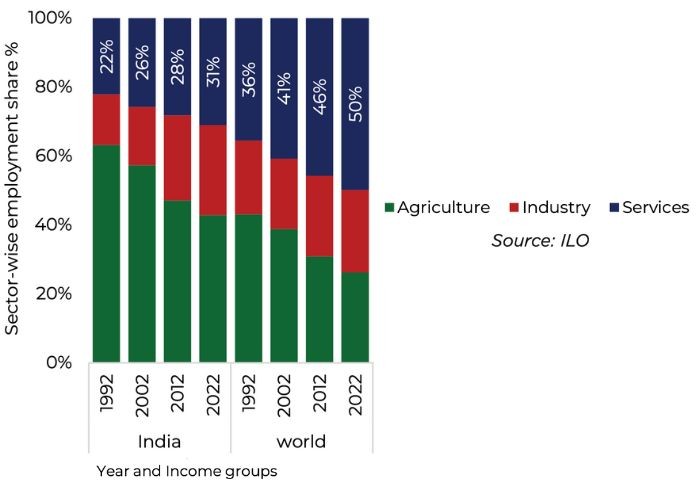
Over the past three decades, the global workforce has shifted decisively towards services. According to data from the International Labour Organisation cited in Niti Aayog’s recent report ‘India’s Service Sector: Insights from Employment Trends and State-level Dynamics’, the global share of workers in services rose from 35.5 per cent to 49.8 per cent between 1992 and 2022. Today, services account for nearly half of all global employment.
The growth varied by income level but remained substantial across all categories. High-income countries saw services employment increase by 12.3 percentage points. Upper-middle-income countries experienced the sharpest surge at 21.8 percentage points, whilst low-income countries recorded an 11.3 percentage point rise. Even lower-middle-income countries saw services employment grow by 10.9 percentage points.
India’s trajectory, however, diverges sharply from these global patterns. World Bank data from 2022 shows that India’s services share of employment grew from 22.1 per cent in 1992 to just 31 per cent in 2022—an increase of only 8.9 percentage points. This falls well below the global average and leaves India with a services employment share of around 30 per cent, compared to the global figure approaching 50 per cent.
Output-employment disconnect
The Niti Aayog report identifies a critical characteristic of India’s services expansion: it has been more output-intensive than job-intensive. This creates a notable gap between gross value added (GVA) and jobs created in the sector.
The report places India unfavourably even among middle-income countries, noting the country’s inability to transform growth into proportionate employment. A key metric highlighted is employment elasticity—the measure of how much employment changes in response to a 1 per cent change in economic output (GDP). In India, this elasticity ranges between 0.2 and 0.4.
Low employment elasticity indicates that economic growth isn’t translating into significant job creation. The report’s analysis suggests that job creation in India’s services sector isn’t keeping pace with the sector’s contribution to GDP growth, pointing to what economists describe as “jobless growth.”
Regional and sectoral variations
The report’s subtitle—”Insights from Employment Trends and State-level Dynamics”—signals that services employment patterns vary considerably across Indian states. This geographical dimension suggests that India’s services employment challenge isn’t uniform but reflects diverse local economic structures and development trajectories.
The findings indicate that different states have experienced varying degrees of success in converting services sector growth into employment opportunities, though the report’s core message emphasises the overall national lag behind global benchmarks.
Automation dimension
The employment challenge intersects with technological disruption. The report references the World Economic Forum’s Future of Jobs Report 2025, which projects that artificial intelligence will disrupt 22 per cent of global jobs over the next five years. The WEF forecasts that AI will create 170 million new jobs globally whilst displacing 92 million, resulting in a net gain of 78 million positions.
For India specifically, the implications appear more severe. Research cited in the report (Kumar, 2024) suggests AI may automate as much as 40-50 per cent of white-collar roles in the country. The WEF data indicates at least 60 per cent growth in demand for AI and big data specialists, whilst clerical and data-entry roles face the highest risk of displacement.
This technological shift adds urgency to the employment intensity question. As automation threatens existing services jobs, the gap between current workforce capabilities and emerging requirements widens. The report emphasises the need for collaborative upskilling on a large scale to keep workers in both informal and formal sectors prepared for technological changes as the economy digitises.
Implications for Viksit Bharat 2047
The Niti Aayog report explicitly connects services employment to India’s development ambitions. The analysis states that strengthening employment intensity in services is crucial for the Indian economy to avoid jobless growth, particularly given the country’s aspiration to become a developed nation by 2047.
The report concludes that achieving the vision of Viksit Bharat @2047 depends on fully unlocking the employment potential of the services sector. According to the analysis, growth must be matched by high-quality jobs that are integral to sustaining an inclusive and competitive economy.
This framing positions services employment not merely as a labour market issue but as central to India’s broader development trajectory. The report’s findings suggest that without addressing the employment intensity gap, India’s path to developed status faces significant obstacles.
Comparative deficit
The report’s comparative analysis reveals the scale of India’s challenge. Whilst global services employment has grown robustly across all income categories over three decades, India’s 8.9 percentage point increase trails substantially behind global trends. The gap between India’s current 31 per cent services employment share and the global average approaching 50 per cent represents millions of jobs that may have been created under different growth patterns.
The employment elasticity figures further illustrate this deficit. When a sector contributes significantly to GDP but generates relatively few jobs, it creates an imbalanced development model. The report’s data suggests India has achieved services-led growth without proportionate services-led employment expansion.
This pattern distinguishes India from successful development models where services sector expansion drove broad-based employment growth. The comparative perspective embedded in the report highlights that India’s services employment performance lags not only behind high-income countries but also behind peer economies at similar development stages.
Policy imperatives
The Niti Aayog report’s central policy message emphasises the importance of increasing employment intensity in India’s services sector. The findings point to a development model that has prioritised output growth without adequate attention to job creation mechanisms.
The report’s inclusion of technological disruption data suggests that policy responses must address both current employment gaps and future workforce transformation needs. With significant portions of existing white-collar jobs at risk from automation, India faces twin challenges: generating more employment from services growth whilst simultaneously preparing the workforce for technology-driven changes in job requirements.
The state-level dynamics dimension of the report implies that effective interventions may require differentiated regional strategies rather than uniform national policies. The variation in services employment patterns across states suggests that local economic contexts, skill bases, and industrial structures shape employment outcomes significantly.
The report’s findings underscore that India’s services sector, despite its contribution to economic growth, has not fulfilled its potential as an employment generator. Addressing this gap emerges as essential not merely for labour market health but for achieving the country’s broader development objectives by 2047.