



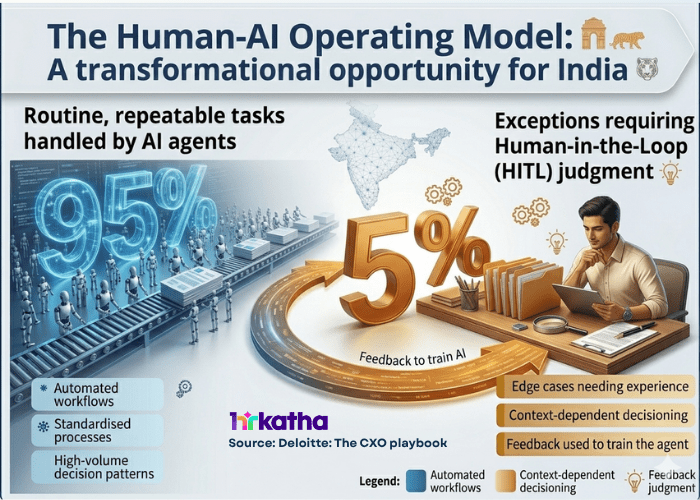
Only 5 per cent of decisions in the future workplace may require a human.
That is the number buried in Deloitte’s latest CXO playbook—and it deserves far more attention than it has received. In the human–AI operating model the report envisions, agentic AI systems will handle 95 per cent of routine, repeatable tasks autonomously. The remaining 5 per cent—exceptions, edge cases and context-dependent judgements—will require human intervention.

The implication is not that humans become redundant. It is something more unsettling: that the value of human presence in the workplace will be concentrated, intensified and held to a far higher standard than before.
That is the central tension running through Deloitte India’s CXO Playbook on agentic AI adoption, published in March 2026. It attempts something harder than explaining a new technology. It asks organisations to confront a deeper obstacle: not whether they can deploy agentic AI, but whether their people are ready to work alongside it.
The promise and the paradox
Agentic AI represents a meaningful shift beyond earlier waves of automation. Unlike generative AI, which responds to prompts, or robotic process automation, which follows predefined rules, agentic systems can perceive, reason, plan and act independently to achieve specific goals. They can break down complex objectives, call external tools, collaborate with other agents and adapt dynamically as conditions change.
The economic stakes are substantial. AI-driven value creation is projected to reach $1.68 trillion globally by 2031. India’s AI market, growing at a projected 44 per cent annually, is among the fastest-expanding in the world. Early use cases already demonstrate measurable gains—significant productivity improvements alongside cost reductions through intelligent task orchestration.
Yet, investment in technology is running ahead of readiness to use it. While over half of enterprise leaders express strong interest in agentic AI and a growing share are exploring deployment at scale, fewer than half of organisations have begun meaningfully adapting their upskilling strategies. Many remain focused on basic AI fluency rather than preparing employees for fundamentally-redesigned roles.
The gap between ambition and preparedness is where returns go to disappear.
The human resistance problem
Resistance to agentic AI rarely appears as outright rejection. It is quieter and more insidious: employees withholding critical information, bypassing AI recommendations, or disengaging from AI-enabled workflows altogether.
Left unaddressed, these behaviours erode value—through underutilisation, rising operational friction and declining morale.
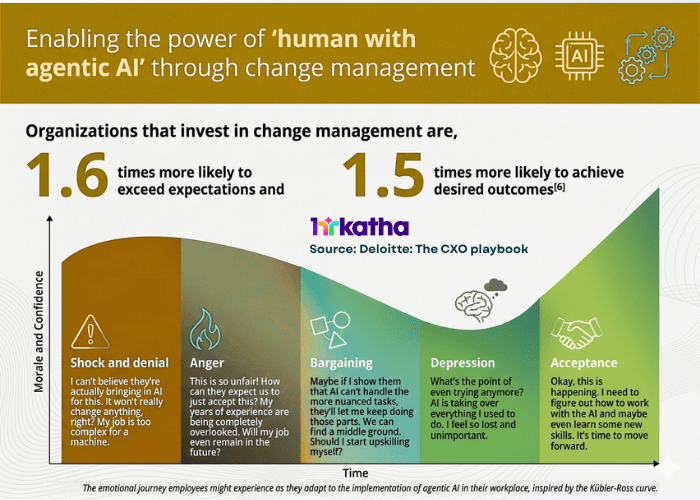
Deloitte maps this response to the Kübler-Ross emotional curve, tracing a path from shock and denial through anger and bargaining before eventual acceptance. The comparison is imperfect, but instructive. Both involve a loss of certainty.
Employees who have spent years mastering a workflow are not being irrational when they resist watching an AI agent replicate it in seconds. They are not resisting technology. They are responding to the sudden depreciation of what made them valuable.
This is why change management is not a supporting function of agentic AI adoption. It is a core capability. Organisations that invest in it are significantly more likely to achieve desired outcomes.
The microculture challenge
To structure adoption, Deloitte proposes a six-part framework built around leadership, communication, learning and feedback systems. Its most useful insight, however, lies in recognising that organisations do not respond to AI uniformly.
Instead, employees cluster into distinct microcultures based on trust in AI and perceived impact on outcomes. Some are champions, ready to lead adoption. Others are enthusiastic but require reinforcement. Sceptics need transparency and reassurance. Laggards require foundational digital literacy before they can participate meaningfully.
Treating the workforce as a single block is a strategic mistake. Organisations that actively manage these microcultures are significantly more likely to meet their transformation goals.
What happens to jobs
The more difficult question is structural: what happens to roles themselves.
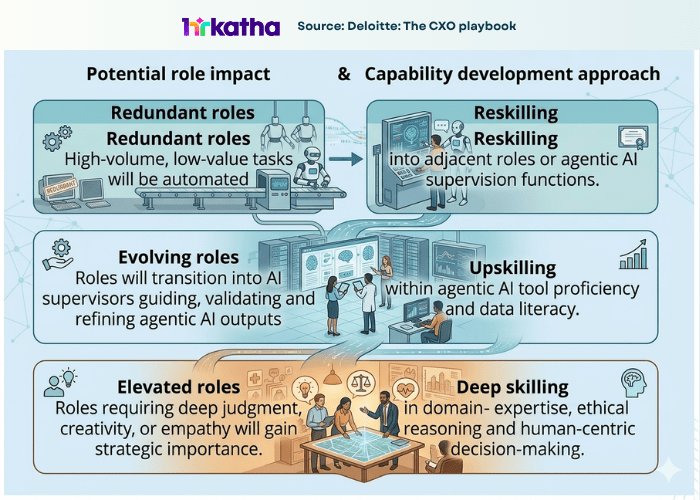
The report outlines three trajectories. Some roles—high-volume and routine—will become redundant, with employees expected to transition into adjacent or supervisory functions.
Others will evolve into AI oversight roles, requiring proficiency in tools and data. A third category—roles demanding judgement, creativity and empathy—will be elevated in importance.
The framework is logical. Its execution will be harder.
Reskilling is not merely a training challenge. It involves identity, status and economic security — factors no learning platform can fully resolve. The assumption that workers will seamlessly transition into higher-value roles remains one of the most optimistic aspects of the agentic AI narrative. In India, where tier-2 and tier-3 cities account for a substantial share of the services workforce — and where digital infrastructure, language access and formal training remain uneven — that optimism is particularly difficult to sustain.
India’s inflection point
For Indian organisations, the implications are particularly acute.
For decades, India’s global competitiveness in services has rested on labour arbitrage—the ability to deliver scale at lower cost. Agentic AI directly erodes that advantage. If machines can handle the majority of routine work, the cost differential that underpinned the model begins to narrow.
Deloitte frames this as an inflection point. India must move from scaling operational volume to delivering strategic value—where humans and AI co-create outcomes rather than compete on cost.
Demand for AI talent is expected to more than double in the coming years. Whether the workforce can be prepared at that pace remains an open question.
The challenge is even sharper beyond the major metros. In tier-2 and tier-3 cities, where digital skills, access and training infrastructure remain uneven, the pathways into the agentic economy are far less clear. Without scalable solutions—vernacular learning, modular credentials and accessible upskilling—the transition risks deepening existing divides.
What organisations must do now
The playbook outlines a phased approach: define the AI vision, map workforce sentiment, mobilise champions, engage sceptics and institutionalise feedback loops.
These steps are practical. But they address only part of the problem.
The deeper question is governance.
Agentic AI systems are not infallible. They are prone to errors, biases and flawed reasoning. The 5 per cent of decisions reserved for humans are, by definition, the most complex and consequential ones—where judgement, accountability and context matter most.
Whether organisations are building the capability to handle those decisions consistently is far less certain.
The real test
The intelligent revolution is already underway.
But its real test will not lie in how effectively organisations deploy machines to handle the 95 per cent.
It will lie in whether they can prepare humans to handle the 5 per cent—the decisions where judgement, accountability and consequence converge.
Technology may take over the routine.
The future of work will be defined by how organisations value—and prepare people for—the exceptional.