



Something quietly radical is happening in India’s corporate corridors. Nearly half of all professionals—46 per cent—now say they would turn down a promotion if it compromised their well-being. Just a year ago, that figure stood at 41 per cent. The shift may seem modest, but it signals a profound recalibration of what Indian workers consider success.
This isn’t merely about wanting more time off. It’s about a generation reassessing the fundamental bargain of work. And the numbers tell a story that should unsettle any employer still operating on 20th-century assumptions about ambition.

The holiday paradox
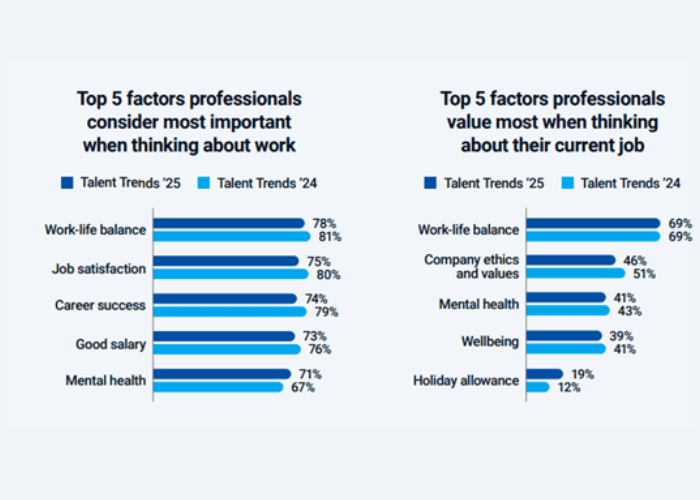
Consider this: in 2024, just 12 per cent of Indian professionals cited holiday allowances as amongst the most valuable aspects of their current job. By 2025, that figure has leapt to 19 per cent—a 58 per cent increase in a single year. Meanwhile, the proportion valuing work-life balance has remained stubbornly static at 69 per cent.
What explains this apparent contradiction? Why would holiday allowances surge in importance whilst overall work-life balance holds steady?
The answer lies in what isn’t being said. When work-life balance remains valued by the same proportion year after year, it suggests not satisfaction but stasis—a baseline expectation that simply isn’t being met. The surge in holiday allowance prioritisation reveals something more tactical: workers are no longer waiting for cultural change. They’re demanding concrete, measurable time away from work. Holidays can be counted, scheduled, and enforced in ways that vague promises of “balance” cannot.
According to Michael Page’s Talent Trends 25 report, this represents a strategic shift in how Indian professionals negotiate their relationship with work. They’re moving from aspirational language to contractual specificity.
The mental health premium
The data reveals another striking pattern. Mental health as a job consideration has climbed from 67 per cent in 2024 to 71 per cent in 2025 when professionals evaluate new opportunities. Yet paradoxically, mental health as a valued aspect of current jobs has declined from 43 per cent to 41 per cent.
This gap—between what workers seek and what they’re experiencing—is where the crisis lies. Employees aren’t just prioritising mental health in the abstract. They’re fleeing jobs that damage it and hunting for employers who protect it. The 4-percentage-point rise in mental health as a hiring criterion, set against its 2-point fall as a workplace reality, suggests widespread disillusionment.
The same pattern emerges with well-being broadly: 39 per cent value it in their current roles (down from 41 per cent), yet it remains amongst the top considerations for new positions. The message is clear: workers are voting with their feet, moving towards organisations that offer what their current employers do not.
The salary mirage
Perhaps most revealing is what’s happening to pay. In 2024, 76 per cent of professionals considered lucrative compensation important when evaluating job opportunities. By 2025, that figure had fallen to 73 per cent. Over the same period, the proportion considering career growth opportunities rose from 74 per cent to 79 per cent.
This isn’t because salaries have become less important—India’s cost of living ensures that. Rather, it reflects a recalibration of priorities. Professionals are asking not “how much?” but “at what cost?” A heavy pay packet loses its lustre if it comes with burnout, constant availability, and the erosion of personal time.
The data suggests Indian workers are beginning to reject what economist Herbert Simon once called “satisficing”—accepting good enough rather than optimal outcomes. They’re no longer willing to trade their well-being for incremental salary gains.
The stubbornness of hybrid work
Forty-three per cent of professionals worked in hybrid arrangements in 2024. In 2025, that figure remains unchanged at 43 per cent. On the surface, this looks like stagnation. But context matters.
During this period, many global corporations attempted to roll back remote work, citing collaboration and culture. That India’s hybrid work percentage hasn’t budged suggests something else: equilibrium through resistance. Workers have drawn a line. Employers have tested it. Neither has moved.
This stalemate may actually represent progress. Unlike the chaotic pandemic-era rush to remote work, or the subsequent employer-led backlash, 43 per cent appears to be where supply meets demand—at least for now. It’s the proportion of roles where flexibility is non-negotiable, and where employers have reluctantly accepted that pulling workers back full-time means losing them entirely.
The paradox of Indian ambition
India has long prided itself on its aspirational workforce—hungry, driven, willing to sacrifice for advancement. The Talent Trends data suggests that narrative requires revision.
Indian professionals remain ambitious. Career growth—cited by 79 per cent as important in 2025—is still valued highly. But it’s no longer divorced from quality of life. The 46 per cent willing to refuse promotions aren’t lazy or unmotivated. They’re applying cost-benefit analysis to their own lives, and finding that the traditional calculus—more responsibility equals more satisfaction—no longer holds.
The trajectory is unmistakable. Post-pandemic, Indian workers have glimpsed an alternative. They’ve experienced flexibility, reclaimed commute time, and reconnected with life outside work. Rolling that back isn’t just difficult—it’s increasingly untenable.
What workers are really saying
When asked about the top five factors they consider most important when thinking about work, 78 per cent of Indian professionals cited work-life balance in 2025 (compared to 80 per cent in 2024). Job satisfaction was considered most important by 75 per cent of professionals, down from 80 per cent the previous year.
These declining percentages, set against rising action (more people refusing promotions, more demanding holidays), suggest something crucial: workers aren’t becoming less interested in satisfaction or balance. They’re becoming less convinced their current employers can deliver either.
It’s the difference between aspiration and expectation. Work-life balance has shifted from something workers hope for to something they demand. When 69 per cent value it in their current jobs—unchanged from 2024—it’s not a vote of confidence. It’s a held position in hostile territory.
Why this matters for employers
For employers, especially in sectors facing talent shortages, these findings present both a warning and an opportunity.
The warning: companies that continue to treat work-life balance as a soft perk rather than a structural priority will bleed talent. Skilled professionals have options. In tight labour markets, they’ll exercise them. The rise in holiday allowance prioritisation—from 12 per cent to 19 per cent—isn’t a request. It’s an ultimatum.
The opportunity: organisations that genuinely facilitate balance, protect mental health, and respect boundaries won’t just retain talent—they’ll attract the best of it. This doesn’t necessarily require lavish benefits. It requires credibility. Employees have learned to distinguish between employers who talk about well-being and those who design work around it.
Company ethics and values, now cited as most valuable by 46 per cent of professionals in their current jobs, matter because they signal whether an organisation’s commitments are cosmetic or genuine. Workers have been promised balance before. Now they’re checking receipts.
The unspoken shift
What makes this data remarkable isn’t the absolute figures. It’s the velocity and direction of change.
Holiday allowances up 58 per cent. Mental health in job searches up 6 per cent. Willingness to refuse promotions up 12 per cent. The proportion considering career growth rising from 74 per cent to 79 per cent whilst salary importance falls from 76 per cent to 73 per cent. These aren’t marginal adjustments. They’re the early tremors of a tectonic shift in how India’s workforce conceives of success.
The question isn’t whether employers will adapt. It’s how quickly—and how many will be left behind in the process.
Indian professionals aren’t rejecting ambition. They’re rejecting the old bargain: sacrifice your health, your time, your peace of mind, and in return, we’ll give you a title and a salary. The new bargain is more straightforward: give us meaningful work, protect our well-being, respect our boundaries, and we’ll give you our best.
Fail to deliver, and that 46 per cent willing to refuse promotions today could be 56 per cent tomorrow. Not because they’ve stopped caring about their careers. But because they’ve started caring about their lives.
That’s not a luxury. That’s the new definition of a good job.