



Dr. Jennifer Doudna, the Nobel Prize-winning biochemist who revolutionised gene editing, once said she actively avoided being seen as a “woman scientist.” She wanted to be judged simply as a scientist. Two decades later, her wish seems closer to reality—at least on paper. Today, 77 per cent of leaders across industries recognise that women are as effective as men in leadership roles. The battle for recognition, it would appear, has been won.
Yet beneath this veneer of progress lies a more insidious problem: a perception gap so wide it threatens to widen further just as organisations race toward an AI-powered future.

The ghost in the machine
Consider this unsettling data point from Capgemini’s latest research, which surveyed 2,750 leaders across 11 countries, 9 sectors, in August 2025: 58 per cent of women now identify confidence as their key strength—virtually identical to the 59 per cent of men who say the same. This marks a dramatic reversal from years of research showing women systematically underestimating their abilities while men rarely did.
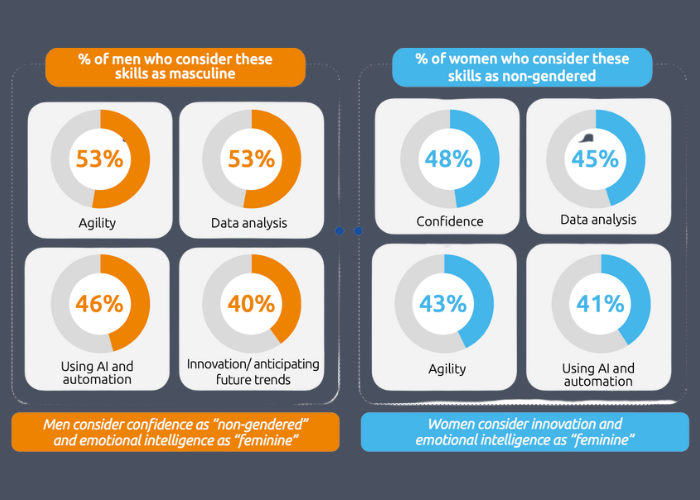
But here’s where the story takes a darker turn. When asked which skills matter most for future leadership, both genders agree: AI proficiency, data analysis, innovation, and agility top the list. Yet men perceive four of these six critical capabilities as inherently “masculine.” Women, meanwhile, view most of them as gender-neutral.
The implications are stark. As Alexandra Taylor, chief people officer, Bank of Queensland, notes, leadership style should be “highly individual and personality-driven,” not bound by gender. Yet the stereotypes persist, creating an invisible ceiling just as the rules of the game are changing.
The technical skills trap
Only 46 per cent of leaders—regardless of gender—consider AI and automation among their key strengths. Just 54 per cent feel confident in data analysis. These gaps matter immensely in a world where 74 per cent of leaders agree that AI proficiency is critical for career advancement.
The problem isn’t that women lack these skills. The research shows women rate themselves nearly equally to men across technical capabilities: 45 per cent of women versus 47 per cent of men cite AI as a strength; 51 per cent versus 57 per cent claim data analysis expertise. The differences are marginal.
The danger lies elsewhere: in the perception that these skills somehow belong to men. When male leaders unconsciously associate technical prowess with masculinity, they create biased mental shortcuts that influence everything from project assignments to promotions. As one senior manager at BNP Paribas Personal Finance observed, “there is still a lingering bias that underrates the capabilities of women leaders… often in subtle ways, such as assumptions about a woman’s commitment to her career.”
The cost of outdated thinking
The consequences play out in cold, hard numbers. While half of all respondents claim compensation is fair and equitable, 53 per cent of women report experiencing negative bias in pay—while 40 per cent of men openly acknowledge enjoying an advantage because of their gender. Travel opportunities? Forty percent of women face bias; an equal proportion of men admit benefiting from it.
The result: 35 per cent of women have considered leaving their organisations due to perceived barriers to advancement, compared with 26 per cent of men. Women at the vice president level report particularly low satisfaction with compensation and career prospects.
Yet the irony cuts both ways. Men face their own stereotyping prison: 44 per cent report negative bias in accessing flexible work arrangements, trapped by norms that cast them as always-on providers rather than humans seeking balance.
The sports analogy nobody asked for (but everyone needs)
Jacqui Kernot, vice president, Thales Cybersecurity Services, puts it bluntly: “We have spent years trying to ‘fix’ women with more training and mentoring. But the real transformation happens when we fix the environment.”
The report draws unexpected wisdom from an unlikely source: professional sports. Among the world’s 20 most powerful women, 19 played competitive sports. In the UK, women who played extracurricular sports as children are 50 per cent more likely to reach senior professional roles.
Why? Because sports strip away ambiguity. Performance is measured objectively. Resilience is visible. Strategic thinking is rewarded regardless of the athlete’s gender. Coaches mentor based on potential, not politics.
The parallel is uncomfortably clear: organisations claiming to value meritocracy often fail to implement the very systems that would make it real.
The AI acceleration problem
Here’s what should keep CHROs awake at night: the technical skills gap affects everyone, but the stereotypes surrounding those skills disproportionately harm women. As Anna Perrin, Chief Customer Officer, NBN, argues, “new technologies—especially AI—are reshaping the way we lead. For women in leadership, this is a chance to challenge old structures.”
Yet that chance evaporates if male leaders unconsciously view AI expertise as masculine. The risk is not merely that women get left behind; it’s that organisations lose the diverse perspectives essential for ethical, effective AI deployment. Research repeatedly shows that profits can be 50 per cent higher when women are well-represented in upper management. Companies with women CFOs see 6 per cent stock price increases within six months of appointment.
Diversity isn’t charity. It’s competitive advantage.
Eight moves that matter
The Capgemini research doesn’t just diagnose problems; it prescribes solutions. Eight specific interventions stand out:
First, make bias impossible. Implement “bias interrupters”—structural changes in hiring, performance reviews, and succession planning that remove subjectivity. Colgate-Palmolive India now trains its entire workforce, particularly men, to recognise and eliminate biases.
Second, democratise technical training. Provide organisation-wide access to AI and data literacy programs. Integrate these tools into daily workflows so everyone develops fluency, not just the already-converted.
Third, transparentise promotion. Define clear, objective, measurable criteria for advancement. Make the process visible. Base decisions on balanced competencies, not single “moments” in presentations that may favour certain communication styles.
Fourth, normalise flexibility for all. Research shows that when men access flexible work options, they share more domestic burdens, which reduces pressure on women to scale back professionally. Work-life balance shouldn’t be gendered.
Fifth, redesign leadership models. Celebrate diverse styles. One-third of organisations now promote transformational leaders who inspire change rather than command-and-control authoritarians. Expand that definition further.
Sixth, democratise mentorship. Use algorithms to match mentees and mentors, rotating assignments to prevent closed networks. Track participation and impact.
Seventh, recognise transferable skills. The strategic thinking that drives business growth isn’t fundamentally different from the emotional intelligence that builds high-performing teams. Stop treating them as separate domains.
Eighth, invest beyond the workplace. Support community programs promoting women’s mentorship. Fund minority-owned startups. Use brand influence to advocate for gender-equity policies.
The leadership summit question
As delegates gather for the HRKatha Leadership Summit, they face a moment of reckoning. The session on “Beyond numbers: Building authentic diverse leadership that drives innovation and performance” isn’t merely about diversity metrics or compliance. It’s about whether organisations will squander a historic opportunity.
For the first time, women leaders possess the confidence research once said they lacked. They rate themselves as competent in technical skills as their male peers do. They recognise that AI and agility matter for the future. They’re ready.
The question is whether organisations are ready to see them clearly—to strip away the outdated stereotypes that cloud judgment, to build systems that make bias structurally impossible, to create environments where leadership transcends gender not just in theory but in practice.
Paul Polman, former Unilever CEO, argues that leaders need to “adapt, build bridges, and cooperate” to solve today’s complex challenges. That wisdom applies internally too. Organisations must adapt their mental models, build bridges across perception gaps, and cooperate to dismantle the stereotypes that limit everyone.
The irony would be tragic if it weren’t so preventable: just as women achieve confidence parity with men, just as their capabilities match the moment’s demands, unconscious bias threatens to render both invisible. The confidence paradox isn’t that women lack self-belief anymore. It’s that outdated perceptions may blind organisations to what’s right in front of them.
The future of leadership doesn’t belong to men or women. It belongs to those organisations wise enough to see talent without the distorting lens of gender—and bold enough to build systems that make that vision real.
As the HRKatha Leadership Summit will explore, authentic diverse leadership isn’t about ticking boxes. It’s about fundamentally transforming how organisations think, innovate, and succeed in an AI-powered world.